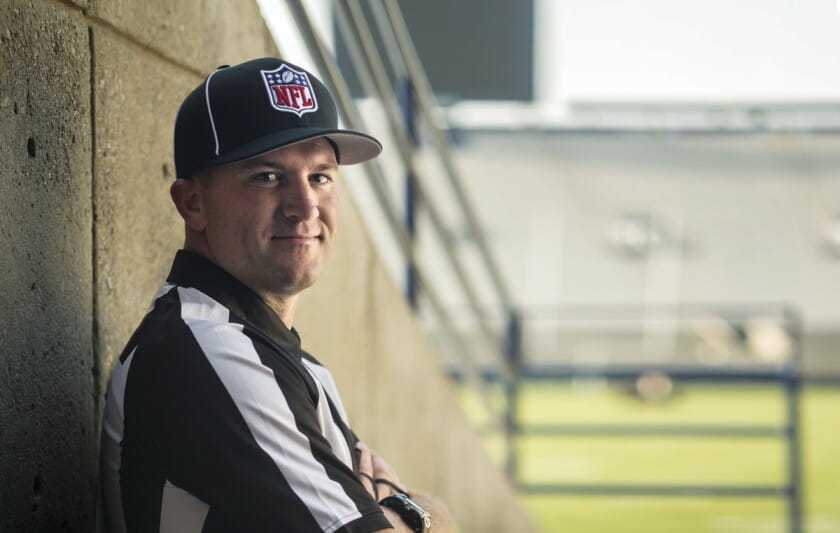
Bart Longson's first regular-season assignment in the NFL placed him at the line of scrimmage for Cowboys at Eagles in Philadelphia. This is an unfriendly room for hesitation. The players are quick, the crowd is quicker to object, and the official has one small yellow flag with which to disappoint an entire side of a stadium. Longson remembers the first half as a blur. The game seemed impossibly fast. Then it slowed down, as difficult work sometimes does once the body catches up with the preparation.
Longson would work six seasons as NFL line judge number 2, from 2015 through 2020. By then, he was also deep into a second career: building finance companies in Utah. One job involved false starts, offsides and illegal formations. The other involved underwriting, capital and the stubborn arithmetic of small-business cash flow. The uniforms were different. The central demand was not. Look carefully, decide quickly, and do not let the previous play steal the next one.
Two careers, neither content to sit still
Longson grew up in Eagle, Idaho, in a household where running a business looked ordinary. His father operated a commercial heating and air-conditioning company. His mother, he has said, supplied the confidence. At Brigham Young University, Longson imagined a future in sports medicine and took the MCAT. But finance behaved differently in his hands. The material made sense. He liked it. In 1999, he graduated from BYU's Marriott School with a management degree and a finance emphasis.
The consequential partnership had begun much earlier. Longson met Matt Hawkins in seventh grade when their older brothers belonged to a ski group. They became friends, then BYU roommates, then business partners. Together they bought farmland, secured city entitlements, developed residential property, started a mortgage company and ran a real-estate fund. It was an education conducted in balance sheets, municipal meetings and the peculiar optimism of a rising property market.
Football ran beside it. In 2000, a neighbor suggested officiating as a way to stay near the game Longson had played in high school. He began with youth and school contests and was hooked. By 2005 he had joined the Mountain West. In 2010 came the Big 12. A year later came the Pac-12. He attended practices to study snaps, learned from crews, and collected the sort of experience that looks repetitive until one difficult Saturday asks for all of it at once.
The crash supplied the curriculum
Then the housing market collapsed. A business that had taken years to assemble lost its exits in a matter of months. Lots would not sell. Financing tightened. Paper wealth became an especially unhelpful kind of paper. Longson and Hawkins needed cash flow while they worked through the property problems, so they moved into merchant cash advances for small businesses. Snap Advances began in 2009.
The new company did not promptly reward their ingenuity. Longson has recalled reaching a point with roughly $25,000 left in family reserves, enough for about two months, with four children under nine. He wondered what job he could apply for after years of wearing every hat in his own companies. The answer never became necessary. Snap started producing enough to slow the bleeding, then enough to live on.
The other career provided a bridge. In 2010, Longson's Big 12 officiating income helped his family through the lean stretch. The side pursuit, so demanding that it consumed weekends and travel, had become useful in a way no tidy career plan could have anticipated. There is a small joke here at the expense of specialization: the striped shirt diversified the balance sheet.
The episode also left Longson with a less romantic understanding of entrepreneurship. Markets do not applaud effort. Timing can be rude. A company may be competently run and still find the ground moving beneath it. His account of those years is notable for refusing to launder strain into destiny. The experience was frightening while it happened. Its value became clear later.
The resignation nobody accepted
Snap Advances worked, until the market changed again. Heavily funded competitors compressed pricing. Growth flattened. Longson, who readily admits that he enjoys growth more than maintenance, became restless. The company had outside capital, and he entered a board meeting prepared to resign as chief executive. The investor representative, Noel Strauss, declined to accept the resignation.
It is a strange feature of corporate life that a resignation can apparently become the opening bid. Longson offered a condition: he would stay if the group backed an equipment-leasing business they had been studying. He asked for $10 million. The investors agreed. In 2018, that project became Clicklease.
The model combined two bodies of experience. From Snap Advances came the small-business customer and an understanding of commercial cash flow. From Snap Finance came automated decisioning and a technology-centered process. Clicklease would work through equipment sellers, giving small operators a route to the tools that produce revenue: the oven, trailer, salon chair or machine that is less a purchase than a job waiting to happen.
Clicklease says it has now helped more than 80,000 small businesses through more than 7,000 partners, with 294 employees in the United States and Costa Rica. In 2021, the company announced a $63 million Series A round. The numbers describe scale. Longson chooses a more domestic measure when asked about pride: the hundreds of families the company has been able to employ.
The operating instruction
“Put your blinders on and become great at your core business.” The sentence is plain enough to tape above a monitor, and severe enough to eliminate a long meeting.
Knowing when to leave the field
Longson's route to the NFL had continued through the upheaval. He officiated major college bowls and the 2015 College Football Playoff semifinal at the Sugar Bowl, where Ohio State beat Alabama. The NFL recruited him through its development process. A call from the league arrived that spring. His family heard the news after he stepped back into the room and announced that he was in.
Professional football offered familiar pressure in a louder package. Longson worked on the line of scrimmage, where tiny movements become public facts. He learned the personalities too. In one game during his rookie season, Tom Brady greeted him by name and asked after his wife and four children. Longson understood the preparation behind the charm. The quarterback had scouted the new official as carefully as another defense. Courtesy, in this telling, was both genuine human contact and competitive detail.
After the 2020 season, Longson left voluntarily. The league expected officials to stay, and he could have continued. But football took nearly every weekend from August into January. Clicklease was growing. His family had supported the travel for years. He had reached the level he once chased, worked there for six seasons, and decided the correct call was departure.
The Utah Football Foundation recognized that officiating career in 2026. Its record traces the climb from Utah high schools through college conferences, bowl assignments and the NFL. The honor arrives after the noise, when what remains is the shape of the route: repeated preparation, careful advancement, then an exit on his own terms.
Momentum, with room to change direction
Longson talks about momentum as if it were an operating asset. Standing still offers no angle for adjustment. Movement creates information. A founder can pivot a company already in motion, just as an official can refine his position while a play develops. This is not a case for speed without thought. His career is full of studying, practicing and choosing partners. It is a case for refusing to confuse incomplete certainty with a stop sign.
He is candid about what does not come naturally. He does not present himself as an effortless networker. He has called himself more emotional than Hawkins, whose steadiness helped their partnership through the recession. He speaks with admiration about executives who know the business more deeply than he does. For a founder, this is useful vanity control. The title does not need to contain every skill.
That may be why the team recurs whenever Longson explains the work. Hawkins appears at the beginning and through every reinvention. Investors convert a threatened exit into a new company. An executive group turns an idea into an operating system. Family makes the weekend career possible, then helps clarify when it should end.
The two tracks have finally narrowed to one. Longson's Sundays are no longer measured in downs. Yet Clicklease still asks him for judgments made with imperfect sightlines: where to focus, whom to trust, when a market has shifted, and whether the next move is a flag, a pivot or simply letting the play continue. The stadium was excellent training. The company is the longer game.
Keep reading and watching