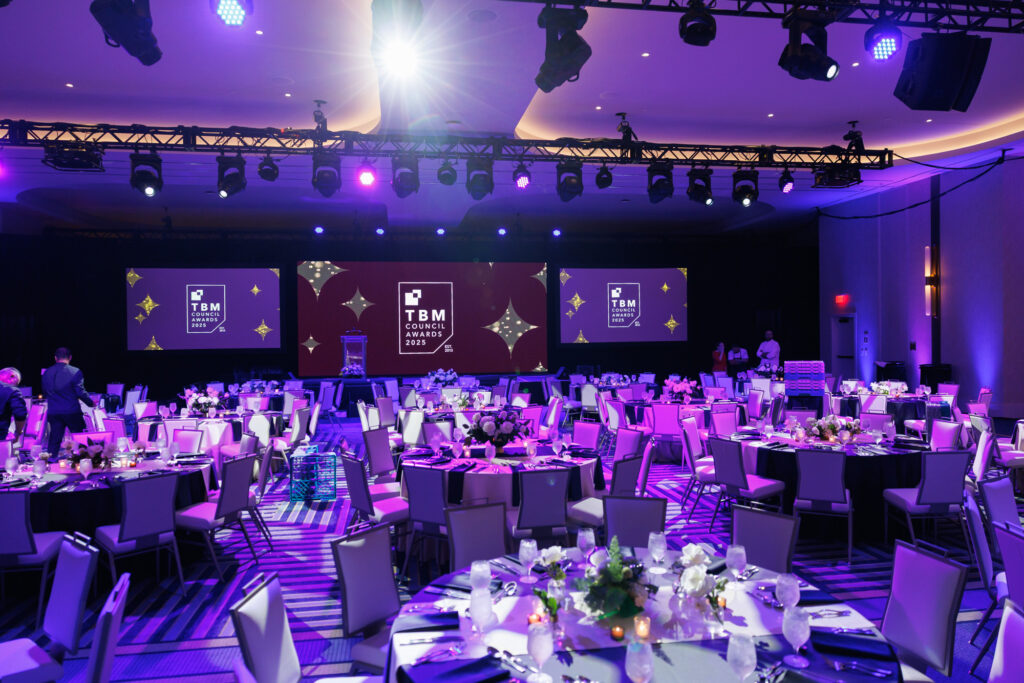
The trouble was getting into the building. For TBM Conference 2025 at Fontainebleau Miami Beach, Brite Ideas faced a venue without a dedicated loading dock. The team knew the property. It arrived with a plan. During a complicated load-in, that plan needed changing, and the crew went into overtime.
This is a useful place to begin a story about an event production company. The finished photograph gives you the light, the color, the handsome stage. It rarely gives you the route the equipment took to get there. Yet both belong to the same job.
Brite Ideas provided technical production alongside project-management partner ITA Group, while Apptio supplied content. The responsibilities crossed lighting, sound, video, rigging and stage design. The show required coordination among organizations with different jobs, working toward the same opening cue. A production drawing can be beautiful. It still has to survive the building.
A lighting designer walks into a business
Founded in 1989, Brite Ideas grew from Greg Christy’s background in theatrical lighting. Its own account of his first independent job is wonderfully practical: another company folded, and he still arrived to run the lighting, equipment in hand. The obligation to put on the show outlasted the organization originally meant to deliver it.
That origin helps explain the company’s attachment to owning its tools. Brite Ideas describes building its equipment inventory alongside its team, storing gear in Southern California and sending it out with crews. Its argument is that ownership improves control and gives designers more freedom within a project’s budget. That is a business proposition worth examining, rather than treating a warehouse as scenery.
Today the company combines creative direction, production management and technical execution. The team’s stated experience reaches across theater, Disney Imagineering, broadcasts and corporate conferences. Those are different settings for a recurring design question: where should the audience look next?
“Story First. Tech Second.”
Brite Ideas’ working philosophy
A buyer can bring Brite Ideas an early concept or bring it into an existing production team. Its process begins with audience and purpose, then develops drawings, renderings and system diagrams. Lighting, audio, video and staging are considered together. In practical terms, the conversation starts before the equipment list becomes the plan.
- 01Define the roomAudience + purpose
- 02Design togetherLight + sound + image
- 03Make it happenBuild + crew + show
A simplified view of Brite Ideas’ published approach.
The church becomes the screen
At Mission San Juan Capistrano, the setting offered a particularly apt opportunity. For the Romance of the Mission gala, Brite Ideas proposed projection mapping onto the ruins of the Great Stone Church. In its first year, imagery suggested the building’s former appearance, visually reconstructing what the audience could no longer see in the stone.
The second year’s work included concert lighting and audio, sound in the gardens and central courtyard, and content and mapping for the concert. Greg Christy called the show. Here, theatrical experience had a very literal job: tying lighting and video cues to the music.
The company says much of the site’s problem-solving happened in year one, making year two easier. That is an understated advantage of a returning production team. The next performance inherits knowledge of the place. For the client, continuity can mean fewer hours spent explaining the same physical constraints all over again.
A stage with more than one setting
For Magento Imagine at the Encore Theater in Las Vegas, Brite Ideas used an automated LED wall system whose screens changed position. It designed for the theater’s architecture and sightlines while accommodating presentations, conversations, demonstrations and entertainment.
The interest lies in the connection between movement and programming. A changing stage can support an entrance, then reorganize around the next speaker or demonstration. Brite Ideas’ account describes coordinating automation with content, lighting, audio and show control. Moving screens add another department to the conversation, and another reason to have that conversation early.
The company published this retrospective in August 2026; it describes an earlier Magento event, before the Adobe acquisition. The lesson is about production design, not a newly launched piece of technology. The right equipment earns its place through the job it performs.
A golf gala, with room for a second draft
Discovery Cube’s golf-themed gala provides a smaller, equally useful example. A proposed sportscaster desk beside the main stage was dropped during brainstorming. The team instead turned an approximately 20-foot dark hallway into a lit exhibit space. An awkward bit of circulation became part of the evening.
Brite Ideas also describes using fixtures associated with the Cube’s Pumpkin Palooza event, reducing the effort needed to deliver the gala lighting. Repeated collaboration created an opportunity to use what was already available.
Fundraising totals reported by Brite Ideas. These are event outcomes, not its production fee or a measure of its individual contribution.
The copyable habit is to leave some decisions open long enough for a better use of the space to emerge. A recurring event needs continuity, but it also needs somewhere to put a new idea. In this case, that somewhere was a hallway.
What the buyer is actually buying
Brite Ideas sits between creative event design and technical production. Its menu includes site surveys, technical direction, stage and set design, graphics, video editing, show calling, livestreaming and equipment. The commercial model is a personalized project quote combining services, people and production infrastructure.
Its customers include corporations, institutions, nonprofit organizations and the agencies serving them. GoGather is one such agency partner. Their published account describes a relationship that began with a personal introduction and allows each company to introduce the other when a client needs its particular expertise. An agency can manage the wider event while Brite Ideas handles production.
That division matters when comparing proposals. A venue AV team, an independent production house and an agency assembling separate specialists may cover different scopes. Buyers should establish who develops content, who approves the technical design, who manages rehearsal and who can authorize a change. A cheaper line item is difficult to interpret without those answers.
Equipment ownership also deserves a complete budget conversation. Brite Ideas says it reduces reliance on sub-rentals. Ownership still leaves transport, labor, maintenance and setup to be accounted for. For a simple meeting with an adequate installed system, additional design and shipped equipment may offer little benefit. For an event with complex cues or a distinctive venue, early technical involvement has more work to do.
The founder learns to leave the room
The company’s internal operations offer a final, less photogenic lesson. In a May 2023 case study, consultant Tom Stimson described a profitable business whose daily running depended heavily on Christy. Years earlier, Christy had resisted recommendations for change. Around age 60, thinking about a smoother operation and an eventual exit, he returned to the discussion.
According to Stimson, Brite Ideas adopted a management approach involving leaders from its major departments. Christy reported more shared responsibility and repeatable processes. A particularly concrete result: he could spend a week away and return to a business that was still moving along.
It is a consultant’s account of his own engagement, but the underlying question travels well. Can the people responsible for delivering a show also make decisions without the founder directing every step? Brite Ideas’ projects reward preparation, coordination and accumulated knowledge. Its business needed those things too. Even the person who loves calling the show needs a team that can keep it running.