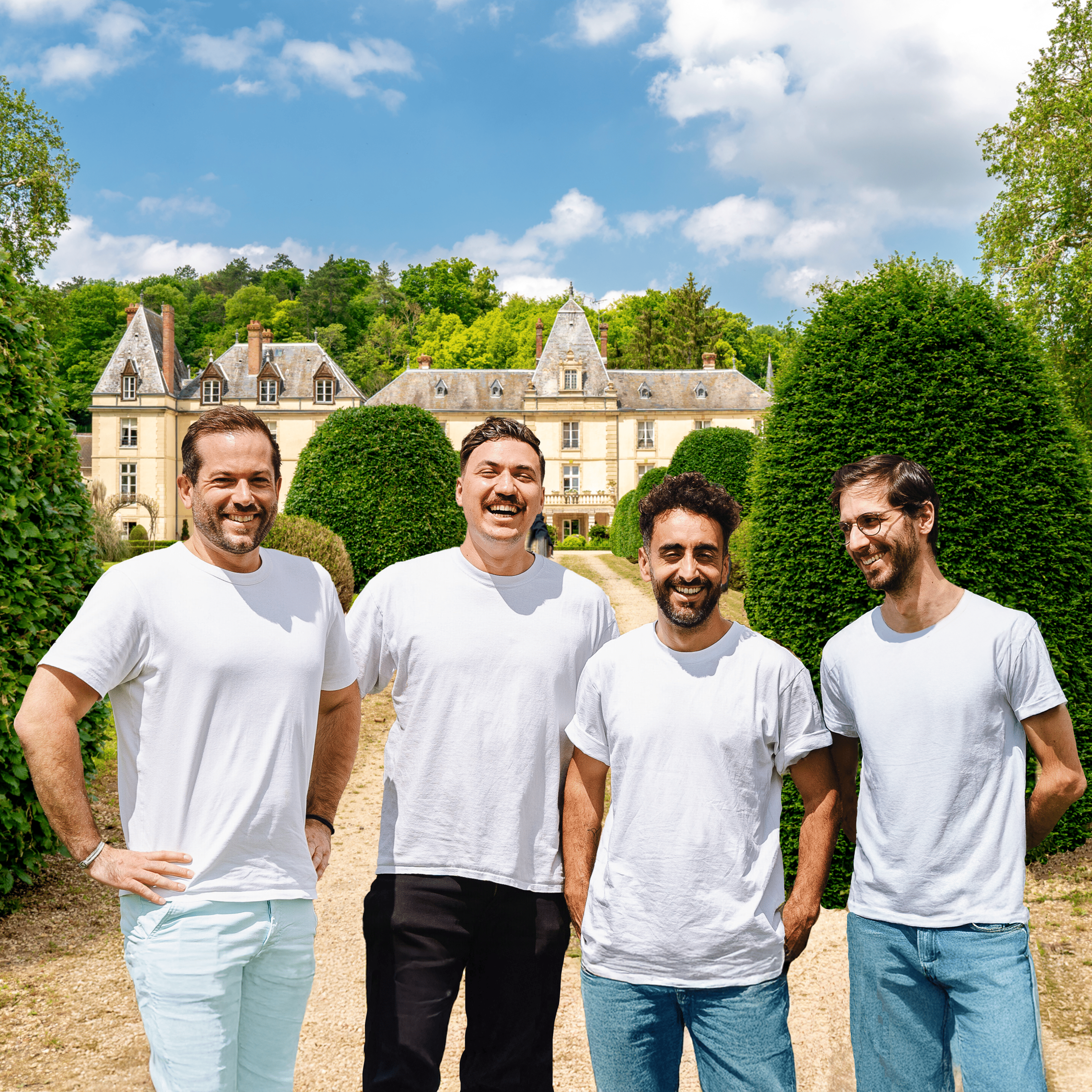
The first version of Naboo had a lovely proposition and a fatal defect: too few people wanted it. It was 2022, and the company then known as WOME offered employers a way to send workers to appealing houses in the countryside. After confinement, freedom, broadband and a large kitchen table seemed a plausible bundle. Maxime Eduardo later supplied the postmortem in four unvarnished French words: “Ce fut un véritable flop” - a real flop.
There are founders who embalm an original idea and call the preservation conviction. Eduardo did something more useful. He and his cofounders watched what customers were actually trying to arrange. Companies might not have needed a pastoral annex to the office, but they did need to gather people for seminars, team meetings and retreats. So WOME became Naboo, the remote-work premise gave way to event booking, and the team moved toward the demand instead of scolding the market for its poor taste.
That first correction created another discovery. The visible part of a corporate event is congenial: a bright room, a decent meal, the hope that colleagues will speak to one another without a calendar invitation. Behind it lurks an administrative operetta. Venues send quotes. Caterers send different quotes. Someone needs a bus, somebody else needs an approval, and finance would rather not meet 47 new suppliers through 47 new invoices. The party is one evening. The paperwork acquires tenure.
“We are a procurement company - not an event company.”Maxime Eduardo
Eduardo's decisive move was to take this dull backstage seriously. Naboo would not remain a pleasant catalogue of country houses. It would become software for buying, governing and paying for meetings and events across a large organization. The sentence he now repeats - “We are a procurement company - not an event company” - is more than positioning. It describes the distance between helping someone find a venue and helping a global enterprise understand an entire category of spending.
He learned to read the machinery first
The route to that idea runs through numbers and operations. Eduardo studied applied mathematics at CentraleSupélec, added applied economics at Paris Dauphine and completed a master's in operations research at Columbia. He then spent 2014 to 2017 at Oliver Wyman, where strategy is supposed to become legible through models, interviews and very orderly slides.
In 2017 he cofounded A-Partners, a boutique consultancy for smaller and mid-sized companies. Advising eventually turned into operating. Eduardo became managing director of LABATUT Group, a logistics, distribution and transport business reported at about 700 employees and €100 million in revenue, and stayed for roughly three years. It was an education in the stubborn physical world: trucks must arrive, costs must reconcile, and a theory that works only inside a deck has the commercial value of decorative parsley.
Leaves engineering school for strategy consulting at Oliver Wyman.
Cofounds A-Partners and begins the move from adviser to entrepreneur.
Takes the managing director role at logistics company LABATUT Group.
Turns the WOME experiment into Naboo's event-booking business.
Raises a $70 million Series B and opens a New York hub.
That sequence explains something about Naboo's appetite. Eduardo does not describe event planning as a lifestyle category. He describes inputs, process costs, supplier creation, compliance, tax recovery and transaction volume. The romance has not disappeared; it has merely been assigned to the guests. His company is busy with the wiring.
A booking site follows the paperwork
By early 2024, Naboo had raised €7.5 million and was selling customizable seminars with accommodation, meeting space, meals, transport and activities in one reservation. The promise was deliberately prosaic: one contact and one invoice. Later that year, the company acquired BizMeeting, gaining experience and relationships with large corporate clients. A €20 million round followed in early 2025 as Naboo expanded across Europe and sold more directly to procurement departments.
This was the second, more consequential pivot. Managers booking an occasional retreat are customers. Procurement teams overseeing thousands of requests are systems buyers. They want rules, audit trails, comparable quotes, negotiated terms and an answer to the question finance asks with devastating regularity: where did the money go?
Small events make the problem particularly disagreeable. Eduardo says roughly 78 percent of requests fall below $20,000. Individually they may not command executive attention; collectively they manufacture supplier records, approval chains, invoices and compliance risk. In procurement dialect this is tail spend. In ordinary language it is death by a thousand perfectly reasonable dinners.
Naboo's Control Tower gives procurement and finance teams a consolidated view of budgets, policies, tax issues and approvals. Its event app handles the execution layer. Its agency and studio work covers elaborate productions. The company talks about the whole arc as “Source-to-Reclaim,” starting with a brief and extending past payment to reconciliation and eligible tax recovery. The name is inelegant in the way plumbing is inelegant. Both become fascinating when they fail.
The machine gets the PDFs; people keep the nerves
Meetings and events are unusually fertile ground for current AI because the work arrives as a jumble: menus, images, contracts, room specifications, prices, terms and free-form requests. Earlier software could store these materials. Newer systems can extract, compare and act on them. Naboo's AI Planner searches venues and suppliers, assembles recommendations and centralizes proposals. Eduardo has said it handles close to 90 percent of booking research.
In September 2026, Eduardo reported that 81.4 percent of events in the company's latest month had been booked by AI agents without a human in the loop, up from about 35 percent in July. The figure is striking because it measures completed commercial work rather than a demo's ability to compose a cheerful itinerary. Earlier in the year, he said the average employee used AI daily and that every proposed hire required a business case explaining why software could not do the job.
This could sound like the usual fever dream of a company becoming a computer with a cap table. Eduardo's more interesting argument is that events remain a service business. Clients still want a person to understand the atmosphere, notice the risk and care whether the evening works. His formula combines automation with a “white-glove” layer. AI receives the repetitive search and comparison. Humans retain judgment, reassurance and the delicate assignment of preventing a thousand-person gathering from becoming a thousand-person complaint.
“The future of this category is neither purely tech nor purely service. It is the combination of both.”Maxime Eduardo
A French retreat business walks into New York
The international push has been led by customers as much as ambition. Large companies do not stop being large at the border. Naboo followed them into the United Kingdom, Germany, Spain, Italy, Portugal and the Netherlands, then into North America through Montreal and New York. Eduardo said that within six months of going international, half of revenue came from outside the home market. The New York office, announced alongside the February 2026 financing, turned a geographic plan into a visible commitment.
The $70 million Series B was led by Lightspeed, with Notion Capital, ISAI and Ternel participating. Naboo said it had raised $100 million over three years and employed 180 people across eight countries at the time of the announcement. The stated targets were equally tidy: triple revenue in 2026 and exceed $1 billion in transaction volume in 2027.
Eduardo's ambitions now extend beyond meetings. If the system can standardize an unruly category full of quotes, suppliers and local complications, he believes it can move into other fragmented spending in marketing and human resources. It is a classic expansion thesis: solve the difficult corner, then carry the machinery next door.
There is also a more personal version of scale. Eduardo has said his favorite company memories come at summer offsites and Christmas celebrations, when the number of people in the room reveals how far the original intuition has traveled. He has spoken about sharing value through employee equity, with the specific hope that early employees might leave with a meaningful contribution toward a home. The operator counting transactions is also counting who gets to benefit from them.
What the flop preserved
The first Naboo was wrong about the product but not entirely wrong about the human impulse. Companies do spend heavily to bring people together. What Eduardo and his cofounders misunderstood was where a new company could contribute. The breakthrough was not a prettier destination. It was the connective tissue that lets a sprawling organization buy thousands of moments with some coherence.
This makes Eduardo's story less a hymn to stubbornness than a case for disciplined embarrassment. He was willing to name the flop, then follow the evidence into a less photogenic business. Country houses led to seminars; seminars led to invoices; invoices led to procurement; procurement led to AI systems parsing the disorder. Each step moved farther from the postcard and closer to the budget owner.
At a good corporate event, nobody thinks about vendor onboarding. That is the compliment. The lights work, the room fits, dinner arrives and the people who normally communicate in rectangles remember they possess depth. Somewhere behind this graceful illusion is a chain of software, contracts and payments. Maxime Eduardo has chosen the backstage. It is crowded, expensive and wonderfully short on champagne. In other words, it looks rather like a business.