Consider the macramé planter. Online, it is a photograph of somebody else’s competence. In a box, with the materials and a lesson, it becomes an afternoon you might actually attempt. In March 2017, Brit + Co took that distinction to Target. Its first ten DIY kits cost $19.99 to $24.99 and included a gift card for an online class. The company had found a way to sell the distance between admiring a thing and making it.
- Make starting easier: pair an appealing project with supplies and instruction.
- Know who pays: readers buy classes; brands buy access to the audience.
- Watch the distribution: falling social traffic helped force a painful reset.
- Keep listening: Selfmade members wanted support beyond a ten-week course.
That is a useful place to begin with Brit + Co. The colors are cheerful, the projects photogenic, and the subject matter often pleasantly domestic. Beneath them lies a more demanding question: how do you build a business around helping people become more capable? The company has tried several answers. Some fit in a shopping bag. One required cutting much of the staff. Another became a school for women starting companies.
01 / The beginner is the customer
Brit + Co is a digital media and education company aimed at women. Its website carries recipes, home ideas, beauty guidance, shopping recommendations, entertainment coverage and DIY projects. Its classes teach specific skills. Selfmade addresses the woman who wants to build a business. Advertisers are customers, too: the company offers sponsored editorial, branded classes, influencer collaborations and dedicated content destinations.
These activities meet different needs. A reader may need a dinner idea, a student may want better lettering, and a founder may need help describing her product. A brand wants attention in a setting where its product has a plausible purpose. Brit + Co’s expertise is turning broad aspirations into approachable editorial and instruction. The practical value depends on how well the next step is explained.
On its About page, Brit Morin describes leaving the screen-heavy rhythm of Apple and Google work and rediscovering the satisfaction of making things. Friends kept saying that “they were NOT a creative person.” She wanted to challenge the assumption. The company began in 2011; its own anniversary account also identifies Anjelika Temple as co-founder.

The revealing word in the friends’ complaint is person. They were describing an identity, not a missing technique. A beginner’s class offers a modest way to test that identity. Learn one stroke. Finish one object. The result can be imperfect and still count. That makes the lesson easier to sell than a grand promise to transform someone’s life.
02 / A tutorial walks into Target
The Target launch made this logic physical. Brit + Co said it chose projects using a library of more than 100,000 tutorials and Pinterest activity. The range included wall hangings, scarves and metal-stamped necklaces. Projects were designed for beginners, and supplies came together in the box. The launch date was March 12, 2017. These were products built from evidence of what readers already found appealing.
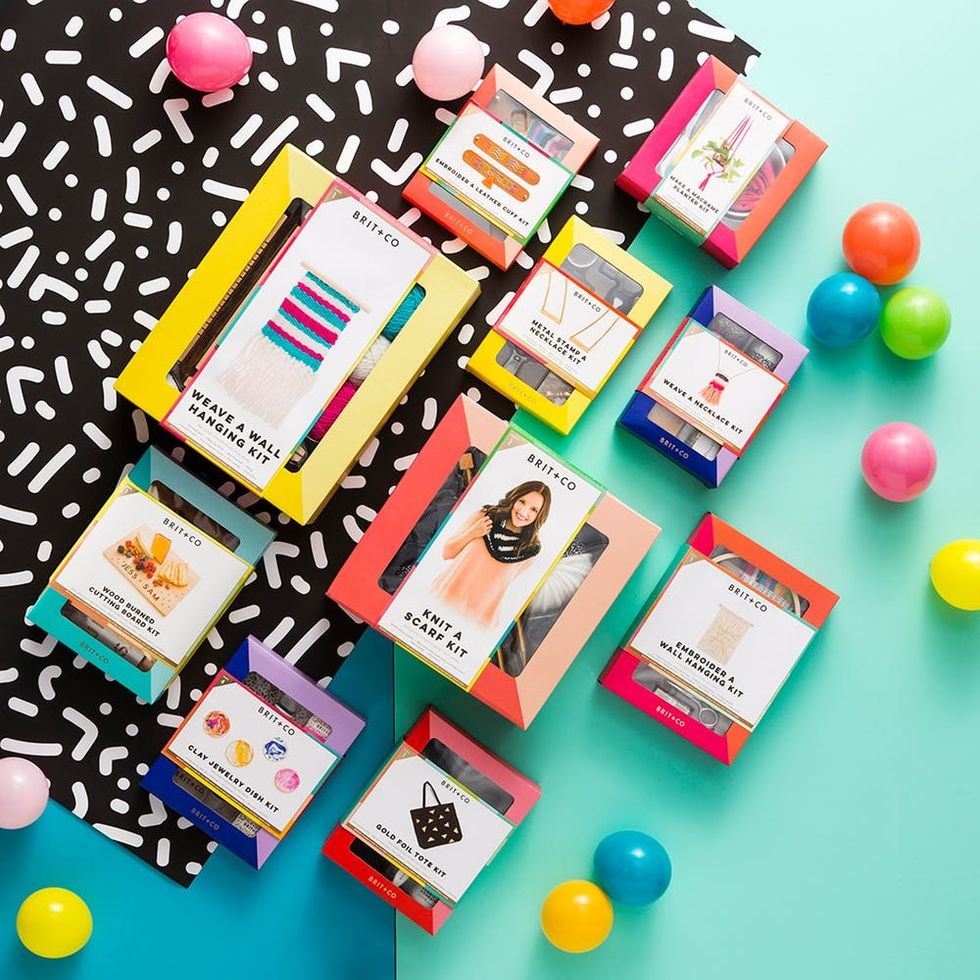
A saved project has no obligation to become a finished project. Buying separate materials takes effort; choosing the wrong ones adds doubt. Bundling them removes decisions before the first stitch. Including a lesson also gives a retailer something more useful to sell than an attractive pile of yarn. The customer buys a defined attempt, with a beginning and an end.
This is where Brit + Co fits among its alternatives. Pinterest helps people discover possibilities; YouTube offers a vast supply of demonstrations. Lifestyle magazines provide taste and curation. Creative course providers sell instruction. Brit + Co has worked across those jobs, giving the reader a selected idea and, sometimes, a way to carry it out. Its distinction is the combination. Each individual activity has plenty of competition.
The kits also suggest something another publisher can copy: study repeated reader interest, identify the effort that prevents action, and package help around it. The condition is consequential. Enthusiasm for a photograph does not establish willingness to pay. Materials, fulfillment and retailer economics must work as well as the tutorial. A pretty box has remarkably little patience for a bad margin.
03 / The audience’s landlord changes the locks
The problem that became decisive was distribution. In April 2019, after acquisition talks fell through, Brit + Co laid off a majority of its staff. The contraction followed earlier cuts. Morin’s public explanation called the next phase a “reboot” and described the difficulty facing independent publishers centered on advertising. Multiple revenue streams had offered no exemption from that difficulty.
By March 2020, executives described a smaller, search-focused operation. Facebook supplied 40% of website traffic in early 2017. Google’s share rose from 22% to roughly 75% by the later report. The company said it was profitable in the final quarter of 2019. Advertising still represented about two-thirds of revenue. These are historical figures, not today’s operating results.
A how-to article suits search because the reader arrives with an intention. Someone asks a question; a useful answer may remain useful next month. That creates a different editorial incentive from chasing a moment in a social feed. It also leaves another dependency: search engines decide which answers appear. The lesson is to understand the fragility of each route to your customer before building costs around its continued generosity.
“reboot”Brit Morin’s description of the company’s next chapter, April 2019
Audience claims need the same discipline. Brit + Co’s About page advertises reach across its website and social platforms. Those impressions and encounters should not be treated as a count of paying customers, or even of people visiting the website. A broad audience can support a brand. It does not, by itself, explain the business underneath.
04 / The next project was a company
In June 2020, Brit + Co introduced Selfmade, a ten-week virtual startup program. Morin explicitly connected the launch to pandemic unemployment and the wish to help women create or grow businesses. She and Temple would lead it alongside female entrepreneurs and investors. The announcement also pledged 20% of net proceeds to Digitalundivided and offered 50 scholarships to BIPOC women.
The earlier kit asked whether a reader could make an object. Selfmade asked whether she could build an enterprise. The stakes changed, but the practical obstacles remained recognizable: unfamiliar steps, too many decisions, and no one nearby to ask. Coaching and peers could supply help that a standalone article could not. A founder’s problem, however, rarely finishes as neatly as a scarf.

That mismatch produced a documented change of mind. In its August 2022 relaunch announcement, Selfmade said members consistently wanted more than ten weeks. It shifted to ongoing membership, offering on-demand instruction, mentoring, weekly workshops and business templates. Office Depot OfficeMax sponsorship included 600 scholarships over the year. By June 2023, the program said it had helped nearly 4,000 women since launch.
Membership makes sense when the need recurs. It demands continued usefulness in return: a founder has to find value after the introductory lessons are familiar. For someone seeking a single creative skill, the regular class catalog is the more direct starting point. At the research check, examples included $19 calligraphy, $29 water-brush lettering and a $9 imposter-syndrome class. Business education calls for a larger commitment of attention.
Brit + Co’s public values include curiosity, utility and community, and its site promises credit and promotion disclosures. Those values describe the intended relationship with readers. The financial reset and Selfmade’s format change show how much work that relationship can require. The most useful idea to borrow is wonderfully concrete: give people a manageable next step, then watch where they get stuck. Sometimes the missing piece is yarn. Sometimes it is another ten weeks.
Try a project. Hear the founder.
Explore Brit + Co, browse creative classes, or learn about Selfmade. For the origin story, listen to the ten-year anniversary episode.
Watch Brit Morin’s Stanford talk or explore the Brit + Co video channel. Follow the company on LinkedIn, X, Instagram, Facebook and TikTok.