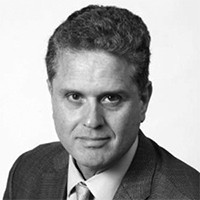
The YesPress Profile
Paul Slavin
He spent three decades chasing the news. Now he is teaching the world to make things.
He spent three decades chasing the news. Now he is teaching the world to make things.
In August 2025, Skillshare handed its top job to someone who had never built an ed-tech company. Paul Slavin walked into the New York online-learning marketplace - 30,000-plus classes in illustration, photography, design, freelancing, music - and took the CEO chair from Matt Cooper, who had held it for more than eight years. The platform he inherited teaches people to draw, edit, paint, and pitch. The man now steering it learned his trade in network television control rooms, where the only deadline that mattered was the one counting down to air.
His pitch for the place is disarmingly plain. "Skillshare has built something rare," he said on arrival, "a global community rooted in creativity, authenticity, and a passion for learning." He frames the road ahead in the same register: build the next generation of tools, content, and community for creative learners and teachers around the world. No moonshot vocabulary. Just product, audience, and craft - the three things he has spent a career obsessing over.
To understand why a creative-learning company would reach for a former newsman, you have to rewind to a convoy in Iraq. Slavin was running international coverage when one of his convoys came under attack and several people were badly hurt. He spent the following weeks talking to the families and arranging medical evacuations to Germany. It was the kind of stretch that makes a person ask whether the work is worth it. He stayed - but the question never fully left, and it shows up later in a leadership philosophy that puts people first and treats the spreadsheet as a means, not the point.
What makes Slavin worth watching is not a single triumph. It is the refusal to stay put. Television news. Web video. Digital book publishing. Media M&A. Now creative education. Each pivot looks abrupt from the outside and obvious from the inside, because the throughline is constant: take a quality product, display it well, price it right, and put it in front of the person who actually wants it. He has said exactly that, almost word for word, as his entire theory of business.
He also has a habit of arriving when the easy growth is over. Skillshare announced him in August 2025 as the company moves into a more demanding chapter of online education, where subscription platforms have to earn renewals rather than ride a pandemic surge. That is, oddly, the climate Slavin has always preferred. He took over ABCNews.com when the question was whether a broadcaster could matter on the web at all. He joined Everyday Health to figure out web video before anyone had cracked the unit economics. He ran a digital book publisher through the messy middle of the e-book transition. The pattern is not a man who chases momentum - it is a man who shows up when the answer is genuinely unknown.
"Allow yourself to fail; if you are not making mistakes, you are not trying hard enough."
// Paul Slavin
The first thing to know about Slavin is that he came up in newsgathering, the unglamorous machinery behind the anchor. Newsgathering is logistics under fire: getting a crew, a satellite truck, and a correspondent to the right corner of the world before the competition, then getting the tape back in time to air. He did it for 33 years, rising to Senior Vice President, Worldwide Newsgathering, and his stretch at the top coincided with World News Tonight with Peter Jennings, the broadcast he executive-produced. The awards followed - a dozen Emmys, a Peabody, a Murrow, an Overseas Press Club honor - but the awards were a byproduct. The job was logistics, judgment, and nerve.
The convoy attack in Iraq sits at the center of his story precisely because it was not a story he was telling. It was one he was inside. People in his coverage operation were hurt; he spent weeks with their families and on the phone with hospitals in Germany. He has said it made him question the work. Most retellings of executive biographies sand down moments like this into "resilience." Slavin keeps the rough edge. It is the reason his leadership advice circles back, again and again, to the idea that work is not life - a strange thing to hear from someone who spent decades in a profession that eats lives.
The move to the commercial internet came at Everyday Health, the consumer health publisher, where in 2011 he was brought in as a "former ABC News executive" to lead an expanded push into health video and global news. He ran Everyday Health Studios, then climbed to Executive Vice President and Chief Operating Officer, taking responsibility for the strategic direction of the company's business units, including its news operations and subscription properties. This is where the broadcaster became an operator. Video at a health site is not a story you produce once; it is a product you have to make pay, week after week, against the unforgiving math of online advertising and subscription churn.
Open Road Integrated Media was the proof. He joined the digital book company as President in 2015 and was elevated to CEO in 2017, with co-founder Jane Friedman moving to Chairman. Open Road's whole premise was data-driven marketing of backlist titles - taking books with audiences that had gone quiet and finding the readers again. Slavin ran the audience-development and content engines and, by his own description and the company's, took the business to growth and profitability before a 2021 transaction closed the chapter. It is the kind of result that does not make headlines but makes reputations: a quiet turnaround in a brutal category.
Then came the connective tissue between operating and advising. A brief, intense run as President and CEO of Resolute Square in 2022. And in 2023, a move to Oaklins DeSilva+Phillips as Managing Director, sitting on the deal side of the table and advising clients on transactions across digital media, marketing services, and healthcare media. Spend two years watching deals get done and you learn, in a hurry, which companies have real engines and which are running on narrative. When Skillshare came calling in 2025, Slavin arrived having seen the category from inside and from across the negotiating table.
So what does a creative-learning marketplace get in Paul Slavin? Not a visionary in the Silicon Valley sense - he does not traffic in the language of disruption. It gets an operator who has spent a career on the unsexy questions. Who is the customer, really? What is the product, exactly? Is it displayed well, priced right, and timed to the moment someone actually wants it? He has reduced his philosophy to a single sentence and he is not embarrassed to repeat it, because he believes mission only sticks when you say it until it is boring. For a platform built on 30,000 classes and a community of teachers, that plainness may be the point. The man teaching the world to make things has always cared more about the making than the noise around it.
"Work is not life. On your deathbed you will not look back and say: I wish I'd taken more meetings."
// On keeping perspective
Three decades of live television teach you that a deadline is a feature, not a threat. Slavin built ABCNews.com into a top-six destination by treating the internet like a broadcast that never goes off air.
"A quality product, well displayed at a good price shown to a relevant customer at the right time." He repeats it because he believes it, and because clarity of mission only works when you say it more than once.
He tells leaders that mistakes are the toll for trying hard. The trick, he says, is honesty and self-reflection: discuss the failures openly, with peers, and learn out loud.
Slavin credits a "long and tumultuous relationship" with anchor Peter Jennings as the thing that shaped how he leads. Friction, it turns out, is a fine teacher.
"On your deathbed you will not look back and say: I wish I'd taken more meetings." From a man who ran war coverage, that is not a throwaway line.
At Skillshare he leads with the word "community" - teachers and learners, not users and seats. Authenticity and craft are the metrics he names first.
Skillshare has built something rare: a global community rooted in creativity, authenticity, and a passion for learning.
Together, we'll build the next generation of tools, content, and community for creative learners and teachers around the world.
Allow yourself to fail; if you are not making mistakes, you are not trying hard enough.
Work is not life. On your deathbed you will not look back and say: I wish I'd taken more meetings.
He studied political philosophy at the University of Chicago - not business, not media - and later did graduate coursework in economics at NYU.
His trophy shelf is from journalism, not tech: 12 Emmys, a Peabody, an Edward R. Murrow Award, and an Overseas Press Club Award.
He spent 33 years at a single organization, then reinvented himself across at least four more industries.
Before running any tech company, he executive-produced one of America's flagship evening newscasts alongside Peter Jennings.