The first thing Brickyard sells is an inconvenience. If the Chattanooga venture firm backs your company, all the co-founders are expected to move to Tennessee, work from the same former Persian rug warehouse and remain there until the business reaches a revenue target they chose on arrival. The minimum guide is a $1 million run rate. The average stay is 18 to 24 months. There is no graduation date to circle and no stage waiting for a polished pitch.
This arrangement looks like an accelerator from a distance. Up close, its defining feature is how much accelerator machinery has been removed. There are no cohorts, classes, demo days or standing mentor meetings. New teams arrive on a rolling basis. Brickyard's five operator-investors sit nearby, but the founders do not report to them. Advice is available when requested, often after a walk of a few feet. The partners call the place an "insulator," a word that captures both the attraction and the constraint.
The product is a place
Matt Patterson and Cam Doody arrived at this idea through memory rather than management theory. The pair had helped build Bellhops, now Bellhop, after moving from Birmingham to Chattanooga in 2012. Their investor, Lamp Post Group, put young founders together under one roof. Patterson has said that environment supplied a support system they would not have had alone. When he and Doody later considered venture capital, they returned to the part of early company building they understood firsthand: the murky stretch after a first check but before product-market fit.
They launched Brickyard in 2021 with fellow Chattanooga operators Ted Alling, Allan Davis and Barry Large. Patterson and Doody self-funded the first 16 companies. In 2022 the group raised a reported $17 million from 65 local limited partners in roughly five weeks. Early checks were often described as $200,000 to $400,000. Brickyard has since moved up-market: its current site says it writes about ten checks of $500,000 to $800,000 each year, while its FAQ puts the average at $700,000 and the full range at $250,000 to $1 million.
The firm invests on individually negotiated market terms and charges no separate fee for the residency. It prefers to lead, though it will follow, and typically operates at pre-seed and seed. The customer is not every ambitious entrepreneur. It is a full-time founding team willing to put geography, routine and much of ordinary life behind a single company for a sustained period.
“We’re not an incubator, we’re an insulator.”Matt Patterson, Brickyard co-founder
What subtraction solves
Brickyard is built around a diagnosis: founders before product-market fit suffer from fragmented attention and shallow support. Remote networks produce plenty of introductions but fewer people who see the same team struggle every day. Accelerator programming can be useful, but a calendar of talks and pitch preparation may pull attention away from customers. Traditional seed investors can offer advice, yet even good advice often arrives asynchronously and without the texture of daily operations.
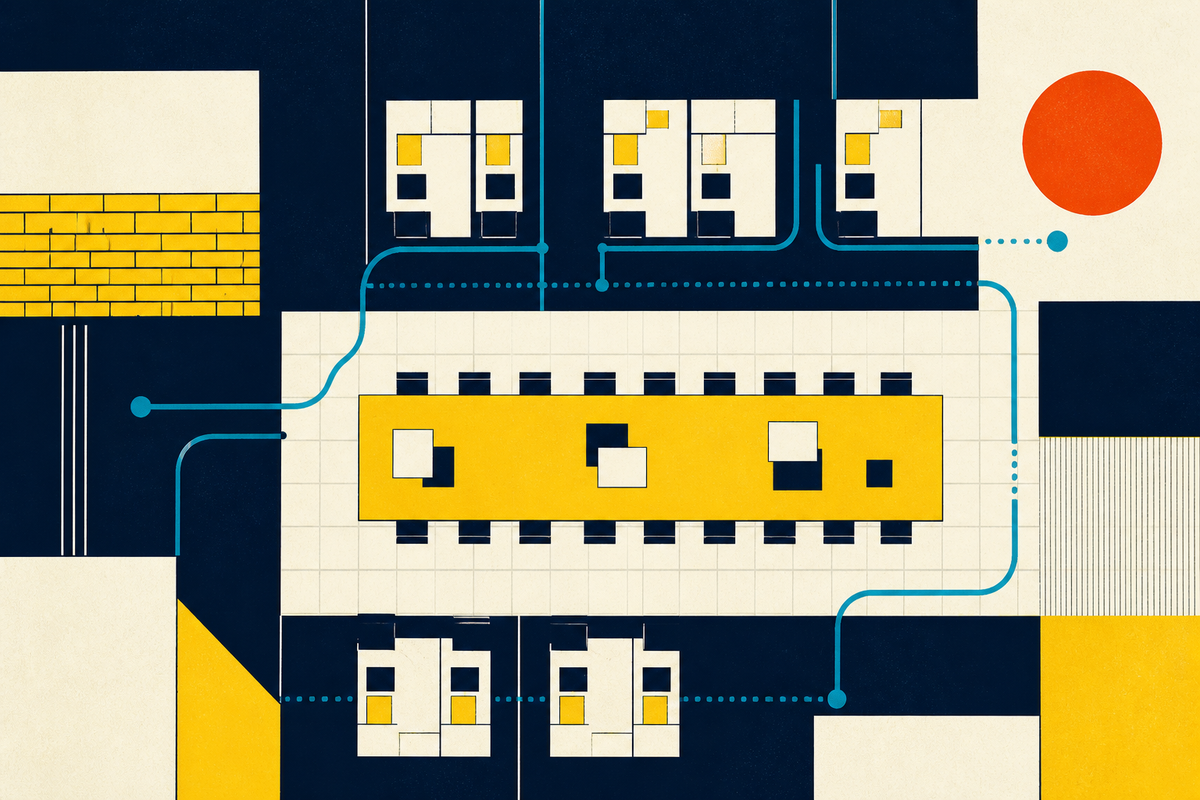
The Yard turns those gaps into architecture. Its 12,000 square feet include open worktables, private breakout rooms, call boxes, a conference room and 24-hour access. The extras are unusually domestic for an office: gym, showers, sauna, steam room, cold plunge, pickleball court, rooftop and pool. An 11-bedroom house across the street gives some founders a ready-made place to live. None of that makes a product customers want. It reduces the number of excuses and logistical interruptions between waking up and trying again.
The useful mechanism is not the sauna. It is repeated observation. A founder can watch another team lose a customer, change a sales motion and recover. Co-founder tension becomes visible before it can be edited out of an investor update. Tactical questions about hiring, pricing or a difficult board conversation find answers in the room. This is peer support with context, and context is what most online founder communities cannot accumulate.
An incentive hidden in the walls
Brickyard reinforces that social system with fund economics. Founders who meet its one-year vesting condition receive upside in the general partner, giving them a financial interest in the other companies in their active fund. The original structure was reported as 10 percent of GP carry shared with founders. The firm now describes the arrangement more generally as founder ownership in the GP.
The design does two jobs. It rewards founders for referring strong teams, a key source of venture deal flow. It also makes collaboration less abstract. Helping the startup across the table may improve the value of a shared pool. No incentive can manufacture trust, but Brickyard has at least aligned the spreadsheet with the behavior it wants in the building.
Selectivity supplies the other half of the model. Brickyard says it reviewed more than 10,000 decks in a recent year and invested in 12. Diligence usually runs two to three weeks and ends with an in-person partner meeting in Chattanooga. The founders inspect the fund as much as the fund inspects them. Relocation then acts as a second filter: a team willing to disrupt its life has revealed something about conviction, though not necessarily something about the quality of its idea.
The cost of intensity
Brickyard does not disguise its culture. Its site uses "9-9-7" as shorthand for work from 9 a.m. to 9 p.m., seven days a week. Founder testimonials describe 100-hour weeks. An antique punch clock stands inside the building, and one resident reportedly logged 117 hours in a week. The firm's preferred archetype is high-agency, competitive, optimistic, low-vanity and capable of selling. One item on that list is simply "Leeroy Jenkins," the internet's enduring symbol of charging ahead.
This is a coherent positioning choice and a real tradeoff. Long hours do not guarantee insight, and exhaustion can make judgment worse. Mandatory relocation excludes talented founders with caregiving duties, health constraints or partners whose careers cannot move. An in-person model can deepen relationships while narrowing access. Brickyard's answer is not to claim universality. It says plainly that the model is not for everyone.
Brickyard's lesson is not "work 100 hours." It is to decide what behavior a product depends on, then make the environment and incentives support that behavior. Here, the behavior is sustained, in-person focus.
That candor distinguishes it from startup programs that promise community without defining the commitment community requires. Brickyard asks for a lot, specifies the ask before investment and allows founders to leave without a contractual residency term. The forcing function is cultural rather than legal.
Where the wager is paying off
The portfolio shows a category-agnostic investor with a strong technology bias. Public entries stretch from fintech infrastructure and enterprise software to warehouse robotics, health monitoring, defense drones, food manufacturing and consumer products. The list had reached 58 companies by August 2026 across a pilot fund, Fund I and the opening investments of Fund II. The geographic roll call includes founders from San Francisco, New York, London, Vancouver, Dubai, Malta and dozens of other cities.
Brev is the most visible result. Brickyard backed the cloud development company early, reinvested and hosted its team before NVIDIA acquired it in 2024. The firm also marks Rollfi, Sendspark and Pledge as acquired. Those outcomes are meaningful but still early evidence for a young fund. Venture performance takes years to resolve, and the public portfolio also records companies that have shut down.
Compared with Y Combinator or Techstars, Brickyard is smaller, longer and less programmed. Compared with HAX, it lacks a specialized engineering platform and sector thesis. Compared with ordinary seed capital, it demands far more physical commitment. Its closest substitute may be raising money and renting a house with other founders, though that lacks the curation, operator network and shared economics.
Brickyard also refuses an easy civic story. It says the objective is not economic development and does not require companies to keep their headquarters in Chattanooga after residency. That boundary makes the local effect more credible. Kunin, a portfolio company working on mineral extraction, stayed and built operations near a manufacturer. Other teams leave for customers, talent or another financing round. Chattanooga is a tool in the model, not the promised destination.
“Proximity is one of the biggest game changers at Brickyard.”A Brickyard founder, quoted by the firm
The broader market is crowded with capital and advice. Brickyard occupies a narrower lane: venture as a controlled environment for the phase when a company has pressure but not yet a reliable direction. Its expertise comes from operators who remember that phase, and its service is a place where other people are living through it at the same time.
The clever part is how little the thesis depends on novelty. Founders have always worked better with trusted peers nearby. Investors have always used selection to create networks. Shared upside has always changed referrals. Brickyard bundles those old truths into a demanding physical product and removes almost everything else. The building is not a metaphor. It is the operating system.