Brian Otte reached the microphone at a Jack Henry investor gathering with a nickname ready. He was, he told the room, “the Accordion.” If the speaker before him stretched, Otte would compress. It was a clean little joke, the sort that tells you someone has spent years reading rooms where a clock, a forecast, and an audience all require attention at once.
The accordion image also fits the career. Otte has moved between the meticulous and the expansive: accounting and sales, network security and brand strategy, startups and a public company, international business and community banks. He can speak in the hard units of quota coverage and pipeline, then turn around and credit his team so plainly that the corporate varnish falls away. Without them, he once said, he would “fall flat on my face.”
Today he is vice president and chief sales and marketing officer at Jack Henry, the financial-technology company based in Monett, Missouri. He leads the implementation and execution of business development across an organization whose software sits deep inside banks and credit unions. It is work conducted far from the consumer gloss of fintech. Core systems, fraud controls, payments, cloud migrations, and digital banking are not impulse purchases. Their buyers have long memories and a professional interest in things continuing to work.
Before fintech had a nicer wardrobe
Otte started at Arthur Andersen in the late 1990s as an IT auditor. His background joined accounting with management information systems, and his work focused on network security at a moment when putting a bank online still carried the air of an experiment. The assignment introduced him to financial institutions through their vulnerabilities. It is an excellent, if severe, education in how banks think: every innovation arrives holding hands with risk.
He then helped start Guarded Networks, where he served as executive vice president. The business grew to support roughly 1,000 community financial institutions before its exit. Otte was learning enterprise sales, but he was also learning a particular market. A community bank cannot hide a broken experience behind a global brand. Its customers may know the branch manager. A credit union has members rather than a distant mass of accounts. Trust is local, visible, and easily bruised.
Corporate development at SilverSky and financial-services sales leadership at Oracle followed. International business had an obvious pull. Otte says he lived in six countries before moving to the United States, and his public profile lists Spanish alongside English, with some Dutch and Portuguese. Yet the grand international canvas did not erase the attraction of smaller institutions. He missed home, and he missed community banks and credit unions.
That distinction is the hinge in his story. Ambition is usually drawn as a line toward larger territories, larger logos, larger everything. Otte's path bent toward proximity. The technology could be vast. The relationship needed to remain human.
The long courtshipFourteen years of watching before one decisive yes
Otte first encountered Jack Henry around 1999. For roughly fourteen years, he watched the company from the outside. When he finally joined in 2012, he did not arrive as an untested admirer. He had audited bank technology, built a security vendor, developed companies, and sold financial software across regions. He had seen enough corporate machinery to know the difference between a value printed in a lobby and a value that survived a difficult quarter.
He joined as a sales director for Gladiator, a Jack Henry unit focused on network security services, cloud solutions, and business continuity. The fit had the pleasant neatness of a loop closing. His first subject was security; now that expertise brought him into the company he had studied for years. He later took charge of sales for ProfitStars, Jack Henry's collection of complementary solutions, before being named chief sales and marketing officer in March 2022.
Standardize how teams measure the work, not how every manager behaves. A common dashboard can create mobility without manufacturing identical personalities.
His operating idea is simple enough to fit on an index card: teams should speak the same language. A sales leader moved from one part of the company to another should recognize the management rhythm, the forecast, and the meaning of the numbers, even before mastering every feature of the new product line. Shared measurement makes expertise portable.
One Jack HenryThe glamorous business of cleaning the seams
Otte took the top commercial job as Jack Henry was consolidating a collection of familiar business names into one market identity. Brand refreshes are often discussed in a vapor of adjectives. He described one benefit that anyone who has worked a trade-show floor can understand: one logo on the booth. One identity meant one asset to invest in, one story for prospects, and fewer internal borders for a client to cross.
Behind the visual change sat the less photogenic work. Back-end sales operations were unified. Teams aligned territory planning and white-space analysis. Forecast calls included senior company leaders, with the month, quarter, and coverage made visible. Otte did not argue that every manager should adopt the same style. He wanted everyone gauging the business in the same way.
At a 2023 investor event, Otte attached numbers to the cleanup. Since the brand launch, daily website sessions were up 51 percent, new monthly visitors 48 percent, social followers 21 percent, and social engagement 91 percent. Leads generated by the website were up 51 percent. He said the sales pipeline had risen roughly 30 percent from the end of August and beginning of September, reaching 105 percent of the annual sales target.
These figures belong to Jack Henry, not to one executive, and Otte is unusually quick to make that distinction. The interesting part is how he connects the layers. A clearer brand supports more awareness. Shared operations turn attention into an intelligible pipeline. Consistent forecasting makes the pipeline credible. The logo is the visible tip of an operating decision.
The sale before the saleEarn the right to talk about the software
Education, Otte says, is close to his heart, and he is careful to separate it from narrow sales training. His stated aim is education all around: giving team members a proper program, allowing them to learn from one another, and designing prospect events that do more than parade products across a screen. The company should educate first, then earn the right to discuss a solution.
That order is commercially shrewd because banking software is full of consequences. A core conversion changes how employees work. A fraud platform sits between convenience and loss. A cloud migration must satisfy an appetite for modernization and an obligation to control risk. The seller who begins with a pitch asks the buyer to do the translation. The seller who begins with the buyer's problem has already begun the work.
Otte's language around existing clients is equally revealing. The first priority is to protect the house. New business matters, but retaining institutions and keeping them satisfied is the foundation. In software, the phrase “customer service” can sound like the department reached after something goes wrong. In his account, service is among the main reasons clients sign in the first place. The support model enters the buying decision before the contract does.
A spreadsheet with people still inside it
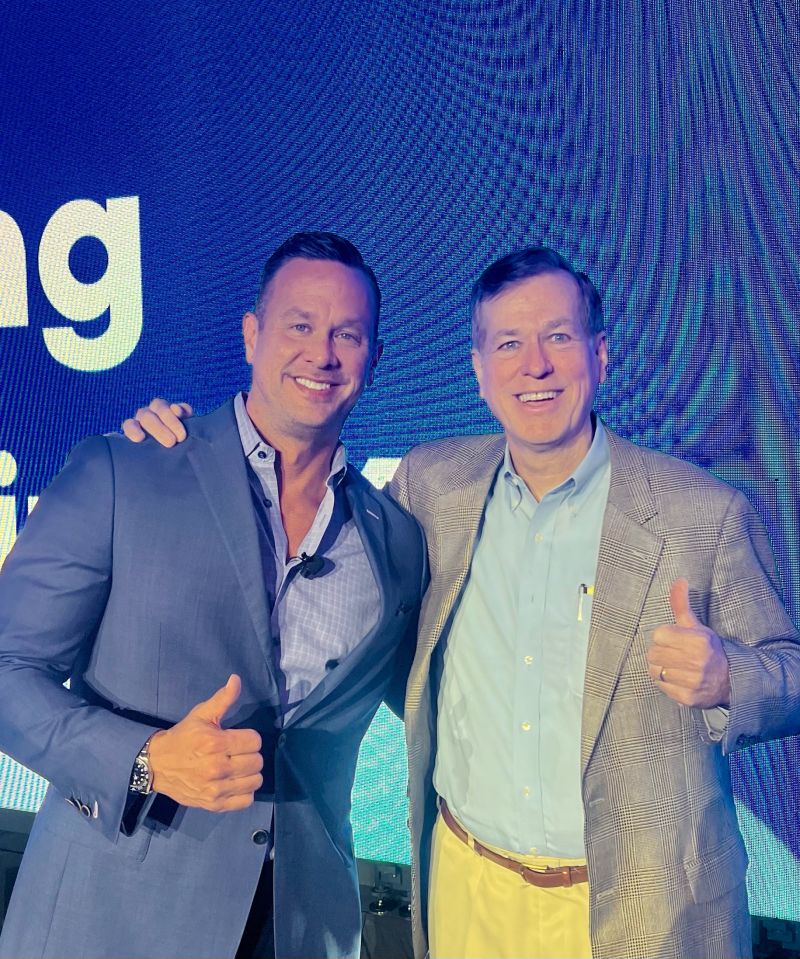
The public version of Otte is animated by other people. He cites the late Jack Henry sales mentor Steve Thompson when talking about looking forward. He calls Kellogg professor Harry Kraemer a favorite teacher and mentor. In 2024, after wanting for years to bring Kraemer to speak with his teammates, Otte finally did. The same event produced a surprise from Bella, the second of his three children, who appeared with a video message while her father and one of his former bosses were onstage. Otte's published reaction was characteristically unguarded: he was still wiping away tears.
Months later, as Hurricane Milton approached Tampa, Otte canceled his flight to Jack Henry's annual client gathering. He wrote about the disappointment, the colleagues who rearranged plans, and the people who offered his family shelter. His instruction to the team was concise: “Don't honor yourself... honor each other.” It is possible to hear the executive message inside the personal one. A culture becomes real when someone else can step into the work and insist that you step away from it.
There is no contradiction between this sentiment and the exactness of his forecasts. Good operators know that numbers become useful only when people trust the way they were assembled. Otte's system combines transparent coverage, common definitions, continuing education, and visible gratitude. The machinery matters. So does the mood around the machinery.
What banks buy
After a quarter-century around financial institutions, Otte's answer seems to be a bundle. Banks buy capability, certainly. They also buy continuity, credible service, institutional fluency, and the confidence that a vendor will remain coherent after the sales team leaves the room. The product lives in code. The relationship lives everywhere else.
His own career has the same construction. The accounting and MIS training made the numbers legible. Audit made risk tangible. The startup made customers urgent. International work widened the frame. Community institutions supplied the affection. Jack Henry gave those pieces a common operating language.
The Accordion is still a useful final image. Expand for the market. Compress for the moment. Keep the rhythm consistent enough that everyone else knows where the song is going.