The coffee was hot when Brian Imawan bought it. By the time he got back to the office, it was cold. His workplace was in Kuningan, Jakarta, and getting a cup meant walking to a shop three buildings away. A modest journey, perhaps, until it became part of the working day. Convenience has a way of looking rather less convenient when you have to carry it back yourself.
Brian’s response was a question for his employer: could the office have a coffee machine if employees paid for their own drinks? The company would not have to buy everyone coffee. It would simply make room for the machine. Permission came, colleagues tried it, and an everyday irritation began to look like a business. He dates the idea to 2016 in his account of those early days.
That little negotiation contains much of the later JumpStart model. Find a place where people already spend time. Put something useful within reach. Make participation easy for the host. Then see whether customers actually buy. There is a pleasing lack of ceremony about the beginning. Before the thousands of machines, there was an employee asking whether he could make his morning slightly less inconvenient.
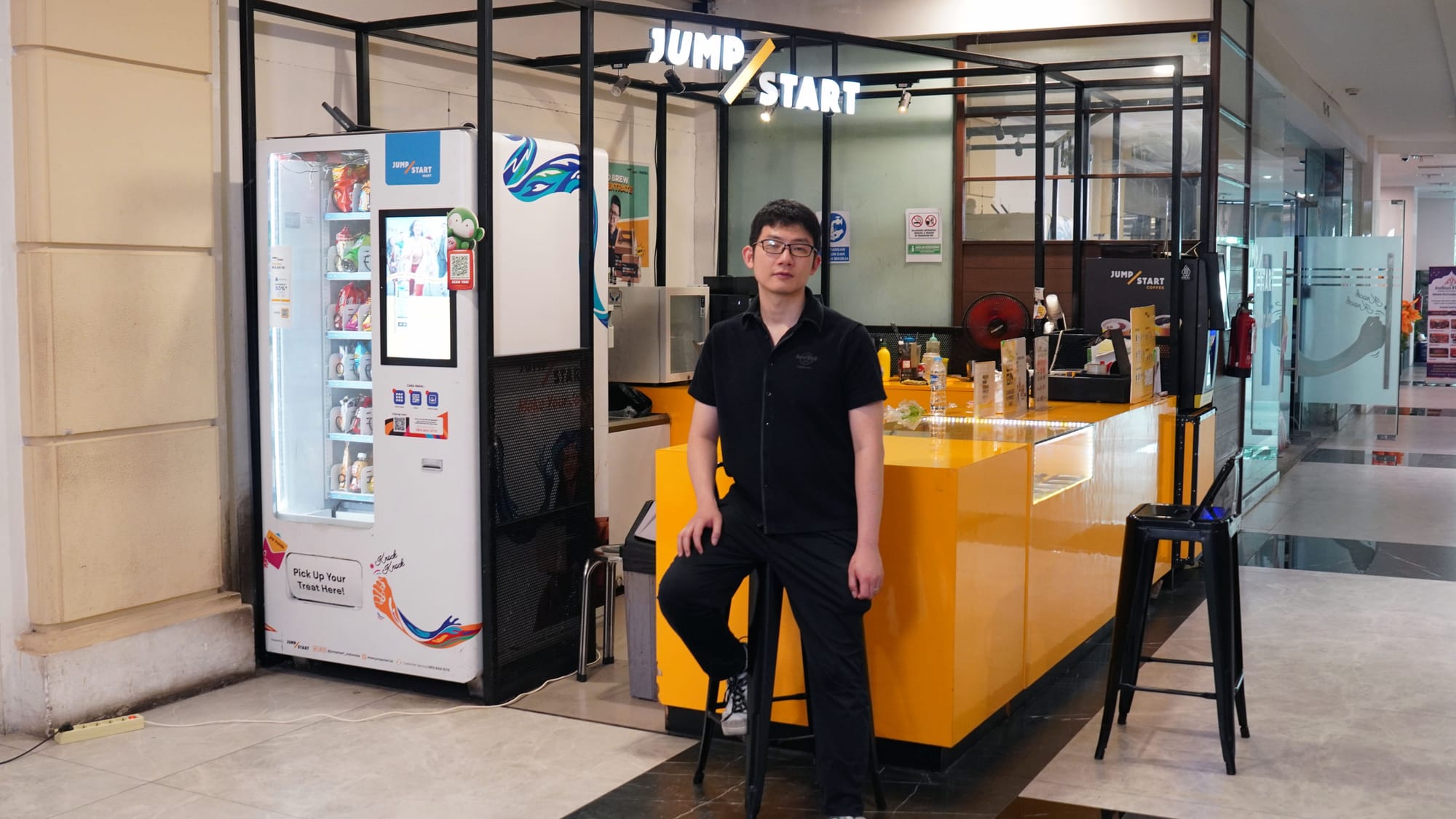
A law graduate learns the machinery
Brian arrived at entrepreneurship with a background in law and a family of businesspeople. Before JumpStart, he worked as a national business analyst for Semen Merah Putih. Neither a legal education nor an analyst’s title would refill a coffee machine for him. The new venture required a practical apprenticeship, with water containers among the teaching materials.
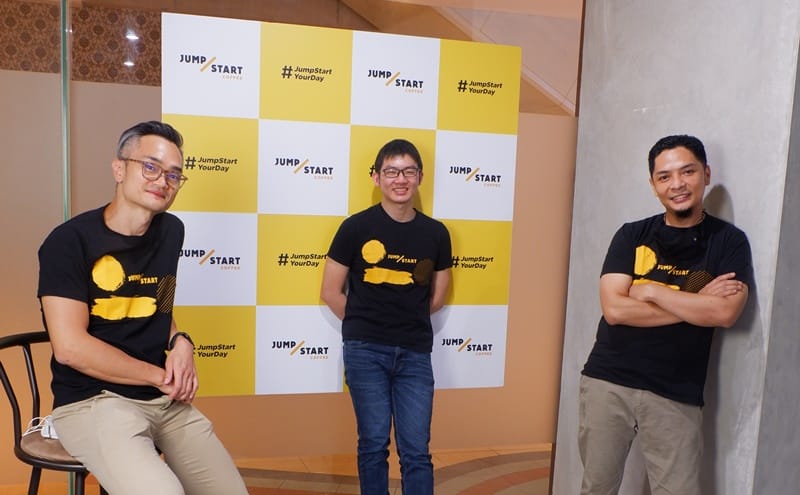
He and his fellow founders financed the beginnings themselves. Brian took responsibility for the business as CEO, while his partners handled operations and coffee quality. In 2018 they invested in imported machines, developing the software locally. The division of work was quite concrete: keeping the company running, keeping supplies moving, and keeping the drink worth buying. An unattended sale still required plenty of attention.
The taste needed work before the rollout. Brian has described six months of initial research and development to get the coffee right. A customer approaching a machine would judge the contents of the cup, regardless of the ingenuity inside the cabinet. That made recipe development part of the business from the beginning, alongside the machinery. Being easy to find would get the first sale; the drink had to earn the next one.
The hands-on education continued after installation. Brian recalls carrying water containers, refilling machines and learning their settings himself. Early customers sometimes needed someone beside the equipment to explain how it worked. A self-service venture had acquired a rather sociable founder’s job: stand nearby, answer questions, and make sure the supposedly simple purchase was simple for the person attempting it.
The customer who thought it was a television
Some people looked at a JumpStart machine and thought it was a television or a decorative object. Brian has repeated the anecdote in interviews, and it is a useful corrective to the idea that a bright screen explains itself. A cabinet can be obvious to its designer and mysterious to everybody else. The first task was getting people to recognise a shop in an unfamiliar shape.
There were also doubts from offices considering an installation. Would people understand it? Would the coffee stay consistent? Brian’s early approach included being there himself while a new machine settled into use. He asked customers what they thought of the drink and whether anything needed changing. Those conversations were part of selling the service. The machine might dispense automatically, but confidence had to be acquired person by person.
He pitched the equipment as a facility for the building. That description makes the usefulness easy to picture: an employee working late can buy something without leaving the premises. The host provides space and electricity; JumpStart evaluates the location and manages the machines. In the partnership model Brian outlined in 2022, installation did not require a fee from the host. The arrangement began with an assessment, rather than a promise to put a machine anywhere.
Payment created its own small dramas. Creased banknotes could cause trouble with the early cash system. Digital payments gave the company another way to complete a sale, and Brian worked with payment providers as QR transactions developed. The lesson is wonderfully prosaic. A business can have a persuasive idea and still lose a customer to a crumpled note. Sometimes progress consists of removing one very specific nuisance.
What happens after the cup drops
Brian describes brewing coffee as a process with several variables: the dose, the grind, pressure and water temperature all matter. JumpStart’s machines use coffee beans and prepare the drink after it is ordered. His pitch has been an affordable, freshly brewed cup available quickly. The mechanical part is visible to the buyer only for a moment, but getting that moment right involves decisions made long before the order.
In 2023 he described internet-connected equipment that let the team check stocks and oversee preparation. He also described scheduled visits to clean and replenish the machines. This is where the attractive simplicity of the purchase meets the less photogenic business of maintenance. A cup arrives in under a minute; ingredients and staff have to arrive on an entirely different timetable.
The operating system became a central part of expansion. Sales data could be collected in real time, inventory needs predicted, and inspection and refill routes planned automatically. Those functions tie the customer’s purchase to the next visit by a member of the team. The intelligence in the operation concerns ordinary questions: what is running low, where is it, and how should someone get there?
That helps explain why Brian’s account of the company keeps returning to practical work. A growing network multiplies the places where supplies and demand have to meet. The apparent stillness of a vending machine conceals an organisation in motion. For someone buying a coffee, the whole arrangement should be pleasantly forgettable. For the person running it, forgetting the arrangement would be a considerable mistake.
The machine has a support crew
- 01Buy a drinkA transaction updates the machine’s sales information.
- 02Check the stockInventory data helps predict replenishment needs.
- 03Plan the visitRouting supports inspection and refill work.
- 04Keep it readyThe team supplies and maintains the machine.
A small shop with room for other people
Brian’s ambitions widened beyond coffee. He wanted people to seek out a vending machine as a retail destination, with products they were curious to try. That opened the cabinet to other businesses. Snacks, packaged drinks and goods from Indonesian small enterprises could share the distribution network. A machine could be a place to encounter something unfamiliar, rather than merely the nearest answer to thirst.
For small sellers, the offer included a shared collection hub, distribution, sales information and stock forecasting. They could reach buyers in established locations without staffing a separate store at each one. Brian has said suppliers could send products to JumpStart’s warehouse and let the company organise the onward journey. His interest was in the retailer’s role: choose useful products, make them accessible, and handle the work between supplier and customer.
In 2023, JumpStart’s end-to-end retail platform received the Indonesia Technology Excellence Award for Smart Technology - Retail at the Asian Technology Excellence Awards. The recognition concerned the company’s work helping small enterprises distribute products and manage sales. It belongs to the organisation and its team. For Brian’s story, its significance is the distance travelled from a personal coffee problem to infrastructure other businesses could use.
Japanese products became another part of that infrastructure. Cool Japan Fund invested in 2023 to support distribution of Japanese beverages, confectionery and snacks in Indonesia. The original office machine now sat within a larger commercial proposition: a network of small retail points could help manufacturers reach consumers. Brian’s coffee break had acquired neighbours on the shelf.
Keep the experiments small
Brian has a terse instruction for founders: “be paranoid.” He uses it in the context of anticipating problems and taking responsibility for the people aboard the business. His metaphor is a ship, with the founder obliged to think about the waters ahead. The phrase sounds severe; the responsibility behind it is more specific. Recruitment creates obligations, and a founder’s optimism does not pay those obligations by itself.
He has described a working culture where employees can suggest ideas and try them on a small budget, with coordination and results deciding what happens next. There is room for curiosity, followed by a reckoning with the data. That combination suits a business in which a new feature eventually has to survive the mundane test of someone buying a drink from it.
His scepticism about spending for its own sake also appeared in a 2019 opinion piece he wrote about startups and aggressive cash burn. The warning was about chasing market share and gross merchandise value through unsustainable expenditure. Read alongside his approach to limited experiments, it suggests a consistent interest in the economics behind growth. Brian wants the enterprise to expand, while asking what the expansion actually costs.
“Be paranoid.”
Brian Imawan, on anticipating business risks
The office idea comes home
In October 2024, JumpStart introduced NOD, short for Never Ordinary Device, bringing its ambitions into the home. The capsule machine could prepare coffee and other drinks, including tea and ginger beverages. Its product development began with a familiar kind of request: could the experience people enjoyed from JumpStart’s larger machines be made available at home?
The home setting required a broader menu. A household contains people with different preferences, and Brian’s team developed drinks beyond coffee. NOD’s launch included 13 varieties, while collaborations brought local coffee roasters and other beverage partners into the range. The move extended his original instinct about proximity. Once the office became a place to buy a drink, the kitchen became the next place to consider.
JumpStart also worked with Mortier on recycling used capsules into household objects. Another collaboration, with designer Hian Tjen, produced a dress using recycled NOD capsules. Coffee equipment rarely gets a wardrobe credit. Here the capsule’s life after brewing became part of the launch, a reminder that moving into consumers’ homes brings new questions about the things a product leaves behind.
The next three buildings
By October 2024, JumpStart reported about 4,000 vending machines. Cool Japan Fund’s subsequent investment announcement put the network above 6,400 installed units at the end of December 2025. Its April 2026 release confirmed additional growth capital. Those dated figures describe an operating network, distinct from the bigger numbers Brian has discussed as future goals.
More places to stop for a cup
In June 2026, he spoke about international expansion and an ambition to take the company public in 2029. Both remain plans. The route abroad he discussed included partners for locally produced capsule machines, with Indonesian drinks among the products he wanted to introduce. His practical problem has grown more complicated, but the question of where a customer can conveniently get a drink remains recognisable.
There is something appealing about an origin that can be measured in buildings. Brian did not need to imagine a distant customer before meeting the first one. He was carrying the cup. The business that followed required partners, software, recipes, routes and people prepared to explain a machine. Its beginning still fits into a morning: a walk too far, a drink cooling on the way back, and a request for room in the office.