Darius Cheung already ran a property search company when a landlord refused to rent an apartment to him and his wife. The objection was his wife’s ethnicity. Roshni Mahtani is Indian. The couple found another place, but the experience left a question that a listings business could hardly avoid: what use is a good search if the door closes when the landlord learns who you are?
This happened after 99.co’s founding, a detail that matters. The episode gave an existing business a more personal reason to confront an old problem. Cheung had entered property technology to make a cumbersome market easier to understand. Now the obstacle was painfully plain. An apartment could satisfy a family’s requirements while its owner decided the family did not satisfy his.
In 2016, 99.co launched its Regardless of Race campaign. Inclusive listings could identify themselves, and the platform would give them greater visibility. By 2021, Cheung described a broader Diversity Friendly option and the removal of discriminatory listings. These were practical decisions about how a marketplace should behave. They also made a fairly pointed statement about what counted as a useful result.
Before the house, a missing phone
Cheung was born in Hong Kong and moved to Singapore to study. His education at the National University of Singapore put engineering alongside a growing fascination with entrepreneurship. Through the NUS Overseas Colleges programme, he spent a year at a startup in Silicon Valley. The attraction was partly cultural: people seemed to enjoy turning up for work. That struck him as a reasonable thing to want for himself and his colleagues.
After university, he worked at a local technology design company. He liked the people. Projecting the job five years into the future was less appealing. Starting a business offered a riskier answer to the question of what to do next, but at least it was an answer he wanted to investigate.
The first business, tenCube, began in 2005. A co-founder’s lost Nokia phone supplied a particularly direct product brief. Phones were becoming repositories of personal information, and losing the object meant losing control of what it contained. WaveSecure let users locate, lock, back up and wipe devices remotely. It was an unglamorous fear with an unusually clear software response.
By July 2010, McAfee had announced an agreement to acquire tenCube. Its announcement laid out why the technology mattered: WaveSecure could join a broader collection of security and device-management products. A Singapore startup’s work would reach users through a much larger organisation. The acquisition followed five years of building the business, rather than arriving as a reward for an appealing pitch deck.
- 2005Co-founds tenCube
Mobile security - 2010McAfee acquires tenCube
A new chapter - 2014Co-founds 99.co
Property search
The milestone nobody celebrated
The version of a founder’s life told through acquisition announcements skips a lot of useful evidence. Cheung’s favourite moment from tenCube was quieter. Asked about his best startup experience, he chose the day the company broke even. There was no office eruption. Business continued, and he doubted the team even knew that month had crossed the line.
That preference is revealing. Breaking even means a company has begun paying its own way. It offers a kind of independence that a flattering valuation cannot deliver. In Cheung’s telling, the achievement was worth enjoying without interrupting the work that produced it. A celebration might have required somebody to stop shipping things.
Funding had hardly been effortless. In a 2015 account of tenCube’s early years, he recalled meeting roughly 50 investors; only five could write cheques of the size the company sought. The business spent 18 months trying to raise capital before obtaining informal seed support and, later, a formal seed round. That history lends some weight to his later advice that founders should concentrate on customers and product rather than treat fundraising as the main occupation.
He also resisted the grand mythology of the solitary founder. In one self-deprecating explanation, he cast himself as the stone in stone soup: the apparently inadequate ingredient around which other people assemble something worthwhile. His description leaves plenty of room for talent, persuasion and the contributions of everyone else. It is a useful corrective to the photograph of one person standing beside the company name.
“This too shall pass”.
A favourite saying of Darius Cheung
A second act with duplicate listings
After tenCube, Cheung became an angel investor, backing businesses including Carousell. He also tried BillPin, a bill-sharing application that was eventually shut down. A successful sale had given him experience and room to try again; it had not supplied a permanent exemption from products that failed to find their place.
Property search offered an irritation he understood from several directions. He had rented, bought a home and dealt with the market as a landlord. Listings could be duplicated, information could conflict, and the gap between a description and an actual property could be substantial. Searching was laborious precisely where the consequences of a poor decision were expensive.
In 2014, he co-founded 99.co. The company’s early backing included Eduardo Saverin, Sequoia Capital and East Ventures. The interesting question was what the site would do with a person’s attention. A property portal has two constituencies: the people searching for homes, and the professionals paying to reach them. Their interests overlap without becoming identical.
Cheung argued that ranking should reward what helped the searcher. Better photographs and more useful information deserved attention. In his early explanation of the model, paying more should not automatically buy the best position. The principle makes the search box a place where the business must make choices about whom it serves, every time it presents a page of results.
An editorial map of the problems running through Cheung’s property work.
The map gets bigger
The company entered Indonesia in 2016. Expansion made the familiar startup instruction to “scale” sound rather more complicated. Property markets depend on local practices, regulation, supply and the people who actually know a neighbourhood. A successful product in Singapore could provide experience; it could not substitute for learning another country.
In 2018, 99.co acquired UrbanIndo, which became 99.co Indonesia. Rumah123 subsequently joined the group, and the acquisition of SRX added a Singapore property-data business. The company’s February 2026 account describes its present brands as 99.co and SRX in Singapore, with 99.co/id and Rumah123 in Indonesia. That is a specific regional footprint, assembled over years.
The institutional backing grew too. In 2022, Gaw Capital Partners led a US$37 million Series C first close. A further US$11 million extension followed in March 2023, co-led by Gaw Capital and OCBC NISP Ventura. Those rounds brought a real-estate investment firm and a bank-linked investor into the financing story of a business that had begun with online search.
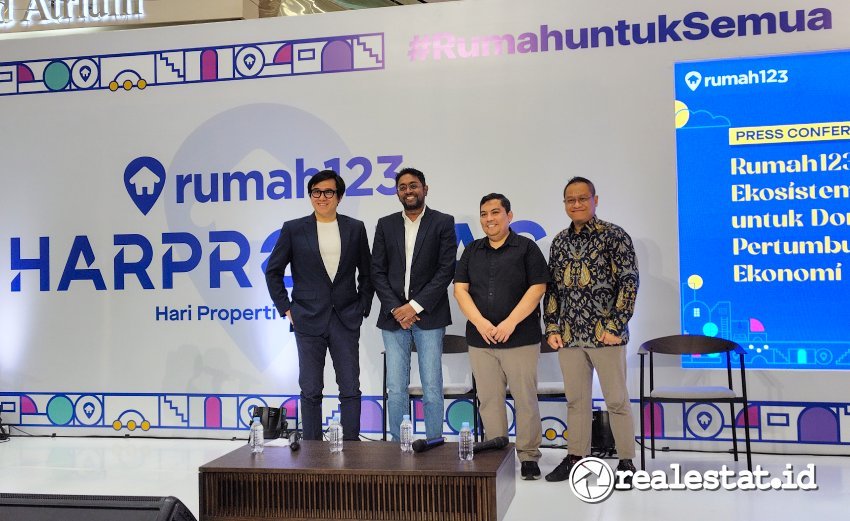
Cheung is now based in Jakarta. The move gives the regional story a human geography: the founder associated with Singapore’s startup scene is working from the other major market his group serves. At the September 2025 Harpropnas property festival in Jakarta, he appeared alongside Rumah123 and industry partners. A search business had become an organisation whose work also involved getting people into the same room.
An engineer’s job advertisement
For a less ceremonial view of Cheung, consider a job advertisement he wrote in 2015. He was looking for an executive assistant. The tasks ranged from meeting briefs and investor scheduling to travel, research and helping him get food. The list possessed the untidy honesty of an actual working day. Even a chief executive with a mission still has to eat.
He did not insist on an elite university degree or a particular technical background. He asked for independence, observation, empathy, discretion and the ability to summarise information. He offered a view into decisions, successes and failures, and a chance to learn how a company grows. The advertisement treated the person organising his time as someone close to the substance of the business.
That emphasis has an echo in a former intern’s account of joining 99.co. Chan Li Shing remembered arriving during a weekly scrum meeting and being waved in by Cheung, loudly and cheerfully. Her description of working with him centred on mentorship and company values. It is a small scene, but small scenes are often where a workplace’s stated principles acquire their first practical test.
There is humour in his public persona too. Asked to disclose a startup secret, he confessed to watching the first season of Glee and pleaded duress. It is an admirably modest scandal for a technology founder. His public writing, meanwhile, includes a university commencement speech filed under the title “Thoughts shared in a funny hat”. The academic gown apparently survived the encounter.
The search continues after the listing
His ambitions for property technology extend beyond making the listings page easier to use. In a 2022 interview, he discussed helping people who could not yet access home ownership and working with financial institutions to address affordability. A better catalogue can help someone compare homes. Financing determines whether the comparison leads anywhere.
In June 2026, Rumah123 and Bank Tabungan Negara strengthened a partnership connecting property search and mortgage support. Cheung shared the announcement publicly. The collaboration included mortgage-readiness tools and help with financing applications through Rumah123, alongside listings available through BTN’s digital platform. It is a concrete example of the wider journey he had described years earlier.
The ambition comes with a slower clock than software usually prefers. People rarely buy homes, and decisions involve money, family and a place in which to live. That gives product improvements a different cadence from an application opened casually several times a day. Cheung has described having the patience, as a repeat founder, to work with the industry’s pace.
The closed apartment door remains a useful way into his story because it reveals the distance between information and access. Cheung has spent his career building tools that return some control to their users: first over a missing phone, then over the search for somewhere to live. The next result still has to be better. More accurate. More useful. And, when the prospective tenant arrives, actually available.
Follow the conversation
Find Cheung on LinkedIn and Medium. Explore 99.co, Rumah123 and SRX.
Watch: starting 99.coBytepushers · interview seriesWatch: long-term views · Listen: startup lessons