The first useful customer for a sauce company might be someone who never buys a bottle. Consider Veeba. Before it appeared in home kitchens, the business had to persuade restaurant chains that its sauces belonged in theirs. A purchase order could test things an advertisement could only promise: flavour, consistency, and the ability to deliver again. For founder Viraj Bahl, that distinction mattered. His previous business had already given him an education in what happens when customers do not come back.
- Veeba began with restaurant supply, then entered consumer retail.
- Its advantage combines flavour development, manufacturing and shop distribution.
- VRB is extending that machinery into noodles and beverages.
01 The customer behind the counter
Bahl had grown up around Fun Foods, the family business sold to Dr. Oetker in 2008. Food manufacturing was familiar territory. Running restaurants turned out to be another matter. His Pocketful venture failed, and Veeba followed in 2013. The restaurant experience had exposed a practical irritation: he wanted a wider choice of sauces than the Indian market readily offered. A problem inside his own kitchen became a possible business outside it.
Starting again meant putting personal money at risk. Bahl sold a house to help fund the venture, a decision he later described as naive. In a 2025 public discussion, his advice to aspiring founders was blunt: “please don’t sell your house.” The story is memorable precisely because its protagonist no longer recommends the dramatic bit.
Veeba built its own manufacturing rather than leaving the product entirely to an outside producer. That offered control over formulation and quality, while demanding money and internal processes before demand was assured. The early business was difficult. Then came Domino’s, repeatedly identified in Bahl’s accounts as the first major institutional customer. Burger King and other restaurant groups followed. These buyers needed a dependable ingredient, supplied repeatedly at commercial scale.
For a household cook, a sauce can rescue lunch. For a restaurant chain, it has to work across many lunches, made by many people. Veeba’s early test was therefore unusually concrete. Could a young supplier turn a recipe into a repeatable operation? Institutional orders gave it a way to answer.
“The right expense at the right time”Viraj Bahl on the lesson of his restaurant failure
02 A bottle is a small cooking lesson
Veeba entered retail in 2015, according to a contemporary company profile. Its present catalogue makes the proposition easy to understand: Sweet Onion, Chipotle Southwest, Honey Mustard, mayonnaise, salsa, pasta sauces, sandwich spreads, peanut butter and dessert toppings. The company sells a collection of shortcuts. A familiar meal can acquire a different flavour without the cook assembling every ingredient from scratch.
That solves different problems for different customers. Someone making sandwiches wants variety with little preparation. A household cooking pasta wants a ready sauce. A professional kitchen wants repeatable taste and reliable supply. The same manufacturing expertise can serve those needs, even though a restaurant contract and a supermarket bottle require different selling methods.
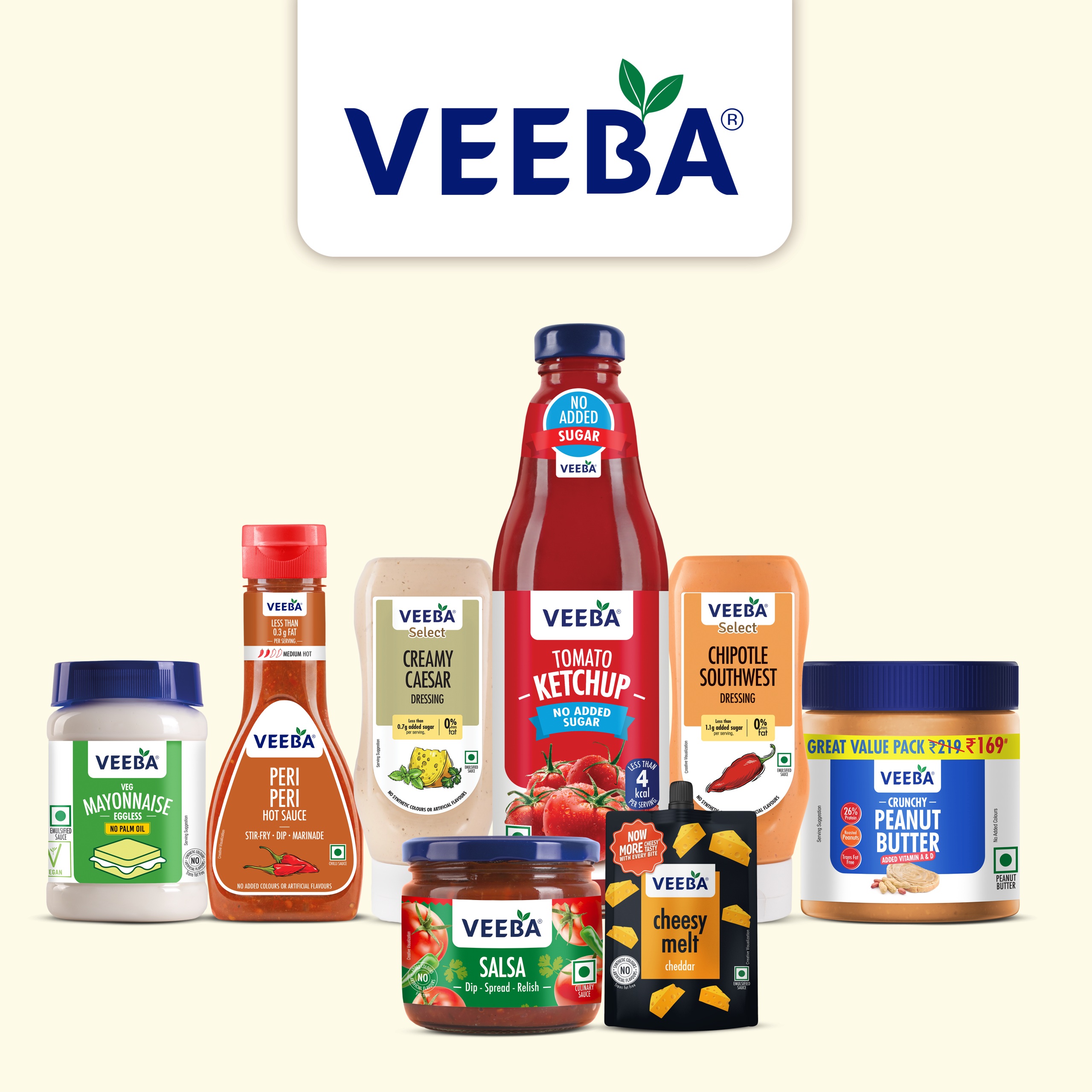
Veeba’s position is clearest beside alternatives such as FunFoods, Kissan and Maggi sauces. It competes in familiar categories while offering dressings and flavour combinations that encourage experimentation. Selected products advertise features such as no added sugar or no added preservatives. Those claims belong to individual formulations. The useful question for a buyer remains what is in this particular bottle, and whether it suits the meal.
03 The shopkeeper gets a vote
A flavour can win a tasting and still lose on a shelf. In an investor-hosted conversation, Bahl recalled an early ketchup launch with poor packaging and an excessive price premium. He had entered a large, established category too soon. An early promotional contest was equally instructive: Veeba offered an 8% scheme; a competitor countered with 16.67%. Competing through richer trade offers was an expensive education.
His response was to focus on retailer service and manageable inventory. Smaller quantities that sell through can earn more trust than a large display that sits untouched. It is a lesson a founder can copy without owning a sauce factory: learn what happens after delivery. The retailer’s next order tells you something the first shipment cannot.
The network became substantial. A March 2024 founder interview reported almost 200,000 points of sale across 700 cities. This is where Veeba fits in the market: a packaged-food manufacturer with broad physical distribution and an online storefront. Getting a product into reach of ordinary shoppers is part of the product’s usefulness.
There is software behind the shelf, too. FieldAssist’s published Veeba case study describes automated claims and distribution management, with faster settlements and fewer returns. That is a reminder of the less visible work in consumer goods: getting orders, stock and money to agree across a network of independent businesses.
04 The bill for a bigger menu
The business model carries physical costs. Ingredients, production, packaging, inventory and delivery all precede the moment someone opens a jar. In October 2016, Veeba raised about ₹40 crore in a Series B led by Saama Capital and Verlinvest. The stated uses were manufacturing infrastructure, distribution and marketing. The money bought the ability to make and move more food.
WokTok made the next expansion bill visible. At its October 2024 launch, VRB described a roughly ₹50 crore investment plan: ₹15-20 crore already spent on additional production lines, and ₹25-30 crore planned for marketing that financial year. The range included Chinese and Pan-Asian sauces and five instant cup noodles. Those numbers describe a launch programme, not a guaranteed return.
Additional production lines + planned marketing
Lines already installed₹25-30 cr
Marketing planned
The condition matters. An existing distribution network helps when its shops and shoppers want the new category. It cannot make an unwanted product rotate. Factory ownership also requires enough demand to justify capacity. Veeba’s own early difficulties show why another founder would need patient capital, product knowledge and credible buyers before copying the sequence.
05 The next aisle is already open
By FY2025, published financial datasets put annual operating revenue at roughly ₹1,000 crore. Veeba had become the flagship of VRB Consumer Products, alongside other food brands. In March 2026, VRB and musician Karan Aujla launched Zyro, marketed as zero-sugar, zero-calorie beverages. The parent was moving further beyond the sauce aisle.

That changes the founder’s work. Bahl has spoken about learning to delegate to domain experts; VRB describes a culture of agility, cohesion and humility. The next bottle can borrow a factory and a sales route. Earning a place in someone’s daily routine takes longer. Veeba’s story keeps returning to that ordinary, stubborn test: will the customer want another?