The Jakarta company that turned a single self-serve coffee machine into the country's largest network of smart, AI-enabled vending - and, increasingly, a distribution channel for global brands.
In 2018, Brian Imawan had an ordinary complaint. Working in Jakarta's Kuningan business district, he found it oddly hard to get a decent cup of coffee near the office. Most people would have grumbled and moved on. Imawan built a machine instead - and then he built a company around it, registering PT Muara Juara Kreasi Indonesia and installing what JumpStart describes as the first smart coffee machine in the country.
Seven years later, that single unit has multiplied into more than 6,500 machines spread across Jakarta, Bandung and Surabaya. JumpStart is now, by its own account and by the reckoning of regional trade press, the largest vending operator in Indonesia. The coffee is still there - roughly 20 hot and iced drinks starting at about Rp 15,000, poured in under a minute - but it is no longer the whole story.
What JumpStart actually sells is convenience at the moment it is wanted: the 30 seconds between craving a coffee and giving up on one. The machines are cashless and contactless, open around the clock, and quietly running software that watches sales and manages stock. The corner store, in other words, without the corner or the store.
That framing - platform, not product - is the thread that runs through everything the company has done since. Coffee was the wedge. What came after was the business.
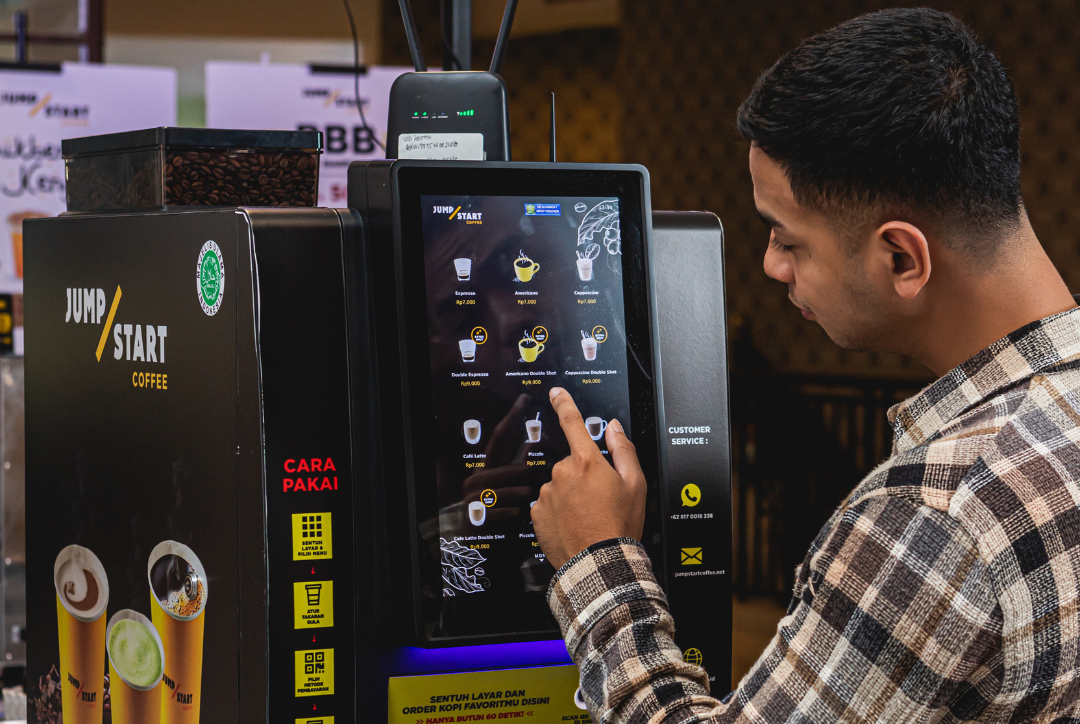
JumpStart designs, deploys and operates its own fleet of automated retail machines. Where it began with self-serve coffee, the lineup now spans smart marts for snacks and merchandise, beverage-capsule dispensers, juice and ice cream machines, and even gamified and mystery-box formats stocked with Japanese products.
Who uses it. Office workers, commuters and shoppers on one side; corporate offices, retail sites and event organizers hosting the machines on the other; and consumer brands - especially Japanese ones - using the network to reach Indonesian buyers. The company has said it wants direct consumer sales to make up roughly 80% of revenue.
The problem it solves. Physical retail in a sprawling, traffic-heavy country is expensive and time-bound. A JumpStart machine has no cashier, no fixed hours and a fraction of a storefront's footprint - so it can sit where a shop can't and stay open when a shop won't.
Figures reflect publicly reported milestones; bar widths are illustrative, not exact counts.
Self-serve, AI-enabled coffee - around 20 hot and iced drinks in under a minute, cashless and contactless. Indonesia's first, by the company's account.
Multi-category vending for snacks, beverages, beauty products and merchandise, with software tracking sales and stock.
Capsule-based dispensers offering a wider range of drinks.
A smaller-footprint machine built to fit tighter spaces such as small offices and shops.
Compact to-go selections combining multiple machine formats in one location.
Short-term rental of coffee and vending machines for events, activations and pop-ups.
With 6,500+ machines, JumpStart's density gives it reach that a coffee chain would take far longer and far more capital to match.
Every transaction is a data point on what a neighborhood wants and when - inventory management and demand sensing built in.
The network doubles as a shelf for global brands, with Japanese products a deliberate focus via Cool Japan Fund.
Smart marts, juice, ice cream, capsules and gamified formats let one operator serve many cravings from similar hardware.
The alternatives are familiar: minimarkets and cafe chains, plus a field of regional smart-vending and unattended-retail startups. JumpStart's answer is to be faster and always open than the first, and denser and more platform-minded than the second.
Brian Imawan founds JumpStart and installs what it calls Indonesia's first smart coffee machine, backed by a Series A from GDP Venture.
Raises Series B co-led by Cool Japan Fund and Living Lab Ventures, scaling across Jakarta, Bandung and Surabaya.
Broadens into smart marts, capsules, juice, ice cream and gamified vending, adding JumpStart Outlet and Mini.
Becomes Indonesia's largest vending operator and reports roughly 200% growth in financial performance.
Secures Series C from Cool Japan Fund to expand the AI-enabled network and distribute more Japanese brands.
The model is operator-owned automated retail: JumpStart owns and runs its machines, earning from per-transaction consumer sales, B2B placements, event rentals and brand partnerships that treat the network as a distribution channel. Management has pointed toward growing the consumer share of revenue to around 80%.
The backers have stayed close. GDP Venture led the 2018 Series A. Cool Japan Fund - a Japanese government-backed fund - and Living Lab Ventures co-led the 2023 Series B, and Cool Japan Fund returned for the June 2026 Series C. Repeat investors are, in their way, a review of the execution.
Early backing that put the first smart coffee machines on the ground.
Co-led round to scale the network and prepare for international expansion.
Follow-on to expand AI-enabled vending and broaden Japanese-brand offerings.
It operates Indonesia's largest network of smart, AI-enabled vending and self-serve machines - coffee, snacks, beverages and merchandise - offering cashless, contactless purchases around the clock.
Brian Imawan co-founded the company in 2018 in Jakarta after struggling to find coffee near his office. He serves as CEO.
More than 6,500 machines nationwide by the end of 2025, concentrated in Jakarta, Bandung and Surabaya.
Backers include GDP Venture (Series A), and Cool Japan Fund and Living Lab Ventures (Series B), with Cool Japan Fund returning for the 2026 Series C.
Coffee starts at around Rp 15,000 (about US$1), with roughly 20 hot and iced options served in about a minute.