BREAKING  Robot kitchen cooks fresh ramen in ~60 seconds 150+ machine locations across North America, Japan, Taiwan & South Korea Founder Andy Lin spent 12+ years in semiconductors before automating dinner Investors: Japan Tobacco, Ippudo, Pulmuone Elon Musk in 2018: "Ramen is sooo good" 30+ menu items from a single box, running 24/7 BREAKING  Robot kitchen cooks fresh ramen in ~60 seconds 150+ machine locations across North America, Japan, Taiwan & South Korea Founder Andy Lin spent 12+ years in semiconductors before automating dinner Investors: Japan Tobacco, Ippudo, Pulmuone Elon Musk in 2018: "Ramen is sooo good" 30+ menu items from a single box, running 24/7
Company Profile Food Tech · Robotics · Autonomous Dining Est. 2016 · Hayward, California

The Autonomous Restaurant

Yo-Kai Express

A full restaurant packed into a machine the size of a vending unit - cooking fresh, chef-quality ramen in about a minute, any hour of the day.

Yo-Kai Express logo

The Yo-Kai - a spirit from Japanese folklore said to appear anywhere, anytime. The machines were named to keep that promise: a hot bowl on demand, at 2am, in an empty airport terminal. — on the name

~60s
To Cook a Bowl
150+
Machine Locations
30+
Menu Items
24/7
Always Open

The Story

A semiconductor engineer got hungry, and built a robot

There is a certain kind of problem that only reveals itself at midnight. Andy Lin, who had spent more than a decade in the semiconductor industry, kept running into it: he would be working late, he would get hungry, and there would be nothing to eat. Most American restaurants close by 10pm. What remains is fast food, or nothing. This is not, on its face, a crisis worthy of venture capital. But Lin had spent twelve years watching an industry take something fantastically complicated - etching circuits onto silicon - and turn it into a repeatable, standardized, machine-run process. He looked at a bowl of ramen and thought: this is a much easier problem than a microchip.

That is the whole conceptual leap behind Yo-Kai Express, and it is worth sitting with, because it explains why the company looks the way it does. A restaurant is, from an engineering standpoint, a maddeningly non-standardized thing. Every cook is slightly different. Every service is slightly different. The industry has spent a century trying to systematize this - the McDonald's assembly line is essentially industrial engineering applied to hamburgers - and Yo-Kai's insight is to push that logic to its endpoint. If you standardize the ingredients enough, flash-freeze them at a precise state of doneness, and control the reheating to the degree, you don't need a cook at all. You need a machine. And a machine, conveniently, does not go home at 10pm.

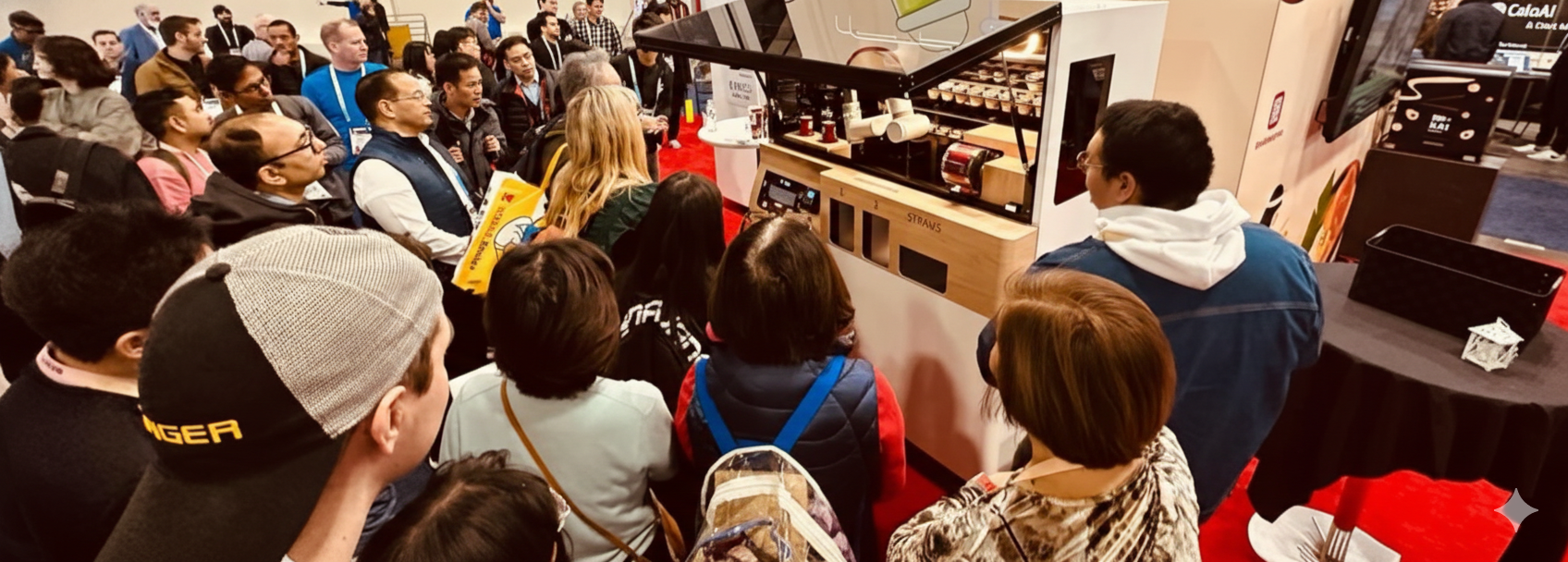
So Yo-Kai Express makes machines. Each one is roughly the size of a large vending machine, but calling it a vending machine is a category error, the way calling a smartphone a telephone is a category error. Inside is what the company describes as a robotic kitchen: patented rapid-heating technology, robotics, IoT sensors, and an AI layer handling inventory and pricing. You tap a screen, and about sixty seconds later a hot bowl of ramen appears - not reheated leftovers, but a bowl assembled and cooked to order from components engineered to survive the freeze-and-fire cycle without turning to mush.

Yo-Kai treats a bowl of ramen the way a fab treats a wafer - standardized inputs, modular steps, precision heat, no improvisation.

The core idea

The freeze-and-fire trick

Ingredients are partially cooked, then flash-frozen. When you order, they are rapid-heated to around 300°C. The hard part was never the robot. It was engineering food that tastes chef-made after a trip through the freezer - which is why R&D moved to Taiwan, for the food science.

What It Does

One box. Thirty-plus dishes. No closing time.

For an operator, a Yo-Kai machine is what the company calls an "upgraded cloud kitchen" - a restaurant that fits where a restaurant can't, staffs itself, and never turns the lights off. Reported machine rentals run around $4,000/month. For the person standing in front of it at an odd hour, it is simply dinner.

FLAGSHIP · 2017

Robotic Ramen Machine

Serves hot ramen with 30+ varieties, including tonkotsu, plant-based, and recipes co-developed with Ippudo. Cooked to order in about a minute.

PLATFORM · 2016

Autonomous Restaurant Kiosk

The self-contained robot kitchen: rapid-heating tech, robotics, and IoT in a single unit that runs 24/7 with no on-site staff.

EXPANSION · 2023

Automated Beverage / Bubble Tea

A newer beverage line. The strategic point isn't the drink - it's that beverages ship at room temperature, cutting expensive cold-chain logistics.

SOFTWARE · 2020

AI Food Management

Dynamic pricing, smart inventory optimization, and remote monitoring across the whole machine network.

Money & Backers

The incumbents became the investors

Here is the pleasing twist. Yo-Kai raised roughly $19 million total, and its Series A came from exactly the companies you'd expect it to disrupt: Japan Tobacco and Ippudo, one of Japan's most famous ramen chains. Rather than compete, they invested - and now co-develop menu items for the machines. Pulmuone, a Korean food giant, used the technology to launch gourmet vending across South Korea. When your would-be competitors want to supply your recipes, you may be building infrastructure rather than a rival.

Total Raised
~$19M
Series A
2022
Early / Seed
2016-21
Japan Tobacco
Series A · TableMark menus
Ippudo
Series A · ramen recipes
Pulmuone
Korea rollout partner
Foodland Ventures
Investor
Plug and Play
Accelerator / investor
Qualcomm ITC
Taiwan challenge

The Road So Far

From a midnight craving to Tokyo Station

2015

The midnight-hunger idea

Andy Lin, frustrated by the absence of hot late-night food, starts prototyping an autonomous cooking machine.

2016

Yo-Kai Express founded

Incorporated in California to build robotic restaurant kiosks.

2017

First ramen machines deployed

Early kiosks appear in Bay Area offices and public spaces, cooking in ~60 seconds.

2018

Elon Musk shout-out

Musk tweets "Ramen is sooo good," handing the young startup a viral moment.

2022

Japan launch & Series A

Debuts at Haneda Airport and Tokyo Station; raises Series A from Japan Tobacco and Ippudo.

2023

Korea & beverages

Pulmuone launches Yo-Kai-powered machines in South Korea as the company moves into bubble tea.

2025

Eyeing public markets

Reports plans for a Nasdaq listing and continued global expansion.

What Makes It Odd

The details that amuse and inform

  • Named after "Yo-Kai," folklore spirits that appear anytime, anywhere - the machines are meant to keep that promise.
  • Founder Andy Lin holds an Electrical Engineering master's from UC Irvine and spent 12+ years in semiconductors.
  • Elon Musk publicly endorsed the ramen with a 2018 tweet - "Ramen is sooo good."
  • Ingredients are flash-frozen partially cooked, then rapid-heated to ~300°C on order.
  • A single kiosk serves 30+ different menu items from one enclosed box.
  • The move into bubble tea is really a logistics play - beverages skip the cold chain.

Partnerships

Who's in the box

Ippudo Investor and menu partner co-developing hakata-style and plant-based tonkotsu ramen.

Japan Tobacco / TableMark Series A backer; TableMark co-develops udon and frozen noodle dishes.

Pulmuone Rolled out Yo-Kai-powered gourmet vending across South Korea.

JR East Japan's largest railway hosts machines at Tokyo Station and transit sites.

Watch

Interviews & demos

Questions

The obvious things people ask

What does Yo-Kai Express actually make?
Autonomous restaurant kiosks - robot kitchens roughly the size of a vending machine that cook fresh hot meals like ramen in about 60-90 seconds, operating 24/7 without staff.
Who founded it, and when?
Andy Lin, a former semiconductor engineer with a master's from UC Irvine, founded the company in California in 2016.
How does the cooking technology work?
Ingredients are partially cooked and flash-frozen, then rapid-heated to around 300°C on demand using patented technology inspired by semiconductor-manufacturing precision.
Where can you find the machines?
In 150+ locations across the US, Japan, Taiwan, and South Korea - typically airports, hospitals, universities, offices, hotels, and transit hubs.
Who has invested in Yo-Kai Express?
Investors include Japan Tobacco, Ippudo (via Chikaranomoto Holdings), Pulmuone, Foodland Ventures, and Plug and Play, totaling roughly $19 million raised.

Find Yo-Kai Express

Links & social

Share this page