Sixteen pitch decks on one flight. Brett Jansen described that burst of production in a podcast conversation about the way she works with AI. The detail has the satisfying absurdity of a business traveler finding a second working week somewhere above the clouds. But a deck is only preparation. The buyer still has to read it, believe it and decide.
That distance between making something and making it useful runs through Jansen’s career. She has sold to large organizations, advised founders and built her own businesses. She now leads Cresera AI Partners as CEO and Chief Growth Officer, with two practices devoted to commercial growth and AI enablement. Her concern is what happens after the clever demonstration, when the person expected to use the technology returns to an ordinary, crowded working day.
The vocabulary around AI tends toward the futuristic. Jansen’s questions are closer to the desk: who owns this task, what information do they need, and where does the work get stuck? There is a certain relief in encountering a technology business that begins by asking what everyone is trying to finish before lunch.
A career that entered through the gym
Jansen’s route into enterprise sales began at Cerner, where she worked as a facilities coordinator at the company’s gym. Executives recruited her into sales. It is an unusual starting point for a career that would later include senior commercial roles at Optum and Butterfly Network. Before she carried a revenue target, she worked in a part of the company where people came and went for quite different reasons.
Across the next sixteen years, her work expanded into sales, marketing, strategy and consulting. She held vice president and chief revenue officer roles, working across established businesses and growing companies. That range matters to the story. A large organization and a young company may buy the same software, but their decisions travel through different people, budgets and expectations.
In November 2021, she began Health Tech House, her go-to-market advisory firm. The work put her alongside founders and executive teams facing specific turning points: preparing to raise money, getting ready for an exit, or trying to restore momentum after early growth had stalled. Her remit included positioning, identifying the right customer, designing the sales operation and preparing an investor narrative that could withstand scrutiny.
She also built brettjansen.ai, an education and executive coaching business whose public employment record begins in January 2024. Cresera now brings the commercial and enablement work into one firm; the advisory work she developed at Health Tech House is moving into Cresera Growth.
Her current career figures separate two accomplishments: more than $175 million in enterprise deals closed, and more than $310 million raised by the companies she has advised. The latter is capital raised by those companies. Keeping the distinction clear is especially appropriate for someone whose methodology begins with proof.
Career figures reported by Jansen and Cresera. Advisory clients span pre-seed through IPO; Cresera also reports two exits among the companies advised.
The buyer still gets a vote
The sales framework Jansen developed is called PLT: Proof, Like, Trust. Its three words are plain enough to remember without a workshop tote bag. They also require different kinds of effort. A buyer needs evidence that an offer will work in their circumstances, a relationship with the people selling it, and confidence that the company will remain dependable.
In a complex sale, those judgments belong to several people. Someone cares about the budget. Someone will have to use the product. Someone else will answer for the result. Jansen’s Growth practice maps the buyers and the evidence each needs, then connects that understanding to the team’s sales process.
The PLT Engine is the application Cresera builds to run the methodology. It gathers market research, buyer maps and a proof library, then supports close plans and deal coaching. Managers and representatives get a place to work through active deals together. There is also a commission calculator, a reminder that even a discussion of trust eventually encounters a spreadsheet.
Jansen’s earlier advisory work made room for investor readiness as well as customer acquisition. The connection is straightforward: a founder needs to explain whom the business serves, why that customer should care and how the company intends to grow. A narrative that sounds persuasive in a meeting still has to hold together when someone examines its assumptions.
AI makes assembling research and drafting materials faster. PLT gives that activity a commercial purpose. The sixteen decks from the flight are interesting because production has become easier; the harder question concerns what each deck enables the person receiving it to understand.
Proof
Evidence that fits the buyer’s situation.
Like
A relationship with the people doing the work.
Trust
Confidence in the company’s ability to deliver.
A job description for the software
The other part of Cresera, Enablement, applies a similar attention to the people inside an organization. It starts by inventorying workflows, mapping roles and decisions, and planning for adoption. Jansen’s position is that buying a license leaves most of the practical questions unanswered. A team still needs to know what to hand over, what to retain and how to judge the result.
Her writing supplies a useful example. Asking AI to help with sales leaves the assignment loose. Turning a discovery call into a proposal draft and a follow-up plan gives the software a bounded job. A manager can then examine whether the draft includes the customer’s problem, appropriate pricing language, supporting evidence and next steps.
One of her questions asks the team to describe what the process should produce. It pulls attention toward the finished work. If five employees use a workflow, she wants five outputs that meet the same standard. That is a teaching problem as much as a software problem.
Jansen also treats company context as something that must be supplied deliberately. Previous proposals, examples of strong work, customer concerns and internal standards help establish what a useful response looks like. “AI needs onboarding,” she writes. The comparison has a pleasingly ordinary logic: a new colleague would need those materials too.
Her Enablement engagements include courses completed before the first live session, followed by training against the team’s actual work. The Academy and community continue beyond the engagement. That sequence gives the live time a practical purpose: people arrive able to operate the tool, then work on the process they need it to support.
“Give AI a job before you give it another subscription.”
Brett Jansen
- 01Define the jobName the recurring task.
- 02Supply the contextExamples, information and standards.
- 03Review the outputKeep a person accountable.
- 04Measure the changeCompare the work before and after.
Follow the hours all the way home
Jansen’s treatment of return on investment starts with a second question after the first apparent success. If a process saves time, what happens to that time? A faster proposal might let a salesperson respond sooner. A simpler reporting process might free a finance team for analysis. The economic result depends on what the organization does with the capacity.
“What changed in the economics of the business?” she asks in her writing on AI returns. Her method begins with a baseline: how long a task takes, how many people touch it, what it costs, how often it happens and what goes wrong when it is late. The baseline gives an improvement something to be compared with.
Cresera publishes an example involving the finance team at an established food products company. Its work included workflow interviews, role-specific AI processes, custom Projects and prompt libraries for reporting and analysis. The company’s finance leader estimated $300,000 in avoided hiring. The qualification belongs beside the number: this is an estimate of hiring avoided.
That example makes Jansen’s commercial background visible in her AI work. She wants a result that can be explained in the language of the business. The four areas Cresera names are growth, time, decisions and innovation. Cost reduction is one possible outcome; additional capacity and better decisions also count.
Her review process allows for a less glamorous ending, too. A useful workflow can expand. An imperfect one can be improved. A process that consumes attention without producing a meaningful result can be stopped. Software deserves a performance review. Preferably before it invites everyone to another meeting.
Estimated avoided hiring at a food products company, according to its finance leader.
Client estimate published by Cresera; a business result, not a guaranteed return.A microphone, caffeine and the next question
There is a more public version of the same work in Prompting Revenue, Jansen’s podcast. She announced it with a short inventory for an upcoming conference: a microphone, caffeine and a camera if the setting allowed. She wanted conversations with operators and investors about revenue, AI and the operational details that usually receive less stage time.
The show now covers AI news, company spotlights and reusable workflows. Its October 7, 2026 episode returned to the difficulty of demonstrating AI’s return in revenue operations. The recurring subject is accountability: someone owns a target, a budget or a team, and needs information they can act on.
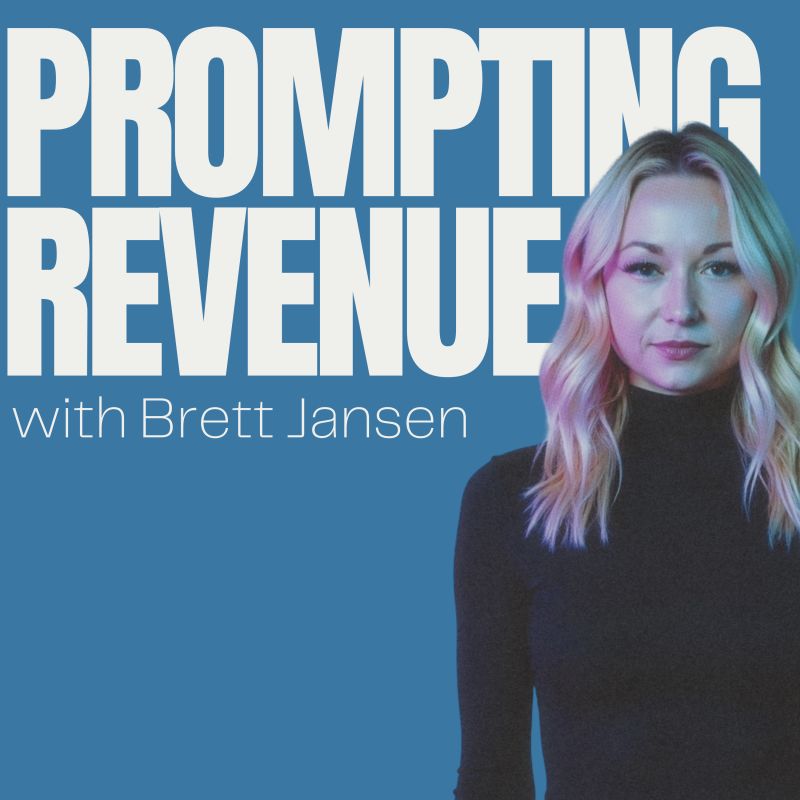
Her teaching also extends to mentoring; she has a public marketing mentor profile. Earlier, she spent several years with Friends of Art at the Nelson-Atkins Museum of Art. It is a small detail beyond the sales figures, and a welcome one. A career can be organized around revenue without containing only revenue.
At Cresera, Jansen and the firm’s senior operators retain the client relationship while AI architects and project managers support the build. Her stated philosophy puts research and orchestration with AI while people keep judgment, relationships and the final call. It is a division of labor shaped by someone who has spent years answering for commercial results.
The flight full of pitch decks captures the new speed. The rest of her work asks what that speed is for. A person still has to decide which buyer matters, which evidence holds up and whether the proposal deserves to be sent. The plane lands. There is a conversation to have.