Brendan Manley was playing a game on the subway and quietly taking it apart. There were soldiers, opposing sides, and seven lanes across a battlefield. He was learning to program, and the game had acquired a second life in his head: what would it take to make a version of this himself?
He knew his limits. Animated soldiers swinging swords were beyond him. A simplified version seemed possible. In October 2013, while studying at Flatiron School, he wrote down the rules he thought his program would need. A game he could play had become a problem he could begin to solve.
It is an early glimpse of the curiosity that makes his later work interesting. Five years afterward, Brendan and his wife, Lulu, would start iCAMP, a place where children could learn to make things with technology, art, and science. Long before there was a camp, he had recorded the moment a consumer began thinking like a creator.
A beginner with a browser open
Brendan’s route into software crossed several subjects. At the University of Miami, he studied philosophy, marketing, and creative writing. He then attended Flatiron School in 2013, joining its Ruby-003 class. His education had room for questions about ideas, audiences, and language before it turned toward the instructions that make computers do something.
The surviving writing is refreshingly particular. His blog, titled mammals, contains entries about centering a web layout, getting a server to call the right methods, and persuading code snippets to appear properly in Tumblr. The subjects are small. Anyone who has spent an evening losing an argument with a web page will recognize their capacity to occupy a life.
In one entry, he describes trying seven walkthroughs before finding a way to embed a snippet. In another, a server problem leads him through the order in which an application starts. These are accounts of somebody working things out, then leaving instructions for the next person who might encounter the same obstacle.
The writing provides a useful counterweight to a founder’s résumé. Here is a learner who has to simplify an ambition, investigate an error, and try again. Those experiences give a concrete meaning to the phrase project-based learning: the project supplies a reason to acquire the next skill.
His working life also included technology roles outside children’s education. He served as chief technology officer at Rise Media, and by 2020 his roles included advising that business and serving on the board of Cobbler Concierge. These affiliations put the education venture alongside experience in other businesses, rather than presenting it as an isolated first experiment. By August 2020, when he appeared on the Investor Connect podcast, iCAMP had already taught thousands of children through in-person and online programs. The founder who once wrote about figuring out individual pieces of software was now discussing the services of an education business and the challenges of running it.
Two parents, one missing summer
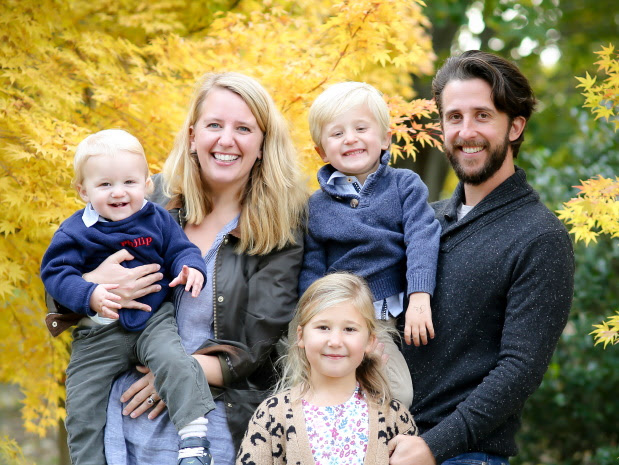
By 2018, Brendan and Lulu were thinking about a different kind of project. They had moved back to the Hamptons to raise their family. Shortly after their second child was born, they founded iCAMP. Their explanation begins with the children they already knew, rather than a prediction about the children of the future.
“create the program we wanted in the world for our children.”
From Lulu and Brendan Manley’s joint founder statement
The division of experience was practical. Brendan brought software development; Lulu brought sales and marketing. One understood the tools that could go into a workshop. The other brought experience connecting an offering with the people who might want it. Both had a reason to care about what happened after a child arrived.
They described the abilities they hoped to develop as creativity, confidence, and critical thinking. Physical and digital tools would provide ways to practise them. That choice of words matters. A child could begin with an idea and use a tool to give it form. The program did not have to organize every interest around a single device.
The family remained part of the account as the business grew. In a later joint statement, the founders described having four children and a larger team while keeping the same mission. The original audience for their idea had expanded in two directions at once.
The computer gets some company
iCAMP’s subjects include coding, robotics, 3D printing, filmmaking, science, and digital and studio art. Read the list as a collection of materials and the camp becomes easier to understand. Some children want to make a game. Others want to draw, build, experiment, or tell a story. Technology can join those activities without having to command the whole afternoon.
Brendan has put the emphasis plainly: “we see ourselves as a creative program.” It is a concise description from somebody whose background could easily have led to a narrower pitch. His own training began with learning how software worked. The camp gives children several possible doors into making.
The New York City program makes that breadth visible in its sample day. Natural science gives way to software technology, then art and design. Later come camp games, hardware technology, and time for passion projects. Lunch and recess are there too. Even an ambitious curriculum has to make peace with a sandwich.
- 01 Natural science
- 02 Software
- 03 Art & design
- 04 Camp games
- 05 Hardware
- 06 Passion projects
Children rotate through workshops and develop more involved projects across the week. There is time outside in nearby parks. The structure lets the program keep the social rhythms of summer camp while making room for sustained attention. A project can continue tomorrow; the whole day need not become one long lesson at a computer.

The five-classroom test
A particularly useful episode in Brendan’s story sits in the records of a school-board meeting. In May 2023, Bridgehampton’s board approved a request he had submitted for iCAMP, operating as Ape & Keyboards LLC. The request covered five dedicated classrooms and a playground, Monday through Friday, from June 26 through September 1.
The hours were 8 a.m. to 3:30 p.m. The purpose was a STEAM enrichment program. There is something clarifying about this level of detail. Creative learning requires rooms. Children need places to move. A school needs to know who will use its building, on which dates, and when everybody will leave.
For a founder trained in software, those are consequential differences between writing a program and running one. A camp has to work in a physical place. The calendar is part of the product. So are the instructors and the relationships that allow a classroom to become a workshop for the summer.
The approval offers a modest, concrete view of Brendan as an operator. He was the named applicant arranging space for children to attend. It places the family’s founding idea inside an ordinary institution, with a timetable and a vote attached.
What happens after the bell
iCAMP also developed a school business. Its current offering takes on the coordination around after-school enrichment: sourcing activities, managing vendors, building schedules, handling billing, and communicating with families. Its own STEAM instructors provide coding, robotics, and engineering; other activities can be organized around what a school community requests.
That work broadens the meaning of the original idea. A parent wants a good afternoon for a child. A school administrator also needs to know who is responsible when a vendor has a question or an instructor needs replacing. The learning experience and the administrative work arrive together, however differently they appear in a brochure.
For Brendan, the story now includes both sides of that relationship. He co-founded a program around children making things. The company grew into the business of arranging the people and practical details that allow those sessions to happen repeatedly. There is little glamour in a well-handled invoice. Its absence is surprisingly noticeable.
Brendan and Lulu found iCAMP.
Bridgehampton approves five classrooms and a playground.
AlphaBEST announces its acquisition, adding 100 schools.
A larger home, then another build
On September 30, 2025, AlphaBEST Education announced its acquisition of iCAMP. The announcement said the purchase added 100 schools and two states to its footprint. AlphaBEST described its existing reach as more than 600 schools across 20 states and outlined plans to incorporate iCAMP’s STEM expertise into its enrichment programs.
Those numbers describe a new context for the work Brendan and Lulu began in 2018. A family’s preferred camp had become a business another education provider wanted to bring into its network. The announcement focused on coding, robotics, game design, and digital arts - the tools around which iCAMP had developed its programs.
Brendan’s subsequent public work brings him back toward software. Flying Point Education lists him as co-founder and CEO, alongside co-founders Britt White, Kyle Shike, and Ben Colice. Its product, Tandem, is designed to help school teams coordinate education plans, documentation, and related work. The company describes introducing it into selected pilot schools across the United States.
The connection to iCAMP is easiest to see in the surrounding work. Children and educators need tools they can use; institutions need the arrangements around those tools to function. His newer venture puts that second concern closer to the centre. The software developer and the education operator now occupy the same job description.
One of Brendan’s more appealing pieces of advice to parents was to try a variety of summer activities. Golf, tennis, surfing: let children meet different people and discover what holds their attention. It is a generous suggestion from a camp founder. His own route has room for several subjects too, from philosophy and writing to code, classrooms, and school software. The beginner on the subway was already practising the first move: find something interesting, then work out where to start.