The least glamorous object at a vehicle show might be the floor. It sits beneath the shelves, under the tools, beyond the glossy paint and the giant screens. Brendan Church sees a different picture. A floor is where a technician plants a boot. It is what a dropped part strikes. It can keep cargo still, stop moisture, insulate a workspace and spare an expensive truck bed from a drill bit. At LEGEND, the commercial-vehicle accessories maker based in Tillsonburg, Ontario, Church has made a career of pulling that kind of overlooked detail into the light.
He is now the company's chief marketing officer, after earlier roles as marketing coordinator and marketing director. The progression matters because his public style still feels close to the work. He visits dealers and upfitters. He walks around builds. He points at a floor, a ceiling panel or a lock and asks what it changes for the person who will use the vehicle on Monday morning.
LEGEND's catalog is practical by design: rigid floors, rubber matting, wall and ceiling liners, thresholds, insulation kits, locks and vehicle-entry products. The company fits them to platforms from Ford, Ram, GM, Mercedes-Benz and Nissan. Church's challenge is the classic industrial-marketing problem. A component may be technically important and almost invisible once installed. His answer is to connect the component to a working day.
“Every single detail of an upfit has the power to make or break a technician's day in the field.”Brendan Church, on the Upfit Package of the Year awards
The mobile workplace
Church's language repeatedly moves away from the vehicle as a piece of equipment and toward the vehicle as a place where people live part of their day. A cargo van can be an office, warehouse, workshop and tool chest within the same few square metres. Its users climb in and out, kneel on the floor, load sharp-edged material, hunt for parts and sometimes work in heat trapped beneath a metal roof.
That view gives the marketing a clear unit of measurement: friction. A slippery surface adds friction. A damaged bed adds cost. Heat makes a task harder. Missing tools can stop work entirely. Each product earns attention by removing one of those problems. The story is not abstract innovation. It is a better foothold, a cooler interior, one fewer dent or a door that resisted an attempted break-in.
In 2023, while serving as marketing director, Church explained LEGEND's SecuriLock in unusually high-stakes terms. The lock did not merely protect cargo, he said. It protected tradespeople's livelihoods. “They rely on this to do their job. When it's gone, they have to start over.” The sentence turns hardened steel and weather-resistant coating into a consequence anyone can understand.
His posts also reveal a preference for learning in the field. On a trip through Salt Lake City, he visited a commercial-truck training session, toured an upfitter with 106,000 square feet of vehicle bays, filmed with another upfitter and stopped at a Mercedes-Benz van centre. What stuck were the practical curiosities: a raised subfloor with room for ladders and conduit, pre-cut insulated panels that replaced hand-cut plywood, and the palpable heat beneath a bare van roof.
There was room for jokes, too. He reported that one partner had missed the bullseye during axe throwing in a high-roof ProMaster, and approvingly repeated a description of LEGEND's mechanical side step as smoother than the steering on an eighties truck. The humour does useful work. It keeps a trade visit from reading like a brochure.
The $80,000 question
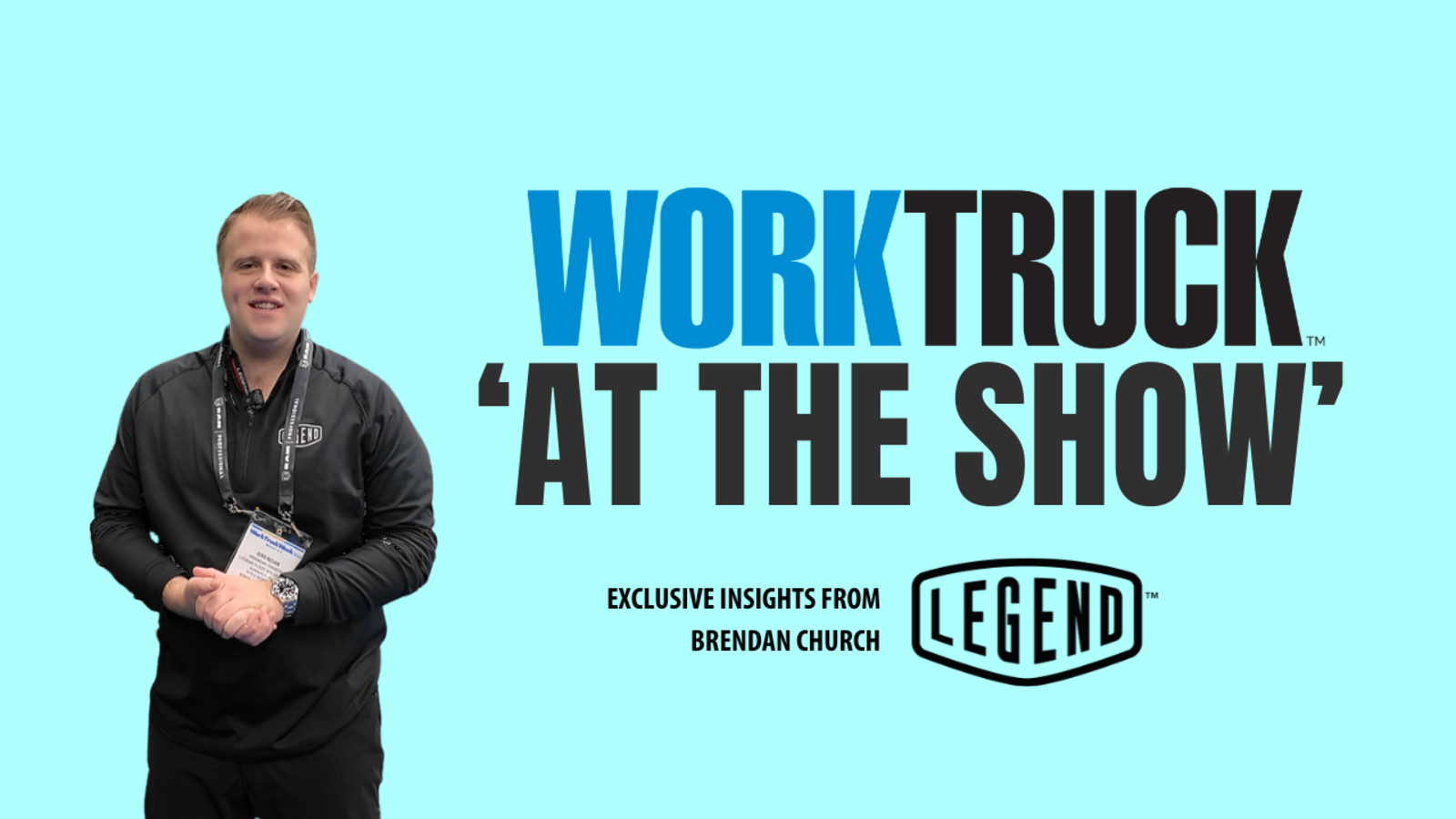
At Work Truck Week in Indianapolis in March 2025, Church stood beside LEGEND's new BedBoss system and offered a product pitch built around one sharp question: why drill through an $80,000 truck? Conventional bed protection can require new holes. BedBoss uses factory mounting points, creating a flat surface while adding cargo tie-down options and avoiding a step that can introduce rust or complicate resale.
The product combines industrial-grade steel with a 19-millimetre composite floor. It was introduced for recent half-ton Ford F-150, Ram 1500 and Chevrolet Silverado models, with development continuing for larger pickups. Those specifications create credibility. The drilling question creates memory. It makes the buyer feel the risk before hearing the solution.
Church used the same launch to widen the frame. Factory liners can handle scratches and abrasions, he explained, while a working pickup may face dents and punctures from heavy cargo. Tie-down points can also be inconvenient or too few. A floor, in this telling, is no longer a flat sheet. It is a system for protecting the asset and organizing the work sitting on top of it.
By April, he was in a Work Truck video moving through LEGEND's broader portfolio: grippy flooring, thermal insulation and bed protection. The unifying idea was not a material or manufacturing process. It was improving the day for the “legends of the road,” the company's name for people whose work happens in and around commercial vehicles.
A stage for the whole build
One of Church's more revealing projects puts other companies in the spotlight. LEGEND came up with the Upfit Package of the Year awards to recognize complete van, truck and SUV builds. The program has involved fleet trade media and public voting, with entries from companies that often work together on customer projects.
In announcing the 2025 winners, Church named the fleets, upfitters and people behind the work. He described the award as a celebration of solutions that help professionals do their jobs. For a company selling components within a much larger installation, the approach is strategically generous. LEGEND becomes the host of the conversation rather than insisting on being its only subject.
This makes the awards a form of market education. A finished vehicle gives fleet managers something concrete to study. The upfitter earns recognition. Suppliers can show how their parts contribute to a coherent result. The end user stays visible. In 2026, the program returned with winners across all three vehicle categories, proof that the idea had become a repeatable industry fixture rather than a one-off campaign.
A component may disappear inside the finished build. Its benefit travels with the driver for every mile.
Marketing after the difficult day
The job has also required a different kind of public voice. After a major fire at a Legend facility in 2024 destroyed a storage and recycling building, Church spoke about working with local authorities, making the site safe and assessing how quickly production could resume. There were no reported injuries or missing people, but products and machinery were lost. It was the sort of moment when a spokesperson's task is clarity rather than promotion.
LEGEND kept expanding. In 2025 it welcomed a Romeoville, Illinois, operation into LEGEND USA. That autumn, the company announced an alliance with vGroup International to broaden the availability of its van interior products across the UK. Church described the partner's fleet, leasing and dealer relationships, backed by a national installation network, as the reason the pairing made sense.
By spring 2026, he and colleague Jerry Simpson were discussing fleet economics on The Fleet Lead podcast. The conversation moved from a return-on-investment case to sceptical buyers, residual value and tariffs. It showed the natural extension of Church's argument. Interior protection is not only about comfort or appearance. If it keeps a working vehicle in better condition, it may also change what that vehicle is worth later.
The industrial storyteller's advantage
Church's career offers a compact lesson in B2B attention. The apparent dullness of a category can be an advantage. Fewer people have already told its stories well. There is room to notice the strange, specific and useful: the ladder hidden under a floor, the heat radiating from a ceiling, the unnecessary hole in a new pickup, the tools behind a lock.
The digital work has produced measurable results, too. In a testimonial for LEGEND's web agency, Church said the company's redesigned site increased quote requests by 400 percent during its first six months. He also pointed to more orders moving through the customer portal, reducing manual entry work. The useful website did the same thing as the useful floor: it removed friction from somebody's day.
His own path supports that mix of observation and communication. His public profile lists study at the University of California, Berkeley in 2017, an educational director's award that year and an early LinkedIn article asking buyers to consider the choice between quality and price. Since 2023, he has also volunteered as a social-media content creator for Rapid Relief Team Canada. Across those activities, the connecting skill is making practical work legible to an audience.
Aspirations are easiest to read in what someone repeatedly chooses to show. Church keeps returning to the technicians, fleet managers, dealers and upfitters around the vehicle. He wants LEGEND's brand to be difficult to ignore, but his method is not to shout over the machinery. It is to crouch down, point to the overlooked part and explain why it matters.
That is where a floor becomes interesting. Not by pretending it is glamorous, but by showing all the work that stands on it.