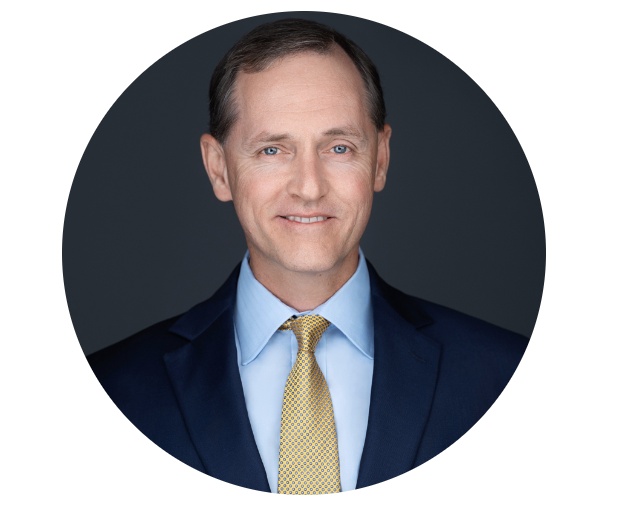
On June 21, 2024, Brendan Cavanagh rang Nasdaq’s Opening Bell in Times Square. SBA Communications was celebrating 25 years on the exchange. Its new chief executive had been at the company longer than that. He joined in February 1998, before the public listing, and had spent much of the intervening time looking after the money. A bell ceremony gives everyone a moment in the spotlight. Cavanagh had arrived there by the considerably slower route of staying.
He became president and chief executive on January 1, 2024, succeeding Jeffrey Stoops. By then, he had served as chief financial officer since September 2008. His promotion brought an unusually long institutional memory into the corner office: acquisitions, accounting, leases, capital markets, and the less photogenic machinery that keeps a tower company standing. The title changed in a day. The preparation occupied most of a working life.
There is something pleasingly appropriate about that career in this particular business. Wireless communications sounds weightless. Its vocabulary is full of clouds, networks and spectrum. Cavanagh’s company deals in places: towers, rooftops, buildings and the right to put equipment on them. The signal may travel through the air. Somebody still has to attend to the ground lease.
Learning the business from underneath
Before SBA, Cavanagh worked in Arthur Andersen’s audit and assurance practice. He earned a bachelor’s degree in accounting at Wake Forest University and an MBA at Florida Atlantic University. Accounting was his professional starting point, but his SBA assignments carried him beyond the ledger. He worked in mergers and acquisitions and became vice president of site administration in January 2003, then vice president and chief accounting officer in June 2004.
That sequence helps explain the executive who emerged. Site administration sits close to the contracts and relationships behind an apparently simple asset. Accounting requires attention to what those commitments actually mean. His later responsibilities included tax, information technology and lease administration, alongside financing. He came to know several different versions of the same company, each with its own vocabulary and practical demands.
The CFO appointment in September 2008 began a tenure lasting roughly 15 years. When SBA announced the succession in February 2023, it put numbers around that period: revenue had grown 555%, and enterprise value had expanded from $6 billion to $43 billion during his time as CFO. Those are company achievements, produced by a management team and its employees. They also describe the scale of the enterprise he had helped finance before being asked to lead it.
Company figures at the succession announcement. Enterprise value includes debt; these are historical snapshots.
Stoops remained on the board and became non-executive chairman. Founder Steven Bernstein stayed a director. This was a handover with familiar people still around the table. Cavanagh publicly thanked Stoops for the guidance and support of their years working together. The arrangement gave the new chief executive continuity, along with the obligation to decide what that continuity should produce next.
When he discussed SBA’s culture in 2024, Cavanagh emphasized quality, financial discipline and integrity, together with an entrepreneurial spirit. He wanted those habits to continue. The combination asks something of an organization: take opportunities seriously, then subject them to financial scrutiny. His public explanation of continuity was rooted in ways of working, rather than in a promise that the portfolio would always look the same.
How much of a map should you own?
One of Cavanagh’s early priorities as CEO was a review of SBA’s markets and business lines. In 2024, he explained an evolution in the company’s thinking about scale. Covering local overhead and generating positive operating earnings had once been enough to count. He now wanted to ask how important SBA was to the principal wireless carriers in each market.
That is a different test. A portfolio can pay its way and still leave its owner a minor participant in a customer’s network. Cavanagh’s argument was that relative importance influences how carriers engage with tower providers and allocate work. More pins on a map do not automatically confer more influence. Sometimes the useful question is how much a customer would notice your absence.
“It’s your relevance to the leading carriers in the market.”
Brendan Cavanagh, July 2024 earnings call
He set out two possible responses: expand where SBA could become more relevant, or consider leaving where it could not. By 2025, that approach had produced decisions on both sides. The company completed its purchase of more than 7,000 Millicom towers in Central America and made strategic exits from smaller markets, including Canada, Colombia and the Philippines. Growth and retreat belonged to the same argument.
For an executive who had spent years financing expansion, the willingness to narrow the footprint is revealing. It makes the measure of progress more demanding than a country count. An international company can get larger in a useful market while getting smaller on a world map. Corporate geography, like an overfilled suitcase, occasionally improves when something comes out.
Seven thousand reasons to matter
The Millicom agreement, announced in October 2024, gave that thinking a concrete shape. The portfolio stretched across Guatemala, Honduras, Panama, El Salvador and Nicaragua. Its announced cash price was approximately $975 million, with an additional earn-out tied to performance. SBA would own the infrastructure; Millicom would continue using it through long-term lease arrangements.
existing towers in five countries
There was a second element beyond the acquired structures: a seven-year exclusivity right to build up to 2,500 additional sites for Millicom, with initial 15-year leases on new sites. That paired an existing tenant relationship with possible future construction. Buying a tower supplies an asset. Becoming the builder for a customer’s next network expansion supplies a reason for the relationship to continue.
The operating model makes the customer question especially interesting. An independent tower owner can accommodate equipment from multiple carriers on one structure. Sites previously controlled by a carrier can therefore become available to its competitors. Cavanagh subsequently described encouraging interest in the Millicom assets. The attraction was access to locations that other operators could use to extend their own networks.

His attention to customers also surfaced at a more ordinary level. On an April 2024 earnings call, he recalled visiting the Brazil team and learning about creative changes intended to improve the customer experience at SBA sites. He connected those efforts to longer relationships. It is a small episode, but a useful one: even a company buying thousands of towers has work to do at the level of a single customer’s encounter with a single site.
The land beneath the equipment has its own timetable. At the end of 2024, SBA said roughly 72% of its tower structures stood on land it owned or controlled for more than 20 years. Long leases and property interests help protect the usefulness of a site well beyond a particular equipment upgrade. That detail fits the world Cavanagh has spent his career learning: the visible structure is only part of the asset, and the paperwork can outlast several generations of wireless technology.
The cost of being patient
A long view still comes with quarterly arithmetic. Carrier consolidation can remove tenants, and higher interest rates can make financing more expensive. Cavanagh’s early CEO years unfolded amid both pressures. His response has involved deciding where to invest, where to sell, and how to balance portfolio spending with debt management, dividends and share repurchases. An accountant’s background gives him plenty to discuss.
In the second quarter of 2026, SBA’s international site leasing revenue rose 30.5% from a year earlier, while domestic site leasing revenue fell 3.7%. Adjusted funds from operations per share, a non-GAAP measure used by the company, declined to $3.05 from $3.17. The contrasting results show why a larger portfolio cannot by itself settle the question of performance. What matters also includes the tenants, financing costs and earnings attributable to each share.
In July 2026, SBA issued its first investment-grade bond offering, raising $3.5 billion through unsecured senior notes, and replaced its secured revolving facility with a $2.5 billion unsecured facility. For a former CFO, this is familiar terrain. It changes the financing behind the physical assets, even though a passing motorist would see precisely the same tower.
Beyond the tower portfolio
Cavanagh’s responsibilities extend into other institutions. He serves as vice chair and secretary of the Wireless Infrastructure Association and sits on the board of 4KIDS of South Florida, a nonprofit foster care organization. In October 2025, he joined Consolidated Edison’s board. The utility appointment brought his experience in financial reporting and operating a public infrastructure company to another business built around assets people rely on every day.
He has also maintained a connection with Florida Atlantic University: its business school listed him on the dean’s advisory board in its 2019-2020 annual report. Together, those roles place him in industry advocacy, local civic work, education and utility governance. They give a broader picture of his professional commitments than a tower count can provide.
Looking ahead, Cavanagh has discussed exploring edge computing and the terrestrial components of satellite networks as potential avenues for growth, while continuing to support SBA’s core customers. These remain possibilities to investigate. His more established proposition is already visible in the portfolio: own locations that matter, make them useful, and earn the next piece of a customer’s business. After more than a quarter century at SBA, he is still working on what staying should mean.
Keep following the signal
SBA Communications · Leadership ↗Brendan Cavanagh · LinkedIn ↗Watch: Behind the Bell with Brendan Cavanagh ↗Read: Cavanagh’s 2024 Inside Towers interview ↗Con Edison · Board appointment ↗SBA · August 2026 results and outlook ↗SBA company accounts: LinkedIn ↗X ↗Facebook ↗