Jeff Stoops was eating lunch at his desk when a call found him. He was a corporate lawyer at Gunster in West Palm Beach. SBA Communications needed advice, and the call could have landed with another partner. It landed with him. The resulting introduction to founder Steven Bernstein eventually brought an invitation to leave the firm and join the company.
There is something pleasingly unceremonious about this beginning. No childhood prophecy involving radio masts. No grand unveiling. A lawyer was available, a business had a question, and the conversation continued. In 1997, Stoops changed jobs. The company he joined had been providing services to wireless carriers. Its future would depend increasingly on owning the places where their equipment lived.
Today he chairs SBA’s board, having retired as president and chief executive at the end of 2023. Between the lunch and the chairmanship came a long education in assets, debt, geography and patience. There was also a discovery familiar to anyone who has changed professions: sometimes your old training becomes more useful after you leave the job it was supposed to prepare you for.
By then, he had spent 13 years at Gunster, working his way from associate to partner. Corporate law put him close to consequential choices: raising money, combining businesses, deciding what an agreement actually committed its signers to do. Joining a client changed his position in those discussions. The advice would now come with responsibility for what happened after the documents were signed. That distinction gives the move its personal stakes, even before the towers enter the picture.
The tenant above your head
Wireless has an excellent publicist in its name. It suggests a world relieved of physical inconvenience. A cell tower restores the missing nouns: land, steel, antennas, access, rent. SBA’s business puts those practical requirements at the center. Carriers need somewhere to install equipment. An infrastructure owner provides space, and a structure can accommodate more than one tenant.
That last detail helps explain the attraction. A tower with room for another carrier contains a possibility that a passing motorist cannot see. The financial question concerns how much of that room will be leased, on what terms, and at what cost. A large tower count alone cannot answer it.
Consider a transaction announced in January 2001, when Stoops was SBA’s president. The company acquired 127 towers from US Unwired for $40 million. The towers averaged 1.2 tenants each, while their structural capacity allowed considerably more equipment. An anchor customer supplied an initial rental relationship; unused capacity supplied room for further leasing. The business case was already visible in the difference between occupied space and usable space.
A later SBA presentation, in October 2004, described a portfolio designed around multiple tenants, averaging 2.3 tenants per tower and capacity for more than four. It also identified multiyear leases and the costs of maintaining the assets. These are satisfyingly specific concerns. The wireless future would still have to make its monthly payments.
The year the arithmetic turned ugly
Stoops became CEO on January 1, 2002. The timing was unfortunate. The telecom bust tightened lending conditions while SBA was still making its transition toward tower ownership. In his later account, debt had reached roughly 15 times earnings before interest, taxes, depreciation and amortization. A covenant problem threatened the shareholders’ position.
The response included selling roughly 850 western towers, using the proceeds to remove troublesome debt and refinancing. SBA avoided bankruptcy. Stoops would later describe that survival as a particular source of pride. A growth company had found an urgent use for getting smaller.
Read beside the later expansion, the episode makes the career more intelligible. Owning useful structures did not remove financing risk. Rental income takes time to arrive; creditors have calendars of their own. The same executive who wanted a larger portfolio had to decide which assets could be sacrificed to preserve the enterprise.
There is no need to tidy this into an inspirational rule. Selling towers during a debt squeeze is a specific response to a specific problem. Its consequence mattered: SBA retained the chance to make subsequent decisions. The international business, the later acquisitions and the eventual succession all required a company that could get through that earlier year.
A passport for the balance sheet
The footprint widened. Canada came in 2009, Central America in 2010 and Brazil at the end of 2012. Stoops explained the expansion as a response to the limits of relying exclusively on American opportunities. A model built around physical locations could travel, provided the company could find suitable assets and operate them.
- 2009Canada
- 2010Central America
- 2012Brazil
His legal background fits this work unusually well. A tower business involves ground leases, zoning, mortgages, financing and contracts. The equipment may belong to a fast-changing industry; the obligations beneath it require the older disciplines of reading closely, negotiating carefully and understanding who can do what on a particular piece of land.
The executive job also changed with scale. Stoops described choosing markets, allocating capital and putting people in appropriate roles. He preferred giving capable colleagues room to work. The skills needed to close a transaction were joined by the harder-to-display task of deciding which transactions deserved attention in the first place.
By the end of 2022, SBA owned close to 40,000 tower sites across 16 countries. For Stoops’s CEO tenure through that date, the company reported annualized total shareholder returns of 16%. Those figures describe a historical period. They also establish the distance traveled from the services business he had joined.
Public recognition arrived along the way. Florida Atlantic University named him its Business Leader of the Year for 2014. SBA elected real estate investment trust status in 2016 and entered the S&P 500 in 2017. The corporate milestones underline the nature of the enterprise: a telecommunications story with property ownership running through it.
Four degrees, one continuing conversation
Another institution runs through Stoops’s life: Florida State University. He earned his bachelor’s degree there in 1981 and his law degree in 1984. Aggie earned degrees in social work in 1982 and 1983. Their relationship began as undergraduates at Cawthon Hall. Four degrees is a substantial amount of shared homework to have behind a marriage.
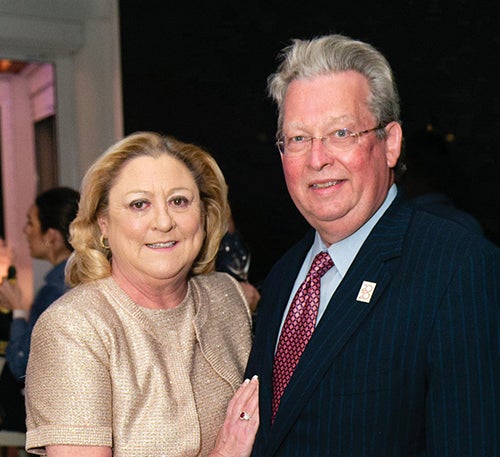
Their support developed over years. They endowed professorships in law and social work in 2004. A scholarship program for students pursuing business law followed in 2015. The Stoops Family Foundation, established in 2013, supplied a vehicle for continuing that work alongside other community giving.
The educational choices have a practical logic. Stoops had seen corporate legal work leave Florida for lawyers elsewhere. Supporting business-law teaching addressed a field he knew from both sides of the desk: as the adviser handling a transaction and as the executive responsible for its consequences. The ambition connected professional experience with the supply of future practitioners.
In 2021, a foundation contribution established the Stoops Center for Law and Business at FSU’s College of Law. A $1 million pledge supported the initiative. Its stated aims included supporting faculty research, professional education and relationships with the private sector.
The earlier professorship gifts show that this interest preceded the center by many years. In explaining his support in 2005, Stoops connected the need for business lawyers with the opportunities Florida companies were sending outside the state. Funding teaching was a way to work on that problem over time. It required accepting a different timetable from a transaction: students would arrive, study and begin careers whose results could unfold far beyond the original gift.
By August 2022, the college was describing an online platform, executive education opportunities and a business podcast. Initial certification offerings included privacy and employment law. The design gave the gift something to do: create teaching and exchanges between people studying business law and people using it at work.
Family participation mattered, too. Stoops has spoken about wanting his children involved in philanthropy. Giving offered a continuing activity to share. His accounts of family gatherings at Kiawah Island provide a more domestic version of that same continuity: people making time to assemble, year after year.
“I consider myself a very lucky guy.”
Jeff Stoops, reflecting on his move to SBA
Leaving the office, keeping the responsibility
On December 31, 2023, Stoops completed his tenure as president and CEO. The next day he became board chairman. Brendan Cavanagh, SBA’s longtime finance chief, took over the executive role. The transition had been announced in February, allowing the handover to proceed over the remainder of the year.
Cavanagh’s first annual letter as CEO described receiving guidance from Stoops during the transition. It also laid out the work of the next team: leasing activity, costs, debt and operational performance. The change in authorship was consequential. A company with a long-serving executive needed its next leader to speak in his own voice.
Stoops’s community responsibilities continued. He chaired the Community Foundation for Palm Beach and Martin Counties from 2023 to 2026; its current board biography lists him as vice chair and immediate past chair. He also serves on the Kravis Center’s board, where he previously chaired the organization.
Board service is another setting in which a decision can outlast the meeting that produced it. An arts institution, a community foundation and a tower company have different purposes. Each requires people to weigh present requests against future obligations. For a former chief executive, that offers continued work for experience accumulated over years, with a different measure of the result.
Stoops has a career that is easier to understand through its relationships than through a single title. Bernstein needed legal advice. Wireless carriers needed sites. A successor needed room to take charge. Students needed opportunities to acquire the skills that had helped him change professions. That lunchtime call kept producing work for years. Stoops stayed in the conversation.
Keep the conversation going
- SBA Communications Company website
- Jeff Stoops on LinkedIn Personal professional profile
- The lunch call, the tower business and the difficult years 2020 interview · South Florida Business & Wealth
- Jeff and Aggie’s continuing work at Florida State FSU College of Law
- A conversation with Jeff Stoops FSU’s podcast announcement · Spotify and YouTube
- His community board work Community Foundation for Palm Beach and Martin Counties
- SBA on LinkedIn Company account
- SBA on X Company account
- SBA on Facebook Company account