In 2016, Tom Stanton offered a curious assessment of a technology his company was selling. “In hindsight, we’re probably pushing SDN too quickly.” Software-defined networking promised operators more flexible control of their networks. Adtran had been building for that future. The difficulty was that many customers were still arranging their present.
It was an unusually useful admission from a chief executive. A product could work, a strategy could make sense, and the customer could still need several intermediate steps. Stanton was describing the awkward interval in which a telecommunications supplier earns its keep. The future has arrived at the loading dock. Someone must find room for it.
By October 2026, Stanton had spent 31 years at Adtran and more than two decades as its CEO. His career runs through marketing, divisional management, corporate succession and a transatlantic business combination. Across those changes, a recurring question gives the story its shape: what will an operator actually be able to do with the thing being offered?
Ten years inside the carrier business
Stanton studied computer engineering at Auburn University. His route to Adtran nevertheless passed through the commercial side of technology. He held marketing leadership positions at E. F. Johnson, then served as vice president of marketing and engineering at Transcrypt International. In 1995, he joined Adtran as vice president of marketing for its Carrier Networks division.
The combination of engineering education and marketing responsibility is a useful starting point. Specifications matter in this business, but somebody must translate them into an operator’s decisions. A customer needs to know what can be installed, what can be retained and what the expenditure will accomplish. Stanton’s early responsibilities placed him at that meeting point.
He became the division’s vice president and general manager in 1999, then senior vice president and general manager in 2001. In September 2005, he succeeded Mark C. Smith as CEO. Smith had led the company since its founding and chose his retirement date to coincide with his 65th birthday, September 10. Stanton’s appointment took effect that day.
The succession promoted someone who had already spent a decade inside the business. Danny Windham became president and chief operating officer at the same time. Smith described the appointments as a way to continue Adtran’s established culture. Stanton added the chairmanship in 2007, taking responsibility for the board as well as the executive office.
The customer has a calendar
By 2015, two developments were occupying him: the return of investment in broadband and the possibilities of software-defined networks. At an informal discussion in Huntsville, he described software as a way for operators to introduce services faster and lower costs. He also acknowledged how difficult moving away from existing hardware arrangements would be.
That tension became clearer the following year. Adtran’s Mosaic architecture offered a route toward software-controlled access networks, including environments with equipment from different vendors. Stanton said many carriers were not yet organized to use the available functionality. Adtran therefore had to provide a sequence of steps they could follow. Having the destination drawn neatly on a slide did little to shorten the walk.
He applied similar reasoning to the wiring already inside buildings. Discussing G.fast, which could use existing copper or coaxial connections, he questioned the expense of tearing open walls when that infrastructure could support a useful upgrade. Fiber remained part of the larger direction. The immediate choice depended on the building, competitive pressure and deployment costs.
His own organization also needed to change. In 2015, Stanton recalled that long-serving employees had been quick to embrace agile development after difficult projects exposed the expense of discovering engineering problems late. Experience gave those employees a reason to try a different process. They had already paid for the old one in rework and delay.
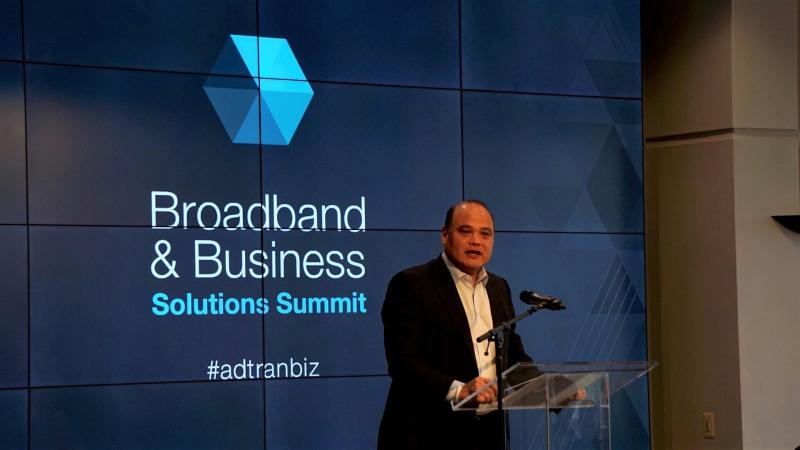
A board with fewer duplicates
The same interest in practical usefulness appeared in his view of management. In 2017, he described a leader’s responsibility to give employees a forum in which their thinking could be heard and developed. The manager should contribute something to the conversation. A large office and a full diary do not, by themselves, accomplish this.
His responsibilities have also extended beyond Adtran. He has chaired the Telecommunications Industry Association’s board and the Federal Reserve Bank of Atlanta’s Birmingham Branch board. He served on the board of the bank now known as Cadence Bank from October 2015 through February 2026, including work on compensation and risk. Those roles put a telecommunications executive into rooms where the questions concerned an industry, a regional economy or a bank. They broaden the picture of a career otherwise closely identified with one company.
At board level, he had been working through a related problem. One director’s planned retirement prompted a review of the skills Adtran would need. Working with search consultant Matthew Mooney, the company brought four new directors onto the board from 2014 to early 2017. Stanton’s instruction was to account for the strengths already present before adding more of the same.
“let’s not duplicate those strengths.”
Tom Stanton, on board recruitment, 2017
The appointments included Kathryn Walker, with senior network and information leadership experience at Sprint Nextel; former Verizon CTO Tony Melone; risk and compliance executive Jacqueline Rice; and Greg McCray, then CEO of Alphabet’s Access division. These were people who could contribute different kinds of operating knowledge. Customer experience, regulation, international business and risk all belonged in the discussion.
Stanton and Walker independently prepared lists of desired board capabilities and found substantial agreement when they compared them. The exercise suggests a concrete habit: work out what is missing, then revisit the question after someone joins. A new director can change the conversation in ways a recruitment brief cannot completely predict.
A bigger network to hold together
On July 15, 2022, Adtran Holdings completed its business combination with ADVA Optical Networking. Adtran became a subsidiary of the holding company, which also became ADVA’s majority shareholder. Stanton remained chairman and CEO of the holding company. The transaction brought broadband access and a broader optical networking portfolio into the same corporate structure.
For Stanton, the job now included making the combination function beyond its legal completion. The company described a portfolio reaching from connectivity inside premises to optical transport. That breadth creates a straightforward customer proposition: more pieces of a network can come from a related set of businesses. Delivering it requires the organizations behind those pieces to work together.
Conceptual view of the combined portfolio. Connections shown are illustrative, not a measured network topology.
On July 1, 2023, he also became ADVA’s CEO. Christoph Glingener stepped back from that chief executive role to concentrate on technology responsibilities at ADVA and Adtran. The business subsequently became known as Adtran Networks SE. Stanton was now carrying executive responsibility at both the holding company and its majority-owned optical networking business.
The quarter refuses to cooperate
The work took place in an uneven market. In April 2023, Adtran warned that first-quarter revenue would fall below its guidance. Customer inventory corrections affected subscriber products, while supply constraints limited its ability to meet demand elsewhere. Too much stock in one part of the system could coexist with too little supply in another.
By the first quarter of 2024, Stanton was emphasizing inventory reduction, operating cash flow and the company’s efficiency program. He also pointed to customer wins and the expansion of Mosaic One. His argument was that operating improvements and market position would matter when conditions normalized. The practical difficulty was carrying those priorities through the intervening quarters.
That difficulty remained visible in 2026. Second-quarter revenue reached $281.1 million, up 6.1 percent from a year earlier, but below the previous guidance range of $283 million to $303 million. The company reported a GAAP operating margin of negative 3.6 percent. Growth had arrived without resolving the profitability question.
Revenue growth and an operating loss occurred in the same quarter.
On the August earnings call, Stanton discussed a delayed customer project, product mix and tight component availability. He described redesigns intended to provide more supplier flexibility and stressed the importance of customers placing orders early enough to secure supply. The vocabulary was familiar to anyone responsible for shipping equipment: orders, components, forecasts, delivery.
He also pointed toward a wider customer base. Revenue from cloud providers and hyperscalers, enterprise and government customers grew 47 percent from a year earlier in the second quarter. That offered evidence of diversification. It did not cancel the missed guidance. Both belonged in an honest assessment of the business he was running.
The next idea still needs an operator
Stanton has long connected Adtran’s commercial work with extending broadband access. There are concrete examples of that work continuing. In July 2026, Adtran announced that Oso Internet Solutions was using its technology to expand connectivity across New Mexico’s Ramah Navajo Indian Reservation. The locally owned provider was building around its community’s needs. Adtran supplied technology and support.
In October, another part of the business moved forward with Mosaic One Agents, designed for network management, customer care and business operations. The product uses data from Adtran and third-party hardware, with controls over the actions agents can take. Glingener and software platform general manager Philip Bednarz explained the launch in terms of helping people coordinate work and resolve problems.
For Stanton, the setting has changed considerably since a marketing vice president arrived in 1995. The company has more of the network to consider, and another generation of software to sell. Yet the customer still has equipment in service, staff with work to finish and a budget with limits. Somewhere between the new capability and the working network lies his enduring assignment: make the next step useful enough to take.
Continue the conversation
Interviews, company updates and places to watch. Social accounts labeled Adtran belong to the company.
- Tom Stanton’s official biography
- Personal LinkedIn profile
- 2016 interview: access networks and deployment choices
- 2017 conversation: changing the board
- Second-quarter 2026 results
- Watch: TIA’s Broadband Capacity documentary
- Adtran videos on YouTube
- Adtran website
- Adtran blog
- Adtran on LinkedIn
- Adtran on X
- Adtran on Instagram
- Adtran on Facebook