Ten days after Carl Russo fired his driver, the driver won. AJ Allmendinger took his first Champ Car victory at Portland in June 2006, beating Justin Wilson, who still drove for Russo’s RuSPORT team. For a team owner, this was an unusually elaborate way to have a bad afternoon. Russo found a joke in it: “I think it’s a RuSPORT one-two...”
He also congratulated Allmendinger. They had won a junior championship together; now the younger driver was succeeding somewhere else. Whatever the discomfort, Russo could acknowledge the talent. The episode supplies a useful opening to a career usually introduced with a dollar figure. It shows a builder encountering the awkward possibility that somebody can flourish after leaving the thing he built.
Russo’s business life has involved several versions of that question: when to take control, when to change direction, when to hand over. At Cerent, the interval between becoming chief executive and a sale to Cisco was measured in months. At Calix, his time as CEO approached twenty years. Racing supplied a stopwatch. Broadband required a calendar with considerably more pages.
A very expensive box
In August 1999, Cisco announced an agreement to acquire Cerent in a stock transaction valued at approximately $6.9 billion. Russo was its president and CEO. The price described a company transaction, rather than a personal payday, though the distinction can disappear rather quickly in a successful executive’s biography.
Cerent made optical transport equipment. Its technology helped service providers move voice and data traffic through networks built for an earlier era. Cisco wanted an entrance into optical transport, and Cerent offered products and more than one hundred customers. An unglamorous problem in the machinery of communications had acquired a very glamorous price.
Approximate announced value of Cisco stock exchanged for the Cerent interests it did not already own.
The story was irresistible to a technology industry learning to express enthusiasm in billions. A small supplier could become strategically valuable because its equipment helped a larger network change. That distinction matters in Russo’s later career, too: his companies occupied the working spaces between an infrastructure owner and what that infrastructure needed to do next.
His preparation had been practical. Before Cerent came operating roles at Xircom, Network Systems and AT&T Paradyne. After the acquisition, he took optical networking leadership roles at Cisco, remaining there until May 2002. He knew the supplier’s side of the table, and then spent time inside the company that had bought the supplier.
The education that escaped the diploma
Russo attended Swarthmore at sixteen, studying mathematics and computer science, but did not complete a degree. His working life developed through electronics and networking. Racing also interrupted the orderly résumé: an earlier venture, Full Time Racing, left him deeply in debt before he paid his obligations.
His management style could be unconventional. A colleague recalled a meeting at Xircom with Russo sitting cross-legged on a table; at the next gathering, everyone sat on the floor. One can debate the furniture policy while admiring the economy of the provocation. A room arranged differently at least makes it harder to conduct the meeting entirely on autopilot.
He later served on Swarthmore’s board of managers. That return gives the education story an appealing shape: an institution can remain important to someone whose relationship with it never culminated in a diploma. In Russo’s case, the connection survived the unfinished course.
“I am not saying what I do is art, but this is my craft.”
Carl Russo, 1999
Back to the pits, back to work
Leaving Cisco did not produce a quiet second act. By the beginning of 2003, Russo was back running a networking business, Calix, while pursuing racing through team ownership. Mike Hatfield, Calix’s first CEO, moved into the chief strategy officer role as Russo took the operating job. The professional network was familiar; the commitment would prove much longer.
RuSPORT, created in late 2002, offered a different test of organization. In its first competitive season, Allmendinger clinched the 2003 Toyota Atlantic championship at Denver. The team had two rookie drivers, Allmendinger and Aaron Justus. A newcomer’s championship gave Russo something more tangible than a theory about finding and supporting talent.
The Denver afternoon also resisted a tidy ending. Justus went into the tire wall, spoiling the possibility of a one-two finish. Russo’s assessment held both results together: a championship won and an opportunity lost. Even an excellent weekend could contain an expensive piece of punctuation.
In 2004, RuSPORT moved into Champ Car with Allmendinger. By June 2006, the partnership had broken down and the team replaced him with Cristiano da Matta. Allmendinger’s immediate victory for Forsythe made the separation look especially uncomfortable. Russo’s public response was generous enough to acknowledge it. The old driver and the remaining driver had fought for the same win.
These episodes complicate a portrait made only from acquisitions and job titles. Russo backed young competitors, moved a team up a category, and made a personnel decision that received an almost immediate public rebuttal. Sport has a useful cruelty: the results arrive before the explanation has finished dressing.
Cerent acquisition announced
RuSPORT wins an Atlantic title
Calix CEO tenure concludes
A company learns to change its business
Calix began in 1999. Russo served on its board that year and became CEO in December 2002. The enterprise he eventually handed to Michael Weening sold software, cloud capabilities and managed services as well as networking systems. Getting from one business model to the other required more than a revised description on the website.
The company began preparing its software and cloud transformation in 2012. Weening joined from Salesforce in 2016. The following year, losses widened beyond $80 million as Calix invested in the transition. Those numbers are a useful antidote to the retrospective neatness of a corporate transformation. A strategy can sound coherent while remaining expensive to carry out.
Weening has credited Russo with the patience to sustain that investment. The intended customer also needed to change. Broadband operators accustomed to constructing and maintaining networks were being asked to think harder about marketing, services and the daily experience of their subscribers. Calix had to alter its own business while helping customers alter theirs.
That is a demanding sales proposition. Buying equipment is a bounded decision. Adopting a different way to run a business can reach into training, incentives and the habits of people who have been doing their jobs for years. A product launch may occupy an afternoon; the new habits have to turn up on Monday.
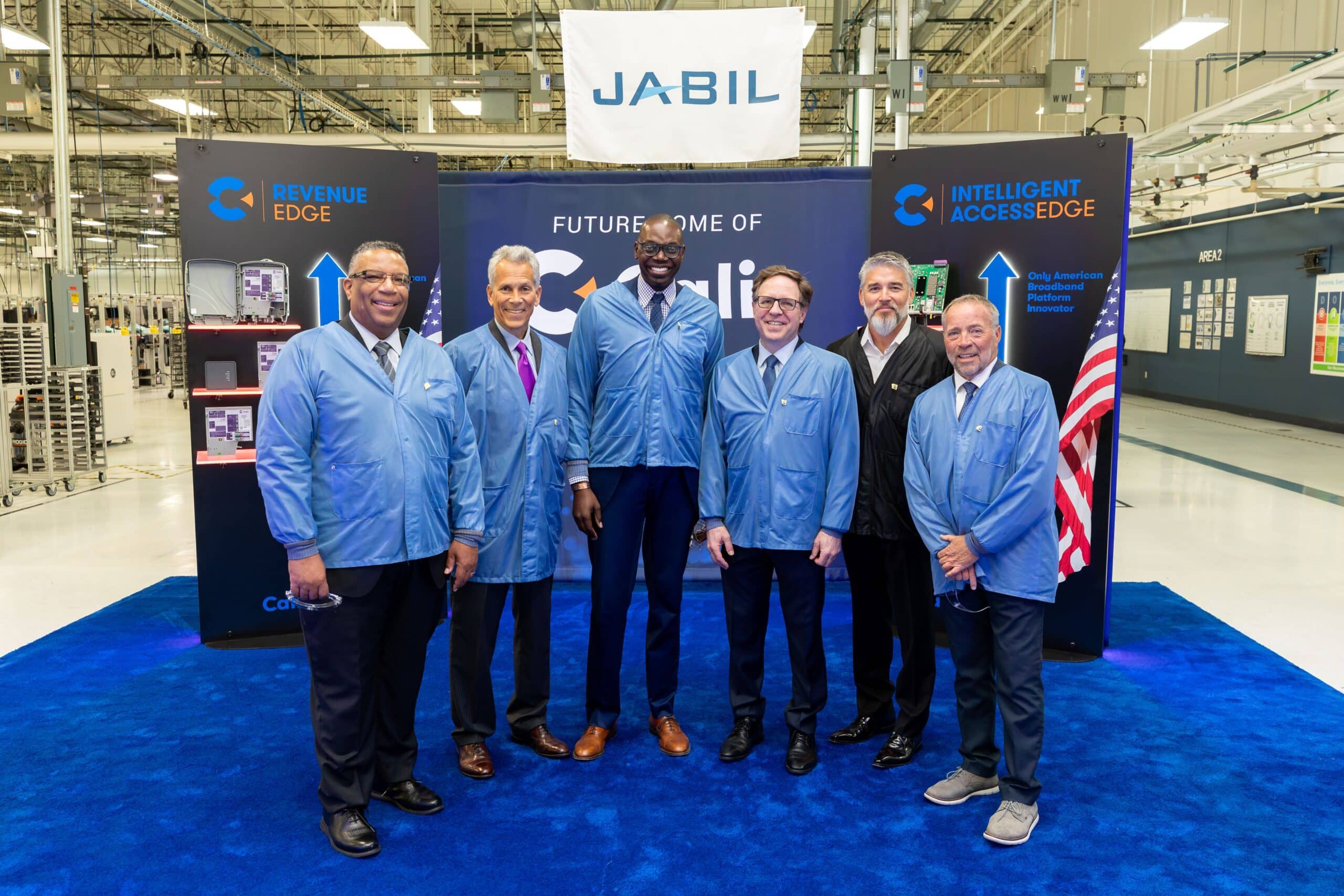
In September 2023, Russo appeared at Jabil’s Auburn Hills, Michigan, facility as Calix outlined American manufacturing plans tied to broadband funding requirements. Jabil would produce optical network terminals and optical line terminals in Michigan; other manufacturing partners would supply equipment from California and New Jersey. The cloud business still needed things that could be made, shipped and installed.
The subscriber at the end of the wire
At a software conference in May 2024, Russo described Calix’s position through the broadband provider connecting a subscriber to online applications and content. The ambition was to give those providers software and services they could offer under their own brands. The household might use the service without ever encountering the Calix name.
His examples included small businesses and community Wi-Fi. The underlying argument was that a local provider could draw on a shared platform rather than build every capability alone. Local knowledge could then become an advantage instead of small size being only a handicap. Russo presented that as the opportunity; delivering it remained the work.
His enthusiasm for fiber also came with boundaries. Discussing satellites in January 2021, he acknowledged their usefulness in extremely isolated locations while arguing that denser places favored other technologies. He framed the question around geography, capacity and economics. The lesson survives the particular technology debate: a solution acquires meaning when somebody specifies where it will be used.
By August 2025, he was discussing an agentic AI direction alongside Calix’s existing operating systems, cloud and managed services. He described a continuation of a long-running strategy. Whatever the newest vocabulary, the recurring concern was recognizable: help the provider make better use of the network and serve the person paying for it.
The handover that kept a partnership
Russo became Calix chairman in July 2021. In September 2022, Weening succeeded him as CEO, with the announcement following in October. Weening had already led multiple functions and served as president and chief operating officer. The transition placed someone with years inside the transformation in charge of its next stage.
“Michael has the right vision and leadership for Calix,” Russo said. He would focus on the board while their partnership continued. This was a different kind of departure from the racing separation: responsibility passed to a colleague who had helped construct the business being inherited.
In May 2026, shareholders elected Russo to another director term, running to the 2029 annual meeting. He remains chairman. The record now stretches from optical equipment and a conspicuous sale to the less easily photographed work of changing a company over many years.
The racing owner once watched his former driver win almost immediately after being dismissed. The Calix chairman has had to work with a slower measure of progress: colleagues assuming responsibility, customers learning new skills, infrastructure finding new uses. For a career with so many fast machines in it, the interesting achievement may be learning how long to stay.