A fencing tournament contains a small administrative miracle. People arrive with weapons, ambitions and very particular ideas about when they ought to compete. Somewhere, somebody must make the arithmetic behave. Brandon Rochelle has spent a considerable part of his life on that side of the equation. His company biography counts more than 400 fencing competitions around the world. His other occupation is co-founder, co-CEO and chief technology officer of Designsensory, the Knoxville agency he started with Joseph Nother in 2001.
The two pursuits make an intriguing pair. An agency promises to help an idea find its audience. A tournament promises competitors a workable place to compete. Both involve people, technology, limited resources and the possibility that a beautifully conceived plan will meet a rather inconvenient afternoon. Rochelle’s career offers a way to think about the work that happens between having an idea and letting everybody else use it.
Two friends, different equipment
Rochelle and Nother knew each other before there was an agency to run. Both belonged to Webb School of Knoxville’s class of 1999. College took Nother to the University of Tennessee, Knoxville, and Rochelle to Johns Hopkins. Their friendship survived the geography. While still students, they began building a business around their different abilities: Nother’s design interests and Rochelle’s technical expertise.
There is a practical charm to that beginning. The founding partnership allowed each to bring something the other could use. In 2001, a design and website agency gave that arrangement a commercial address. A friendship had acquired clients, deadlines and all the other accessories that rarely appear in the photograph of a bright idea.
Rochelle had already started a business at 18. He ran his consultancy while studying at Johns Hopkins, graduating with degrees in biomedical engineering and computer science and a minor in business entrepreneurship and management. His technical interests included distributed databases, information retrieval and web agents. Those are useful interests for somebody whose work would depend on getting information to move sensibly.
The business education continued with an MBA from Northeastern University, concentrating in entrepreneurship and marketing. He also became a Certified ScrumMaster, applying Agile and Scrum methods to project development. Taken together, his training covers the machinery, the organization of the work and the question of who might want the result. An agency needs all three, preferably before the invoice arrives.
- 1999Rochelle and Nother graduate from Webb.
- 2001Designsensory begins.
- 2014Rochelle becomes interim Tournament Committee chair.
- 2026The Webb classmates return as Distinguished Alumni.
The interesting part is where things meet
Rochelle’s technical work has included Designsensory’s custom e-commerce engine, database architecture, search optimization and online marketing strategy. His biography describes an executive who continued participating in the technical team. That combination puts the person making business decisions close to the work required to deliver them. A promise made in a meeting eventually becomes somebody’s development problem.
By January 2015, when he and Nother were being recognized in the Greater Knoxville Business Journal’s 40 under Forty, Rochelle was talking about a particular difficulty. A brand had to behave consistently across an expanding collection of places, each with its own conventions. A website, mobile app, video and social post could belong to the same organization while asking very different things of the people creating them.
His observation was straightforward: each technology had its own characteristics, and keeping the brand coherent across them was difficult. The point still gives his job a useful definition. Technical choices affect how people encounter a business. They influence what is easy, what is confusing and what requires more patience than a visitor intended to spend.
A year later, his reading list offered another glimpse of the same concern. In January 2016, Rochelle was reading Peter Thiel’s Zero to One and Peter Drucker’s The Effective Executive. He wanted to balance the habits of a startup with the incremental work of keeping an established business effective. He described that balancing act as requiring “patience and practice.” It is a pleasingly unglamorous prescription for a field so fond of announcing the next revolution.
“Patience and practice.”
Brandon Rochelle, on balancing innovation and everyday improvement, 2016
A second office, with fencing strips
Fencing gives the story a different scale and a different vocabulary. Rochelle competed in sabre at Johns Hopkins; the university’s record book lists him at the 2000 regional competition at Penn State. Years later, his involvement extended well beyond his own bouts. In July 2014, he assumed the interim chairmanship of USA Fencing’s Tournament Committee. The organization’s current committee listing names him as chair.
Consider what that responsibility contains. The 2014 committee report dealt with volunteer recruitment, computer-driven tournament operations, training and coordination across event calendars. By 2018, the agenda included pool sizes, scoresheet protests, qualification pathways and a review of tournament formats. These are the details that turn a collection of competitors into a competition. None is likely to earn a slow-motion replay.
There is a recognizable technical problem underneath those lists. A tournament has inputs, rules, bottlenecks and users who care intensely about the outcome. It also has a venue with physical limits. Giving everybody a fair opportunity requires attention to the system that surrounds the individual performance. The fencing itself may take seconds; the arrangements behind it have a much longer life.
In 2019, Rochelle’s travels for the sport had taken him to Hong Kong, Seoul, New York, Denver and Kansas City, with Shanghai next on the itinerary. He still competed himself. That combination kept the administrative and competitive sides of the sport in the same biography. A person can help decide how tournaments should run and still have to turn up for a bout.
Fencing competitions run worldwide, as counted in Rochelle’s Designsensory biography.
His standing among officials also has a concrete electoral footnote. In January 2024, referees elected Rochelle, Matt Tucker and Bruce Gillman to the Referees’ Commission Nominating Committee. Rochelle received 50 votes. That committee helped choose nominees for the commission’s general election. It was another assignment concerned with who makes the arrangements, rather than who collects the medals.
Even the timetable has an audience
In a March 2024 episode of First to 15, recorded at the Junior Olympics, Rochelle talked through the work of running a tournament. He returned to the USA Fencing podcast in June 2026 to explain an events restructure scheduled to begin that August. The subject was practical: event tiers, points and the experience of the people spending their day inside the venue.
One problem he described was flighting. When a field exceeds the available space or staffing, competitors cannot all begin their pool rounds together. One group starts, another waits, and the schedule becomes longer. Splitting large fields into elite and national events was intended to give organizers more flexibility in arranging the competition.
Rochelle discussed the possible benefits for athletes, coaches, parents, spectators and officials. Coaches moving between distant strips were a particular logistical concern. He even entertained the image of getting them Segway scooters. It is a small comic moment in a conversation about tournament design, and a reminder that a diagram of a venue leaves out the person hurrying across it.
The proposed time savings were projections. What matters for understanding Rochelle is the question behind them: how could the event’s structure make the day work better for the people attending? That question sits comfortably beside his concern about digital experiences. Whether the route runs through a website or a convention center, somebody has to think about the person trying to get somewhere.
The technologist has production credits, too
Rochelle’s business interests also extend into filmed storytelling. He and Nother co-founded PopFizz with Bryan Allen. A 2015 Knoxville Entrepreneur Center interview described a production company working across photography, video, motion and film, alongside the agency the two friends had already built. Their partnership was finding another medium.
In August 2025, the Designsensory founders announced that they had acquired full ownership of PopFizz as Allen left to pursue other ventures. The production company’s work included Tennessee Uncharted, Lil Jon Wants To Do What and Remastered, alongside campaigns for clients including NASCAR, Bush’s Beans and Dollywood. PopFizz would continue operating independently while drawing closer to Designsensory’s strategy and brand work.
Rochelle’s comment about Allen was specific and affectionate: “His love of visuals and storytelling shaped the company from day one.” Giving a collaborator that credit says more about the partnership than a list of production capabilities could. Businesses are described in services; their histories are made of people whose contributions are harder to put in a dropdown menu.
At Good Gravity Entertainment, Rochelle is also a partner and executive producer, alongside Nother and a leadership team that includes head of development Madelyn Cunningham. The studio develops digital, branded and unscripted entertainment. A career that began with engineering and websites now includes helping stories reach screens. The technical and creative sides of the original friendship continue to share a table.
Back to Webb, looking forward
On September 10, 2026, Rochelle and Nother returned to Webb for the school’s Distinguished Alumni Award. Designsensory was marking its 25th anniversary. The classmates who had started with complementary skills were leading an agency of more than 35 people. During their visit, they spoke with students across the school’s three divisions about entrepreneurship, friendship, learning, technology and artificial intelligence.
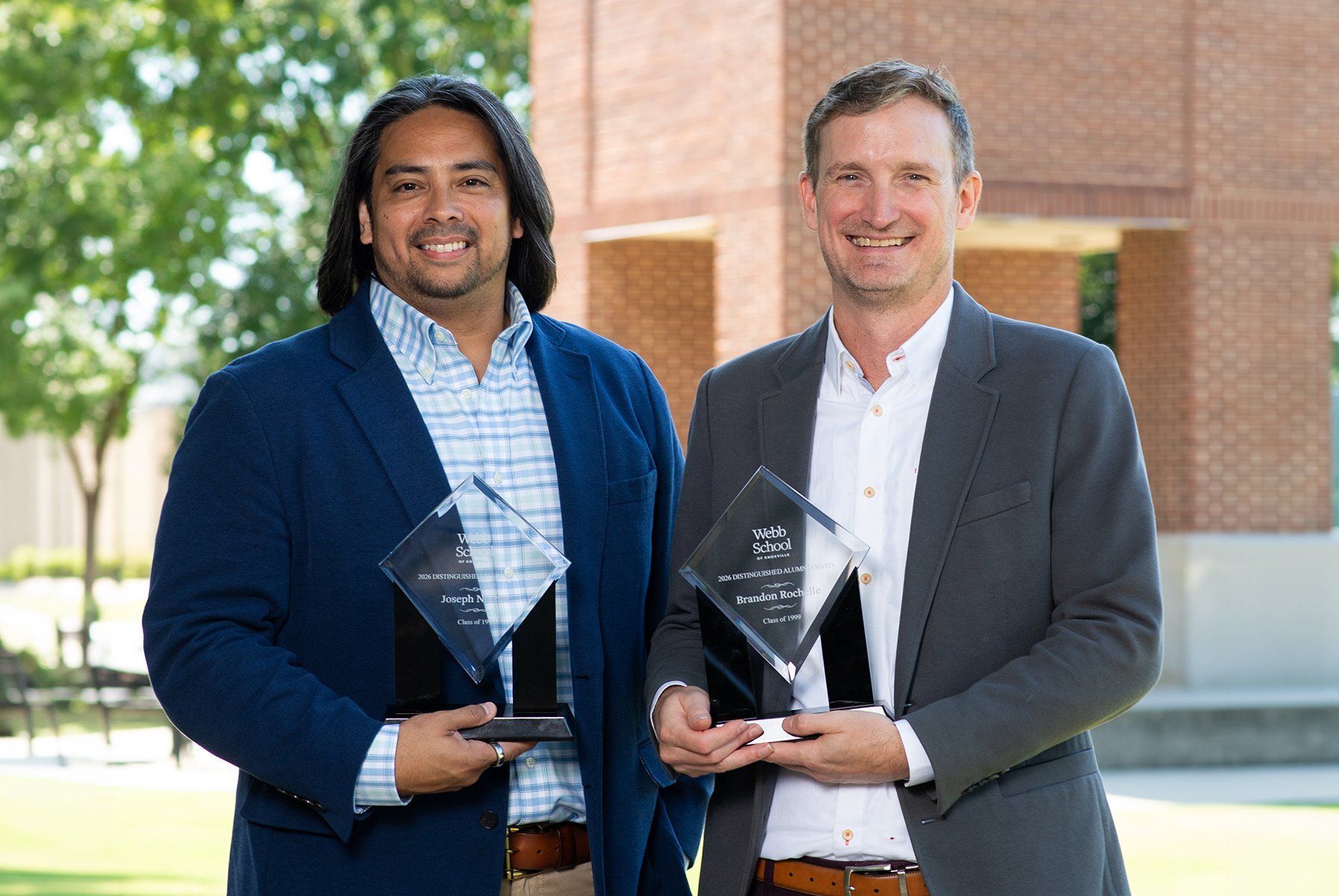
Rochelle’s advice emphasized the ability to “adapt, stay curious and surround yourself with people who challenge your thinking.” After a quarter-century in business with a friend, that last part carries some weight. A good partner brings a different answer into the room. Keeping the partnership useful means leaving space for it.
The return to school makes a satisfying scene, but the fencing timetable offers an equally revealing picture of his work. There are people waiting to begin, constraints that cannot be wished away and a plan that needs improving. Rochelle has spent years arranging those encounters. The next useful idea may arrive as a new platform, a production or a better way to start the morning’s bouts. Somebody still has to make it work.
Keep following the thread
More on the partnerships, the projects and the sport.
- Designsensory
- Rochelle’s company biography
- The Webb alumni award
- The January 2016 reading list
- The 40 under Forty recognition
- Fencing travels, 2019
- USA Fencing committees
- Listen and read: the 2026 tournament conversation
- Listen: behind the tournament scenes, 2024
- The 2024 referees’ election
- The PopFizz ownership announcement
- Good Gravity Entertainment
- Johns Hopkins fencing record book
- Tournament Committee report, 2014
- Tournament Committee agenda, 2018
- The early PopFizz partnership