A pharmaceutical company can know a great deal about a treatment and still struggle to tell the right people about it. Somewhere between the clinical evidence and the advertisement sits a procession of audience files, agency briefs, vendor meetings and measurement reports. By the time the procession arrives, the campaign may already need changing. BranchLab has built its business around this awkward interval: the distance between knowing something useful and being able to act on it.
- Learn from de-identified health journeys; activate with non-health signals.
- Put audience design, advertising and measurement into one working loop.
- Test whether patient subgroups mean something before trusting the model.
Its platform, Pathwai, serves pharmaceutical manufacturers, advertising agencies, publishers and platforms. The work is commercialization: helping healthcare organizations identify relevant audiences, reach them and measure what follows. BranchLab does not provide care. The distinction matters. A well-placed advertisement might begin a useful conversation; it cannot establish that a particular medicine belongs in a particular person’s life.
The information changes clothes
The intriguing part of BranchLab’s proposition is the boundary between learning and deployment. Its models study de-identified health journeys, looking for patterns associated with outcomes. Those patterns inform groups of similar clinical trajectories. For advertising, the company maps models into demographic data and other non-health signals. The health record helps teach the system; individual-level health information is not what BranchLab says it deploys into media.
This is subtler than saying the company avoids health data. It uses such data in learning. Its May financing announcement describes training within customer-controlled environments and deploying non-sensitive demographic and media-side signals. The distinction is an architectural choice, with consequences for which information moves between organizations. Calling something privacy-first is easy. Describing where the information stops is more revealing.
For a buyer, the attraction is practical. An agency can create audiences around a health-related commercial objective, activate them and revise the approach as outcome information arrives. A publisher can apply models to its own demographic inputs. The intended improvement is a shorter, more connected decision cycle, rather than another audience file whose assumptions quietly age in a folder.
The model that passed the wrong test
In January 2026, Kat Drake, BranchLab’s vice president of data science and AI, described a revealing experiment involving a metabolic disease. She wanted to know whether recognizing different clinical subgroups would improve predictions made from demographic information. The idea had precedent in precision medicine. Its usefulness for this advertising problem was still a hypothesis.
The obstacle was deceptively ordinary: algorithms can divide a population into clusters even when the divisions are unhelpful. Drake reported that some models performed well on conventional measures without capturing meaningful clinical differences. In one comparison, the groups were distinct; in another, they were scarcely distinguishable. A neat partition was insufficient evidence.
“you can always cluster data, but it doesn’t matter if the clusters aren’t meaningful.”Kat Drake / January 2026 research note
BranchLab’s evaluation therefore examined whether the groups represented real clinical variation. Drake reported that using meaningful heterogeneity improved the demographic prediction model’s ROC AUC by more than 10%, compared with predicting the disease outcome without it. That is a company-reported modeling result for a particular experiment, not a claim that patients became 10% healthier.
The experiment offers something readers can borrow: inspect what a model’s categories represent. A score can reward separation without explaining whether the separation helps the decision. Here, testing the groups themselves changed the basis for judging the model. That lesson travels comfortably beyond pharmaceutical marketing.
An agency brings its own ingredients
The commercial example arrived in February 2026. Dentsu announced an integration of its proprietary data with Pathwai. The partnership combines demographic intelligence with BranchLab’s audience modeling, bringing audience design into the agency’s own workflow. Dentsu’s Brad Fox described the integration as a way to connect real-world health outcomes with privacy-conscious consumer intelligence.
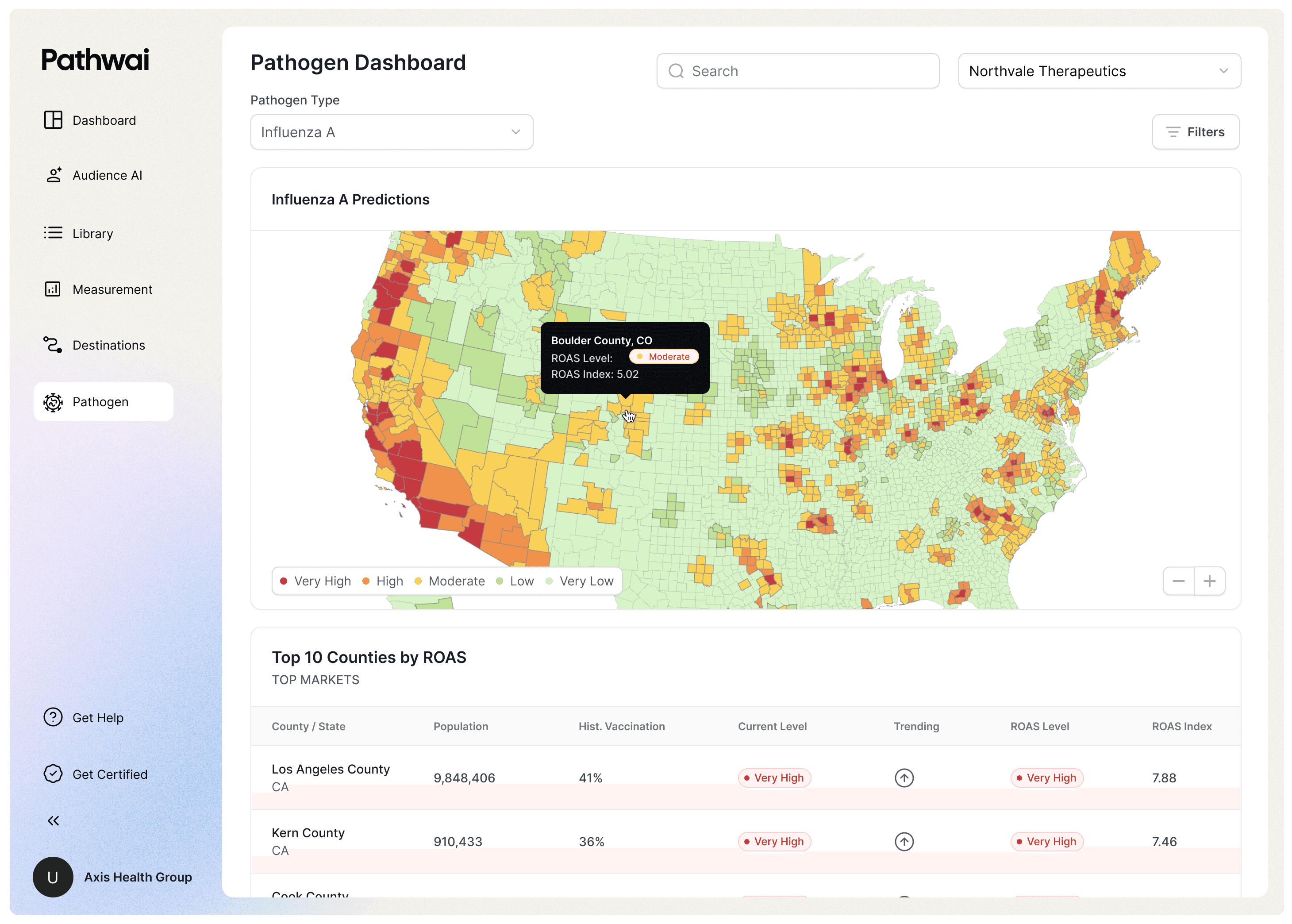
This is where BranchLab fits in the market: between healthcare data intelligence and advertising execution. Claims-based audience vendors and predictive targeting providers are alternatives for parts of the task. Separate planning, media and measurement tools can assemble a comparable workflow. BranchLab’s distinction is its proposed combination of outcome modeling, non-health deployment and a system that connects the stages.
Its business is consequently an enterprise platform proposition, with access requests and integrations rather than a consumer checkout. A prospective customer must establish the scope, data arrangements and commercial terms with the company. The useful buying question is the cost of producing a validated, usable audience and measuring the result, including the work required to connect existing systems.
Capital for the space between systems
BranchLab was founded in 2024 by Josh Walsh, Michael Parkes and Chris Cagle. A June seed round led by Newark Venture Partners, with Aperiam participating, supported development and expansion of privacy-safe healthcare advertising for television. A September 2025 investment from Next Ventures followed. By 2026, the public pitch had widened into connected pharmaceutical commercialization.

On May 13, 2026, BranchLab announced a $26 million Series A led by McKesson Ventures, with FCA Venture Partners, Sanofi Ventures and AIX Ventures participating. Total reported funding reached $35 million. The stated spending priorities were enterprise deployments, healthcare and media integrations, and further platform development. Those figures describe financing, not what a customer pays.
Investor capital for expansion. Customer pricing is a separate calculation.
A shared meaning, before a shared dashboard
In August, BranchLab described Pathwai as a Semantic Activation Platform. Behind the terminology lies a recognizable complaint: brands, agencies and partners often work from different briefs and interpretations. The proposed remedy is shared commercial intelligence connecting planning, activation and measurement. Its privacy-information resource, launched that month with eight states, addresses another source of disagreement about what teams can do.
September brought Stanford AI researcher Christopher Manning onto the scientific advisory board. Manning is also a partner at investor AIX Ventures. Alongside Drake’s healthcare data-science experience, the appointment reflects a broader problem: connected software needs a dependable interpretation of the information passing through it.
That ambition remains conditional. Meaningful training groups, suitable demographic inputs and trustworthy outcome measurement all matter; an attractive interface cannot supply them by itself. For a team considering Pathwai, the sensible next step is a defined pilot with an agreed outcome and a credible comparison. BranchLab’s most persuasive idea is also its most testable: shorten the distance between an audience decision and the evidence that tells you whether it worked.