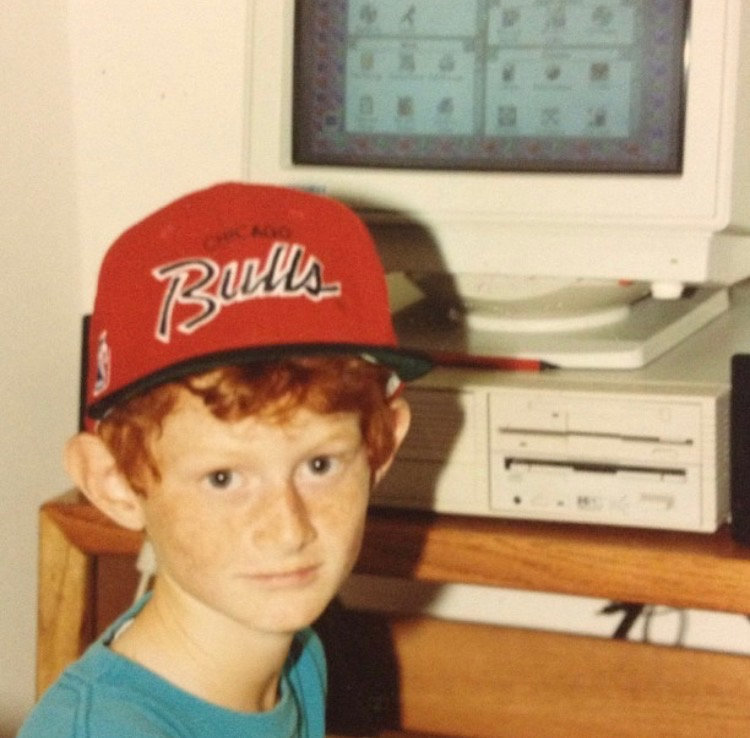
There is a photograph of Bradley DeLoatche as a boy beside a home computer, wearing a Chicago Bulls cap and the guarded expression of somebody interrupted mid-thought. Behind him sits a beige monitor, a keyboard and enough plastic casing to furnish a small kitchen. The image appears on his music page now, which makes it doubly useful. It catches both halves of the adult résumé before either had become a résumé: the machine and the performance.
DeLoatche has spent nearly three decades working where technology, marketing and business overlap. His public career begins in 1997 at a company with the wonderfully period-specific name Webtising Company. He moved from web designer to agency owner, then agency partner, digital strategist and eventually cofounder of Snappy Kraken, the marketing-technology company built for financial advisors. Along the way he also hosted radio, appeared on MTV, won a local entertainment award and helped write a feature-length orchestral score.
This is less a collection of side quests than it first appears. Marketing automation and film music both depend on sequence. Something happens, then the next thing must arrive at precisely the useful moment. A prospect clicks. A contact changes stage. A gargoyle appears over medieval Paris. The systems are different, but the craft is familiar: arrange a chain of events so that machinery produces a human response.
“I love helping people, I love entertaining, I love technology, and I love business.”Bradley DeLoatche, public biography
The web grew up. So did the job.
In 2000, DeLoatche left Webtising and began an eleven-year run as the owner of North Lake Media. The dates matter because they describe an apprenticeship during the internet's awkward commercial adolescence. A web designer in 1997 did not merely choose fonts and argue about button colors. The work could include hosting, server configuration, databases, sales, client education and the delicate art of explaining why a business might need a website at all.
Old technical-forum posts under DeLoatche's familiar handle, bradleyjond, preserve the practical texture. In 2011 he was troubleshooting an HTTPS connection and discovered a closed firewall port. A decade later he was comparing notes with other developers about intermittent database timeouts involving Laravel, AWS and Aurora MySQL. The stack changed. The posture did not: describe the failure, test the system, ask the community, keep hunting.
In April 2011, he became a partner at Modernactive, an Ocala agency that built websites and marketing systems for small businesses. Its plainspoken pitch was telling: build websites into businesses, stay ahead of technology and keep the jargon under control. Three years later DeLoatche moved into financial services as director of digital strategy at Platinum Advisor Strategies. Angel Gonzalez, his Modernactive partner, also worked there. The pair would soon join Robert Sofia in a larger experiment.
A sea monster with a workflow
Snappy Kraken launched in 2016 with an intentionally peculiar name. The founders wanted something unlike the sober brands surrounding financial advice. The mythical monster became friendlier with sunglasses; the absurdity made the company memorable. Under the mascot, however, sits a serious constraint. Financial advisors need regular, personal communication, but they also work inside compliance rules. Every useful shortcut must still respect the guardrails.
The founding trio also brought a useful division of attention. Robert Sofia became the chief executive, Angel Gonzalez led marketing, and DeLoatche took the technology and product side. Their shared history did not begin with a venture pitch. DeLoatche and Gonzalez had already been partners at Modernactive, and both had worked at Platinum Advisor Strategies before Snappy Kraken. By 2025, the resulting company served thousands of individual advisors and roughly 200 enterprise clients. That scale changes the product question. A campaign no longer needs to work only for one clever marketer at one desk. It must be configurable enough for firms, usable enough for advisors and structured enough for compliance teams to understand what is moving through it.
DeLoatche's contribution is easiest to see in the product language. He has been presented as founder, CTO, marketing technologist and Chief Product Officer, titles that circle the same responsibility from different directions. The job is to translate the messy business request into a system that behaves. Campaigns need content, personalization, segmentation, CRM integration, approvals, delivery and measurement. Each piece must pass information to the next without making the recipient feel processed by a conveyor belt.
The company's AUM Pipeline Dashboard, released in September 2025, shows how that translation has matured. Instead of stopping at opens and clicks, the dashboard follows potential assets under management through configurable pipeline stages. At the advisor level, DeLoatche explained, contacts can be segmented and moved using filters fed by marketing engagement, AI lead capture, CRM records and enrichment services. At the enterprise level, firms can see the stages across advisors and connect marketing work to a forecast executives understand.
That progression captures a wider change in digital marketing. The first commercial websites proved that a company existed online. Later systems proved that somebody had looked. Product leaders are now asked to prove that attention moved a business. DeLoatche's career has traveled the same distance, from designing pages to designing the evidence chain behind them.
Then the screen went silent
In 2014, while working in advisor strategy and two years before Snappy Kraken's launch, DeLoatche collaborated with conductor Matthew Wardell on new music for the 1923 film The Hunchback of Notre Dame, starring Lon Chaney. They wrote 108 minutes for strings, flute and percussion. Wardell has conducted silent films and studied the meeting of image and sound; DeLoatche brought a different working life into the room. The score was updated in 2024, a decade after it was first written.
The undertaking gives useful scale to a word like “creative.” A feature-length score is too long to survive on one clever motif. It needs architecture, repetition without tedium, transitions that the audience feels before it notices, and enough restraint to serve images made ninety-one years earlier. Those are compositional demands. They also resemble the problems of a long automated campaign, where one message must prepare the next and every cue needs a reason to exist.
Wardell's portfolio breaks the score into scenes with titles such as “STOP! Esmerelda,” “Jehan's Death and Finis,” “The Lashings” and “Truth and Consequences.” The published clips are short, but together they point back to the full assignment: accompany a story for nearly two hours without speech doing the explanatory work. The instrumentation is compact rather than symphonic excess - a string body, one flute and percussion. DeLoatche's name beside Wardell's on that score is a reminder that technical people often practice their sense of timing somewhere nobody thinks to look for it.
The Ocala connection matters here. DeLoatche's public story is rooted in a city rather than a coastal technology capital. He built agencies there. Ocala Magazine named him to its 40 Under 40 in 2015 and gave him a Best Local Entertainer award. He guest-hosted radio programs and appeared on MTV. In 2023, the local arts community announced the return of an orchestra-backed screening of Hunchback with the Wardell-DeLoatche score. The technologist's side project had become part of the city's cultural program.
A score tells musicians what should happen next. A workflow tells software. The interesting part is whether either one makes a person feel something.
The respectable value of going for it
There is still another clue in DeLoatche's music. On Christmas Day 2010, he released an eleven-track album called Christmas Brad under the name It's Bradley. Its description calls it the holiday journey of an overexcited manchild who does not really know the words but goes for it anyway. The track list delivers on the promise: “Frothsty The Snowm'n,” “Looks Like Kresmess” and “Winder Wanderlond” sit beside “Everyone's Favorite Radio Show (Bramble Tramble).” It is difficult to confuse any of this with executive positioning.
That may be why it belongs in the profile. Financial technology rewards predictability. Compliance workflows exist precisely to reduce surprise. DeLoatche's creative work gives surprise another address. The comic record can mangle a lyric. The film score can swell. The product can remain dependable. Professional seriousness does not require personal solemnity, a fact too many biographies learn only after removing every recognizable human detail.
His own four-part description - helping, entertaining, technology and business - is unusually efficient because the chronology supports it. Helping explains the service instinct in an advisor platform. Technology supplies the machinery. Business insists that the machinery produce an outcome. Entertainment keeps the message from becoming wallpaper. Remove any one and the career grows easier to label but less accurate.
The boy beside the beige computer could not have known that web pages would become automated campaigns, or that marketing metrics would one day end in forecasts of assets under management. The photograph offers no evidence of destiny, which is fortunate. It offers something better: a machine close enough to touch and a child willing to sit beside it. The rest came through sequence - one role, one agency, one product and, occasionally, one improbable musical cue after another.