Brad Buchanan’s future once looked as if it would come through a telephone line. He had worked in telecommunications. His father had run a telephone company. Buchanan prepared a lengthy plan for a venture of his own, called GeoTel. Then the plan stalled. The opportunity that eventually arrived belonged to an older communication system: the newspaper. There is something pleasing about a media-monitoring founder finding his next business through an advertisement in the local paper. Before Buchanan could help customers search the news, he used it to search for a livelihood.
He founded Newz Group in 1995. The business would grow through press-clipping acquisitions and relationships with state newspaper associations, gathering material that customers wanted to find again. Buchanan’s route into that work gives the company a human scale. A career changes course. A modest service has room for improvement. An entrepreneur sees work worth doing in a trade that already exists.
A family trade, with room to leave
Buchanan came from a family accustomed to running businesses. His father, Waldo, and grandfather, R.S., had each done so before him. Brad’s own early duties included cleaning telephone booths. That is a rather literal introduction to communications: before considering what people say, somebody has to clean the place where they say it.
In 1989, Brad earned an MBA at the University of Missouri-Columbia. His brother Scott earned his law degree the same day. In 1997, Scott and Waldo joined Newz Group. By then, the family connection had moved into another industry. Brad’s experience had crossed with him; the original telephone venture had stayed behind.
A change of industry can look tidy when reduced to a career entry. It is less tidy as a business decision. Knowing a field offers reassurance, but familiarity does not guarantee an opening. Buchanan’s story allows for that awkward interval when preparation has produced a plan without producing a company. The next step came from looking for an existing opportunity, close enough to examine.
“I saw an industry that had not moved with technology.”
Brad Buchanan, 2007
The Arkansas clipping-service purchase supplied that opening. Iowa followed in 1996. The company later reached Colorado, its tenth state, in 2007. Each acquisition widened the collection of newspapers it could handle. The expanding map gives this career its working geography: a Columbia base, relationships across state lines, and a service whose usefulness depended on what it could actually collect.
The page has to get there first
Media monitoring sounds simple until one considers the first practical question: where does the material come from? A search box is an invitation. The collection behind it determines whether anyone receives an answer. For a business serving people who need newspaper mentions, obtaining the pages is part of the product.
Newz Group’s present coverage rests on direct partnerships with press associations in twelve states. Its company history identifies digital processing in 2002, followed by a transition to receiving complete PDF editions between 2009 and 2011. These are operational milestones, the sort that can disappear inside a phrase like going digital. They concern how a page enters a system and what becomes possible afterward.
Receive the editionPublisher PDF02
Keep the pagesDigital archive03
Find the mentionMonitoring result
The company’s timeline puts its archive above 20 million PDF pages in 2015. Online monitoring joined that year, and social and broadcast monitoring followed in 2019. The sequence shows a business adding channels while retaining a relationship with the newspaper page. The archive grew alongside the service that helped finance it.
There is an everyday discipline here. A newspaper edition contains more than a list of article headlines. Receiving the complete edition keeps the page as a unit. Saving it also creates a future obligation: the file must remain identifiable and retrievable. Storage is the beginning of preservation’s paperwork, with the paperwork now performed on files.
The economics inside the archive
Buchanan described an arrangement in which newspapers received digital archiving without a fee in return for licensing content for Newz Group’s monitoring service. That exchange gave preservation a place inside a working business. Publishers supplied material; the monitoring operation could use it; the newspaper acquired an archive.
The appeal of such an arrangement is easy to understand. Saving material requires resources even when nobody requests it this afternoon. Linking that work to an ongoing service creates a reason to continue collecting. An archive can serve historical interests while also doing a useful job in the present tense. Its survival need not wait for a ceremonial anniversary.
“We receive PDFs from newspapers and archive them in a digital format.”
Brad Buchanan, on newspaper preservation
He also discussed standardizing file names, transfers and storage, and explored whether newspapers could include archive access in subscriptions. These were practical concerns about making preservation workable. A collection gains value when people can navigate it. Compatibility helps material travel between systems without requiring every participant to invent the procedure again.
That gives Buchanan’s entrepreneurial interest a particular shape. His public comments return to volume, workable systems and a continuing economic reason to save pages. The ambition is expressed in the mechanics. A preserved edition needs a place to live, a way to be found, and an organization able to keep attending to both.
Sixteen months, on a thumb drive
In May 2012, a storm disabled the server at the Centralia Fireside Guard. The newspaper recovered roughly 80 percent of its computer files, leaving material missing. It had been sending PDF pages to Newz Group for sixteen months. Those copies were still available.
On May 21, Buchanan took a thumb drive to Centralia containing the PDFs the paper had supplied. The archive helped the newspaper recreate important material. General manager Jeff Grimes described the help with evident relief. The account brings the value of preservation down from a large storage number to a delivery someone could hold between finger and thumb.
The June 2012 photograph shows Buchanan holding the drive. It is an unusually compact business illustration. Almost everything that makes an archive useful sits outside the frame: the repeated transfers, the kept copies, the possibility of retrieval. By the time a newspaper needs its own pages back, those earlier routines have already done the essential work.
Consider the difference between promising to preserve something and returning it. Preservation acquires a plain, testable meaning in that exchange. The page can be opened again. Material that appeared lost can be consulted again. A routine service becomes visible at the moment its ordinary purpose meets an urgent need.
Another day among newspapers
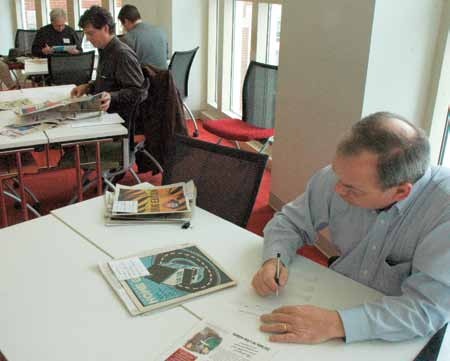
A different photograph places him at the Reynolds Journalism Institute in March 2013, helping judge the Missouri Ad Managers’ Contest. Buchanan sits in the foreground studying an entry; other judges work behind him. Here the newspaper business looks like tables, chairs and attention. The pages have arrived, and somebody is spending time with them.
His involvement also appears in a January 2010 press-association bulletin describing a November meeting about newspaper content control. Brad, Scott and Ian Buchanan attended for GeoTel. The discussion concerned cooperation among publishers and associations. Collecting news, licensing it and deciding how it moves were shared industry questions as well as company business.
The two settings complement each other. One concerns the individual work on a printed page. The other concerns arrangements that let content circulate. A service operating between publishers and customers needs to understand both. Newspaper relationships involve the finished material and the people responsible for producing, owning and distributing it.
What carries forward
Buchanan is Newz Group’s founder and former President/CEO. Public corporate records for GeoTel list him as a director and Ian Buchanan as president. The legal name preserves a connection to the earlier business plan, even as the company’s daily work concerns an assortment of media channels.
Today Newz Group advertises print, online, social and broadcast monitoring in one service. Its website reports processing more than 200,000 newspaper pages a month and monitoring more than 36,000 U.S. news websites. Those are company figures, describing the operation Buchanan founded rather than a personal tally. The distinction matters in a family business whose work continues across generations.
Customers can review mentions, analyze coverage and arrange alerts. Those conveniences depend on an earlier, less visible accomplishment: getting the relevant material into reach. Buchanan’s career offers a useful perspective on that work. The entrepreneur who began by looking through a newspaper for an opportunity built a company that helped others find what they needed in newspapers. Sometimes, as in Centralia, that meant helping the newspaper itself.
The two ends of his working life share a practical concern: whether information reaches the person who needs it. A telephone connection performs that service in the moment. A newspaper archive may perform it years later. The delay changes the work. Someone has to anticipate retrieval before knowing who will ask, or which page will matter. Buchanan’s business gave that anticipation a routine, commercial form. The pages arrived for monitoring, accumulated as an archive, and remained available for another use. In Centralia, the person asking happened to be the publisher that had supplied them.
A thumb drive makes a modest monument. It fits the story. The evidence of the work is the page that can still be found, passed along, and opened when someone needs it.