Teresa Maledy had a view worth keeping. During the renovation of Commerce Bank’s downtown Columbia building, she asked architect John Simon to turn her former top-floor corner office into a conference room. More people, she reasoned, could then enjoy the view along Broadway. It was 2010. The bank was reopening its doors, and one of the privileges associated with being in charge was becoming a room other people could book.
There are more imposing entries on Maledy’s résumé. She became the first woman to hold a president title in the Commerce system. She helped establish a community foundation. She won a school board election. But the office decision has the advantage of being easy to picture. A good view, usually reserved for one person, could serve several. The furniture would have to cooperate.
A career that came home
Columbia was Maledy’s hometown, although her working life also took her to Commerce operations in St. Louis and Kansas City. Her education crossed disciplines: an associate degree in art/design at Stephens College, followed by a bachelor’s degree in business administration at Webster University. Stephens identifies her with its class of 1978.
Those credentials make an interesting pairing for someone whose work would eventually include both bank management and the renovation of a historic building. They do not explain every decision she made. They do place her career at an intersection of practical organization and attention to the spaces people use.
Early in management, she pushed for a treasury-services role after being told the opportunity might come later. Once in the job, she spent evenings studying the industry. Her description of her own working manner was restrained: calm, consistent, respectful, positive. She also volunteered for committees and task forces, which exposed her to parts of the bank she might otherwise have missed.
“Because your team is counting on you”
Teresa Maledy, on the responsibility of leadership, 2017
The lesson she drew concerned daily conduct. Colleagues formed judgments long before a promotion became available. Being ready for the job involved what they had already seen you do. It is an unglamorous theory of advancement, with the considerable advantage that a person can put it to work before anyone offers a better title.
Five towns, one regional responsibility
In 2002, Maledy became president of Commerce’s Central Missouri region. The distinction attached to that appointment was specific: she was the first woman to earn a president title within the Commerce system. Her responsibilities were regional, encompassing Columbia, Moberly, Mexico, California and Tipton.
A regional bank leader has to think across communities without treating them as interchangeable. A branch network is a collection of places where people expect their particular needs to be understood. In Maledy’s case, the work combined the resources of a larger institution with the daily visibility of doing business in her hometown.
One concrete expansion arrived in 2006. Maledy and Boone National Savings and Loan president Rick Kruse announced an agreement for Commerce to acquire Boone National’s banking business. Boone National had approximately $150 million in assets and four Columbia branches, as well as loan-production offices in Ashland and Lake of the Ozarks.
The announcement described a transaction awaiting regulatory approval. Behind its formal language lay the familiar work of combining customer relationships, employees and local operations. The acquisition also brought Commerce into the story of a conspicuous downtown building.
The building behind the view
At Ninth and Broadway, the Haden building carried a history longer than either bank’s occupancy. Earlier structures on the site had burned. The replacement erected in 1921 wore white-glazed terra cotta and classical architectural details, including tall columns and Corinthian pilasters. It was a building with a public face.
Commerce undertook an extensive renovation and reopened it in May 2010. The location became the regional headquarters, accommodating executives, the trust team, human resources and a retail banking lobby. In 2011 it was recognized among Columbia’s Most Notable Properties.
Reusing such a building means making choices about how an inherited space should work now. The conference-room request belongs among those choices. It altered who could occupy one desirable corner without requiring an entirely new building or an elaborate declaration of principle.
Giving needs somewhere to go
While the bank renovation was underway, Maledy was also involved in building an institution without a distinctive façade. In November 2009, as chair of the New Century Fund board, she went before Columbia’s City Council to discuss creating a community foundation.
The New Century Fund already offered a route for charitable gifts benefiting city services. A broader foundation could help public and private resources work together and make giving more efficient. Fellow board member Bob Gerding discussed the administrative services a relationship with a larger foundation could provide, including accounting, donor correspondence and payments to recipients.
This was the organizational side of generosity. A donor’s intention still needs a way to travel from promise to payment. Records, transactions and oversight are part of that journey. Their usefulness is easier to appreciate when they are missing.
In 2010 Maledy became founding chair of the Community Foundation of Central Missouri. The institution’s purpose connected donors with causes they wanted to support. For a banker accustomed to managing relationships around money, the overlap was substantial.
Her other civic commitments ranged across the city’s institutions. Columbia Rotary South lists her as its 2003 president. Stephens College gave her its Alumni Achievement Award that year. The local Women’s Network honored her with its ATHENA award in 2009. In 2014, the Greater Missouri Leadership Foundation named her Woman of the Year.
There were connections to younger leaders, too. University of Missouri educator Leigh Neier named Maledy among her mentors. Shelter Insurance executive Teresa Magruder described Maledy’s ability to bring people together and turn shared purpose into action. Such observations help explain the network surrounding the titles: people who had worked with her, learned from her or watched her organize a group.
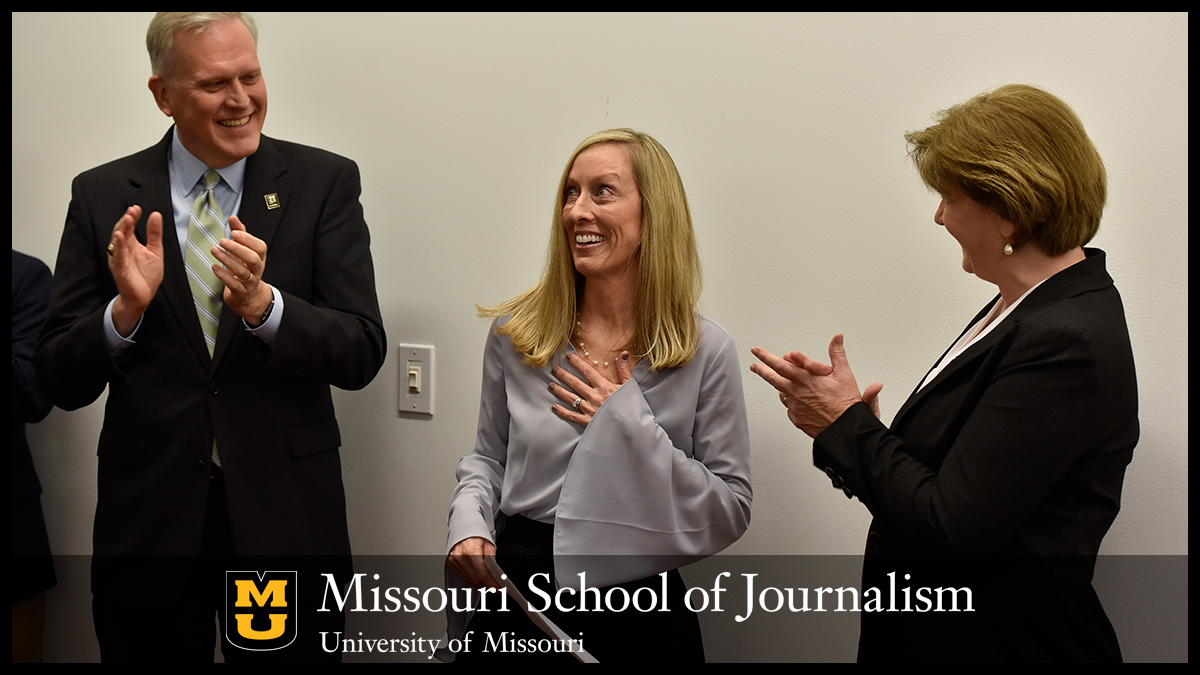
In March 2018, Maledy joined Chancellor Alexander Cartwright in surprising professor Shelly Rodgers with a William T. Kemper Fellowship for Teaching Excellence. The award included $10,000. The photograph catches a different register of institutional life: the delighted moment when someone’s careful work receives attention.
The eight-parking-space question
Civic participation also includes matters unlikely to produce a celebratory photograph. In May 2012, Maledy wrote to Columbia officials about a proposal to add a left-turn lane from Broadway onto Fifth Street.
Her letter questioned the trade-off. The change would remove eight metered parking spaces. She worried about neighboring businesses, increased use of the bank’s parking lot and the consequences of parallel parking on Broadway. Commerce had its own parking, she explained, but that did not remove the problem for surrounding businesses.
The point was practical: a change designed to improve one movement through downtown could complicate several others. Counting the benefits required counting the displaced spaces as well.
In an October 2016 planning hearing, she raised another question about how the city’s rules would work on the ground. Banks regarded their lobbies as retail outlets, she said, and she wanted ground-floor permitted uses to accommodate financial services. Speaking as a banker and a REDI board member, she also discussed how development timelines could affect commercial properties.
These interventions put her professional interests plainly on the table. They also show the scale at which much local leadership operates: wording in an ordinance, time allowed for a project, places to leave a car. A city is partly made of such details.
A different kind of accountability
In April 2018, Maledy entered elected office. She received 8,162 votes in the Columbia school board election, leading a field of five candidates for two seats. Susan Blackburn won the other seat.
Financial experience had an obvious application. By her 2021 reelection campaign, Maledy had chaired the district’s finance committee for two years and had also chaired its Long Range Facilities Planning Committee. Those responsibilities concern choices whose consequences can outlast a board member’s term.
Her stated priorities included closing achievement gaps, retaining quality teachers and maintaining community confidence and financial support. In a separate candidate interview, she discussed early literacy and enrichment opportunities, emphasizing that students needed approaches suited to their circumstances. The argument brought budgets back to the people the district existed to teach.
Her campaign also included an unusual financial decision: she chose to forgo fundraising. She had raised money for the earlier race and donated the surplus to the Columbia Public School Foundation and Cradle to Career Alliance. In 2021 she said the search for a new superintendent was occupying her attention.
“I decided not to raise any money,” she said. It was a decision about campaigning, rather than a guarantee of electoral success.
In April, voters chose Katherine Sasser and Jeanne Snodgrass. Maledy received 5,350 votes and did not win another term. The result belongs in her story alongside the 2018 victory. Public service comes with an audience that can change its mind.
Beyond the office door
Maledy was identified as a retired bank executive by 2021. Her institutional work continued: a Columbia Mutual Insurance examination lists her as finance committee chair as of December 2022, with an additional place on the audit committee. A July 2026 feature on Missouri leadership awards again identified her among past local honorees.
The record contains plenty of titles, but its texture comes from the decisions beneath them. Study for the management job. Help organize a foundation. Ask what happens to the parking spaces. Take financial experience into school governance. Make the room with the view available to more people.
The last of those remains a particularly economical introduction to Teresa Maledy. An office can describe where someone sits. Sometimes, the more interesting story begins when she decides who else can sit there.