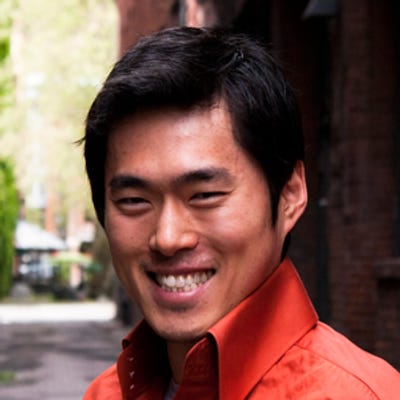
The Pivot Artist Who Never Actually Pivoted
Three industries. One through-line: build the platform that matches supply with demand, then obsess over what happens after the match is made.
Bo Lu graduated with highest honors in Computer Science from the University of Illinois Urbana-Champaign, joined Microsoft as a product manager, and quietly filed two patents around using social signals to optimize mobile computing. Then he left.
In 2010, he co-founded FutureAdvisor with a simple premise: automated financial advice for people who weren't rich enough to get a real advisor. Y Combinator's Summer 2010 cohort took them in. Sequoia Capital wrote a check. Five years later, Bo was at Davos when the World Economic Forum named him a Technology Pioneer.
He was also, that same year, watching BlackRock acquire FutureAdvisor for what press reports put between $150 million and $200 million.
Most founders take the money and disappear. Bo stayed - for four years - running FutureAdvisor as a business unit inside BlackRock Solutions, the technology and risk management arm of a $10 trillion asset manager. He left as Managing Director. That tenure gave him something rare: deep operating experience at scale inside a legacy institution, not just at a scrappy startup.
"Creating value from nothing."Bo Lu - Title of his Substack newsletter and personal operating philosophy
He spent time as a Visiting Partner at Y Combinator after BlackRock, cycling back through the place that had launched his first company. Then came Clipboard Health - a healthcare staffing marketplace founded by Wei Deng, his wife. Bo joined as President and Chief Operating Officer before taking on the Co-CEO title alongside Deng.
The move looked like a left turn from fintech to healthcare. In practice, it was the same problem: a massive, fragmented market with terrible matching infrastructure, participants on both sides losing money to friction, and a technology layer nowhere near thick enough to fix it. He'd built that layer once. Now he was building it again - but instead of retirees and index funds, the supply was registered nurses at two in the morning.
One Platform. 30,000 Shifts. A Broken Industry.
Healthcare staffing was a $35 billion industry running on phone calls, fax machines, and agency fees that consumed 30 to 50 cents of every dollar.
Clipboard Health entered Y Combinator's Winter 2017 batch with a different model: a two-sided marketplace where nurses and CNAs could pick up per-diem shifts at nearby facilities the way passengers pick up rides. Flexible scheduling. Instant pay. Digital timesheets. No agency in the middle taking the margin.
By the time Bo joined as an operating partner, the company had product-market fit but needed operational infrastructure to scale past its momentum. The challenge was the same challenge every marketplace faces: keeping supply and demand synchronized not just at sign-up but shift by shift, day by day, 3 AM on a Saturday in rural Ohio.
Under Bo and Wei Deng's co-leadership, Clipboard Health pushed shift fill reliability past 90% in an industry where 60% is considered competent. The platform moved from a coastal phenomenon to national coverage, into 40+ countries for its global workforce, and began expanding into adjacent verticals - Clipboard Education connecting schools with substitute teachers, explorations in dental and anesthesiology staffing.
Series B in 2021: $50 million, led by IVP. Series C in February 2022: $30 million, led by Sequoia, valuing the company at $1.3 billion. Profitable since 2022 - which in the startup world of 2022 was a headline, not a baseline. Annual revenue crossed $100 million within three years of that growth sprint.
Clipboard Health vs. Industry: The Numbers
Clipboard Health shift-fill performance vs. industry average. Funding displayed relative to $1.3B valuation benchmark.
In February 2026, the company made back-to-back leadership promotions - Esti Levy Dadon to CFO, Jinjin Qian to Chief Business Officer - signals of an org maturing into something that no longer looks like a startup running fast and something more like an institution being built with intention.
Writing Culture Down Before Culture Writes Itself
Bo Lu doesn't talk about company culture in the abstract. He publishes it in public, paragraph by paragraph, on Substack.
His newsletter, "Creating Value from Nothing," has accumulated thousands of subscribers who come for the operational thinking and stay for the specificity. He writes about Clipboard Health's company values not as a HR exercise but as a design document - explaining not just what the values are but why each one made the cut and what it looks like when a team lives it.
The values he's put into writing at Clipboard Health read like a counter-program to corporate vagueness. Extreme curiosity means permission-less problem-solving - you don't ask to investigate something, you investigate it. Bias to action means the operational cadence is set to run, not walk, and the turnarounds are short. Customer-centricity isn't a value about being nice to customers; it's about engineering teams feeling facility and worker pain viscerally while fixing it systematically. Courage means doing what's needed even when it's uncomfortable, especially when it requires learning a skill outside your comfort zone.
Permission-less problem-solving. Investigate without waiting to be told.
Operate at run speed, not walk speed. Short turnarounds, fast cadence.
Feel the pain of facilities and workers viscerally. Fix it systematically.
Do what's needed even when it's outside your comfort zone. Learn the skill.
There's an integrity to publishing your operating manual in public. It means anyone who disagrees with Clipboard Health's culture can read the terms before they walk in. It also means the executives are accountable to the same document. Bo Lu's writing carries the implicit argument that culture isn't something that emerges spontaneously in high-growth startups. Left to emerge on its own, it usually emerges poorly. Writing it down - clearly, specifically, without corporate euphemism - is a design choice, not a documentation exercise.
One of his more counterintuitive pieces is titled "Consistency is not a goal." In a world of OKRs and quarterly metrics, arguing against consistency as a North Star is the kind of thing that sounds wrong until it suddenly sounds obvious. Consistency is the measure of execution. It's not the execution itself. The goal is the outcome. Consistency is just how you track whether you're achieving it.
"Exude Clarity."Bo Lu - Substack essay on leadership communication
For a company serving healthcare workers who take shifts at 2 AM with strangers, and facilities that need those workers to actually show up, clarity is not a soft concept. It's infrastructure. When instructions are ambiguous, shifts go unfilled, patients go understaffed, and facilities lose trust in the platform. Bo's writing - and his operating model - treat clarity as a structural input, not a nice-to-have communication skill.
A Timeline Worth Tracing
| Year | Role | What Happened |
|---|---|---|
| ~2005-10 | Microsoft Product Manager |
Filed two patents for using social signals to optimize mobile computing. Left to start a company. |
| 2010 | FutureAdvisor Co-Founder & CEO |
Y Combinator S10. Built an automated investment advisory platform for everyday investors, not just the wealthy. Raised from Sequoia Capital. |
| 2015 | World Economic Forum Technology Pioneer |
Named to the WEF's Technology Pioneers list. Presented at Davos. That same year, BlackRock acquired FutureAdvisor for an estimated $150-200M. |
| 2015-19 | BlackRock Managing Director |
Ran FutureAdvisor as a business unit inside BlackRock Solutions for four years. Left as Managing Director of a $10T asset manager. |
| ~2019-20 | Y Combinator Visiting Partner |
Returned to YC as Visiting Partner. Mentored the next wave of founders. Surveyed the landscape. |
| 2020-present | Clipboard Health Co-CEO |
Joined as President/COO, elevated to Co-Chief Executive Officer. Steered the company to $1.3B valuation, $100M+ ARR, and profitability. |
What a Wealth App and a Nurse Marketplace Have in Common
FutureAdvisor's premise was access: give regular people the financial tools that used to require a $500,000 minimum account balance. Clipboard Health's premise is similar: give nurses the flexibility and earning power that used to require being a full-time hospital employee or going through an agency that kept 40% of the rate.
Both platforms move opportunity down the economic ladder - not as philanthropy but as a product thesis. The insight that gets repeated in descriptions of Wei Deng's motivation - "move as many people up the socioeconomic ladder as possible" - is also the implicit thesis of both companies. Robo-advisory for middle-class investors. Per-diem healthcare work for CNAs who want to choose their own schedule.
Bo Lu's skill in both was the same: build the operating infrastructure that makes the promise real at scale. It's not enough to have a good matching algorithm. You need systems for credentialing, payment, dispute resolution, quality assurance, shift verification, and trust - especially in healthcare, where a facility can't just take a chance on an uncredentialed worker and a worker can't afford to not get paid after a twelve-hour shift.
Clipboard Health holds Joint Commission certification - a rigorous accreditation standard in healthcare - and maintains a credentialing and verification system that lets facilities trust unfamiliar workers showing up for the first time. That's not a feature. It's the product. Without it, the marketplace doesn't work. With it, the shift fill rate goes to 90%.
The education vertical - Clipboard Education - extends the same pattern into a different fragmented labor market: K-12 schools need substitute teachers daily, sourcing them is chaotic, and workers have no easy way to pick up coverage gigs on their own terms. The geometry is identical to healthcare staffing. The playbook is transferable.
Bo Lu's career, viewed from enough distance, looks like a single long experiment in what happens when you bring serious product discipline and operational rigor to markets that haven't had either. Microsoft gave him the product toolkit. FutureAdvisor and BlackRock gave him the experience of building at scale in a regulated, high-trust environment. Clipboard Health is where those things converge.
He publishes the manual as he goes. Whether it's an article about what Clipboard Health's company values actually mean, or a framework for "creating value from nothing," or a reflection on why consistency is a metric and not a mission, the output is a running record of how he thinks about the work. For anyone trying to build something at the intersection of operations, culture, and marketplace design, the archive is worth reading.