Nobody frames a canceled insurance policy or pins a tax notice to the refrigerator. Yet the machinery that makes those documents accurate, private and provable is a serious business. BlueCrest lives in that machinery. Its systems take a stream of customer data, turn it into printed pages, match those pages to the correct envelope, add postal intelligence, sort the finished pieces and leave behind a record of what happened. The output may be a bank statement, a medical explanation of benefits, a county ballot or a direct-mail piece. The customer is not buying paper movement. It is buying fewer expensive mistakes.
The company arrived in July 2018 with a new blue logo and a very old résumé. Platinum Equity paid Pitney Bowes $361 million for its Document Messaging Technologies production-mail business and supporting software. The division became DMT Solutions Global Corporation, doing business as BlueCrest. There is no garage founder in this story. The founding act was a carve-out: move the people, patents, machines, customers and service obligations into a standalone company, then teach it to make decisions without its former parent.
The industrial stackThe envelope is the last inch of a software problem
BlueCrest's flagship hardware has the blunt names and physical presence of factory equipment: Epic and Evolution inserters, IntelliJet printers, Vantage sorters. An inserter folds and collates pages, adds cards or return envelopes, verifies the set and seals it. A sorter reads addresses and barcodes, then routes each piece to a destination pocket. Production inkjet systems print personalized pages at a speed that makes the office laser printer look ornamental. Around those machines sit cameras, sensors and controls designed to answer the most anxious question in transactional mail: did the right document reach the right envelope?
The software layer is less visible and arguably stickier. Strata bundles output management, desktop-mail aggregation, dashboards and productivity monitoring in the cloud. BCC Software cleans addresses and prepares postal data. Window Book connects mailers to USPS systems, statements and scorecards. Relia-Vote manages ballot workflows. The company also sells implementation, parts, financing and long-term service. More than 900 service personnel support an installed base of roughly 6,500 systems. When a line processing millions of sensitive pieces stops at 2 a.m., the service network matters more than the brochure.
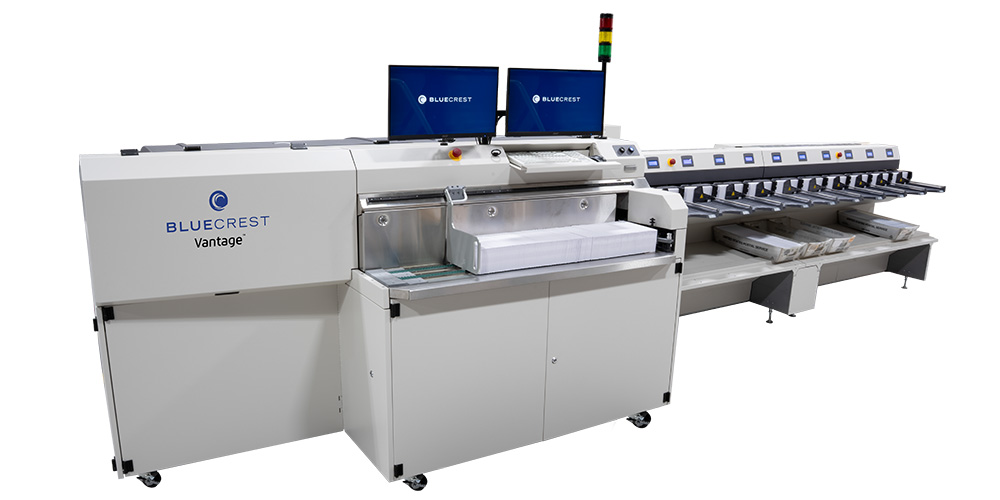
That breadth is BlueCrest's competitive pitch. A customer can buy a printer from one supplier, an inserter from another, postal software from a specialist and maintenance from a regional technician. Or it can put more of the workflow under one contract. BlueCrest argues that fewer handoffs mean fewer integration gaps and a clearer chain of responsibility. Rivals such as Quadient, Pitney Bowes, Canon, Ricoh, Xerox, Böwe Systec and Körber can cover pieces of the same territory. The real alternative is often not a rival machine but a patched-together internal workflow or an outsourced print-and-mail bureau.
One revealing jobWhat failed first was the proof
A BlueCrest case study involving an unnamed Fortune 300 insurer explains the economics better than a product catalog. The insurer needed evidence that regulated letters had entered the mail and, in some cases, that delivery had been attempted. Its first method used USPS Certificate of Mailing and Certified Mail. It worked, but each piece could cost several dollars. The company had already outsourced printing and inserting, so it considered moving this proof process to the same provider. That option was cost-prohibitive too. Nothing dramatic exploded. The workflow simply became too expensive to defend.
The switch, in four moves
BlueCrest enhanced documents upstream, added Intelligent Mail barcodes, cleansed addresses and linked each mail piece to USPS visibility data.
BlueCrest's implementation price was not disclosed. The resulting postal cost fell from several dollars to as little as 39 cents per piece.
USPS tracking data could serve as proof of induction while also showing what each piece represented, such as a specific policy notice.
The insurer projected more than $500,000 in annual savings and a payback period of under six months.
BlueCrest and its partner GrayHair Software shifted the proof from a premium physical service to the data already traveling with an Intelligent Mail barcode. Address changes flowed back into document preparation. The insurer could see not only where a piece sat in the postal system, but that the piece was a particular cancellation letter tied to a particular account. The useful move was upstream: improve the document and data before the envelope ever touched a sorter.
From iron to informationThree acquisitions changed the center of gravity
A hardware company can sell a machine once. Software and service stay in the building. BlueCrest's acquisition sequence shows that logic. It bought BCC Software in 2020, bringing address quality, presort and mail tracking closer to the equipment. Fluence Automation followed in 2021, adding sortation. Window Book arrived in 2022 with post-presort tools, PostalOne connections and mailer scorecard monitoring. Deal prices were not disclosed. Together, the purchases filled gaps between document data and postal acceptance.
The result is a business model with several clocks. Capital equipment produces large, irregular sales. Software subscriptions and licenses add recurring revenue. Parts, consumables, implementation and maintenance continue over the life of the machine. BlueCrest Financial Services can help customers spread acquisition costs. The company is private, so it does not publish detailed segment economics; an external company-data estimate puts annual revenue near $465 million. What is visible is the strategic direction: own more of the workflow, then service it for years.
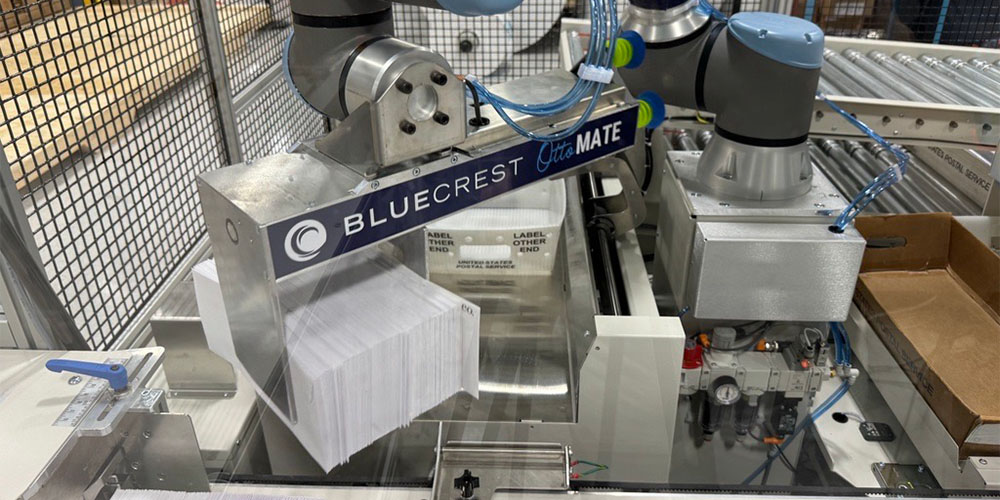
Robotics is the physical extension of that strategy. At Forge, a digital print and mail provider, the first field deployment of BlueCrest's OttoMATE Trayer attached a collaborative robot to an Epic inserter. The arm moved finished pieces into USPS trays, a repetitive job shaped by staffing pressure and injury risk. Operators were unfamiliar with the cobot at first, according to Forge's account, then grew comfortable with it. BlueCrest says the equipped Epic became the best-running unit at Forge's Florida site. The practical insight is not “buy a robot.” It is to automate the handoff that throttles an otherwise fast line.
Who needs thisMail is shrinking. Consequences are not.
BlueCrest sells to organizations for which physical communication remains a regulated system of record: banks, insurers, healthcare networks, utilities, government agencies and election offices. It also serves commercial printers, mailing bureaus, postal operators and e-commerce logistics teams. Platinum Equity lists more than 3,500 global clients and offices in 14 countries. BlueCrest says its systems handle approximately 70 percent of U.S. mail volume. That figure is company-reported, but it captures the odd scale of an invisible category.
- Financial and healthPrivacy, document matching, audit trails and service-level deadlines make errors costly.
- Government and electionsBallots, tax notices and identity mail require tracking, integrity and procurement support.
- Print service bureausHigh utilization turns uptime, throughput and postage optimization into margin.
- Parcel and e-commerceSortation and intralogistics move the same automation logic from envelopes to fulfillment.
The latest products acknowledge a market under pressure. Vantage Select, previewed in April 2026, is a compact letter sorter for operations with less floor space, tighter budgets and smaller teams. Element targets lower-volume inserting. Print+ Statement handles short jobs and reprints inline. This is not a bet that every mailroom will grow. It is a bet that the remaining work will still demand accuracy, while buyers ask machines to occupy less space and labor.
Security has become part of the offer too. In 2025, BlueCrest completed a SOC 2 Type II audit across infrastructure, software development and operations. That matters when dashboards and workflow tools touch healthcare, financial and government data. The same year, Kim Andersen moved from chief operating officer to CEO, while Dennis LeStrange became executive chairman with a focus that includes acquisitions, partnerships and customer development. The leadership change suggests continuity, with more attention on transformation and the next set of adjacent markets.
The copyable playbookAutomate the expensive exception, not the photogenic task
There are three ideas worth stealing. First, map the whole handoff. The insurer did not merely negotiate cheaper Certified Mail; it reconsidered what counted as proof. Second, attach software to a physical consequence. A clean dashboard is pleasant, but a dashboard that prevents the wrong medical notice entering the wrong envelope has budget authority. Third, automate the constraint. At Forge, that was tray filling. In a smaller mailroom, it may be sorting footprint or reprint handling. Start where work queues, injuries or errors accumulate.
The approach has limits. Integrated BlueCrest systems make the most sense at sustained volume, where postage savings, labor reduction and avoided errors can repay capital and implementation. They are a poor fit for small senders, irregular jobs, teams without trained operators or sites beyond reliable service coverage. They also lose to outsourcing when a bureau can pool volume more cheaply, and to digital delivery when law, customer preference and access allow paper to disappear. The insurer's sub-six-month payback should not be copied as a promise; it depended on a costly existing workflow and enough qualifying pieces.
BlueCrest's advantage is not romance. It is institutional memory. The brand dates to 2018, yet half its employees have at least 15 years of tenure, inherited from the Pitney Bowes operation. The company reports average customer relationships longer than 20 years. In software, old code can be baggage. In industrial service, knowing why a feeder misbehaves on a humid night, how a postal rule changed, or which camera catches a dangerous mismatch can be the product.
The ordinary envelope remains a small container for large obligations. Somebody must prove the address was current, the pages belonged together, the postage was correct and the item entered the network. BlueCrest has spent its short independent life assembling those obligations into one stack. The mail may be easy to ignore. The machine behind it is not.