At nine in the morning, a trade-show booth is a tiny piece of architecture. At eight fifty-nine, it is a list of possible catastrophes. The crate is late. A panel has been bruised in transit. The new headline arrived after the printer stopped. Someone has discovered a union rule that nobody put in the presentation. In another industry, these are separate problems. In the exhibition business, they are all the same problem: the doors are about to open.
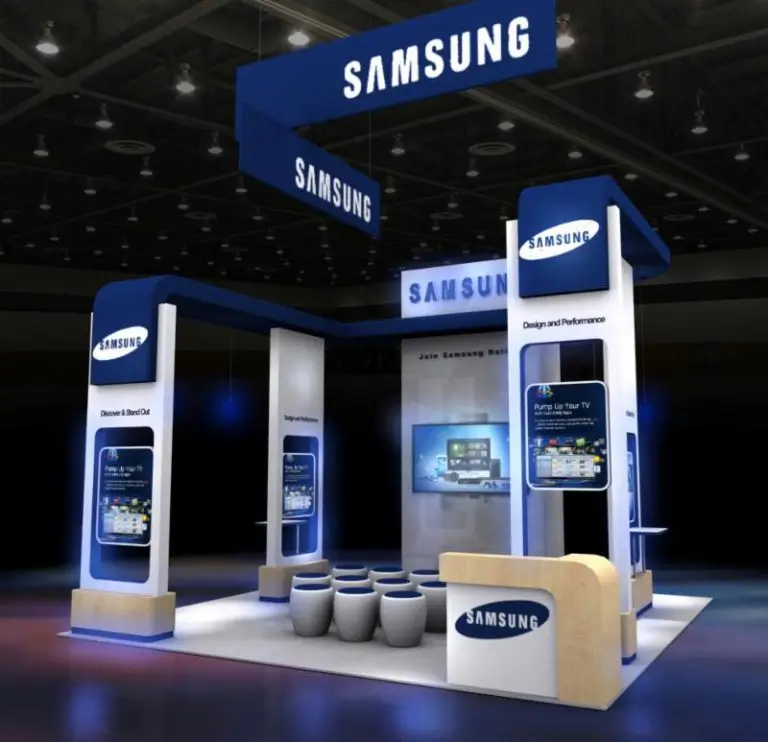
Blazer Exhibits & Events has built its business around that minute. The privately held company, founded in 1983 and now based in Tracy, California, designs and fabricates custom booths, rents modular systems, prints graphics, ships crates, installs structures, stores the pieces, counts them when they return, and repairs what the road has damaged. The company’s public roster lists 19 employees. Its client history, however, reads like a walk through a technology conference: Cisco, Adobe, NVIDIA, Samsung, PayPal, SanDisk, IBM, Intel, eBay and Apple.
A company born between the brush and the microchip
There is an appealing mismatch in Blazer’s origin. It was created to supply the display needs of an emerging Silicon Valley, but its early tools belonged to an older world: silk screens, hand-cut frisket art, hand lettering and mural painting. The customers were accelerating toward the digital future. The signs were still made by hand.
Then the tools caught up. Blazer added vinyl plotters and early large-format digital printers. In 1988 it moved into the design and distribution of exhibit systems; in 1989, into custom and rental fabrication. The sequence matters. This was not a marketing agency that decided to outsource some carpentry. It was a production shop that gradually widened the circle around the thing it knew how to make.
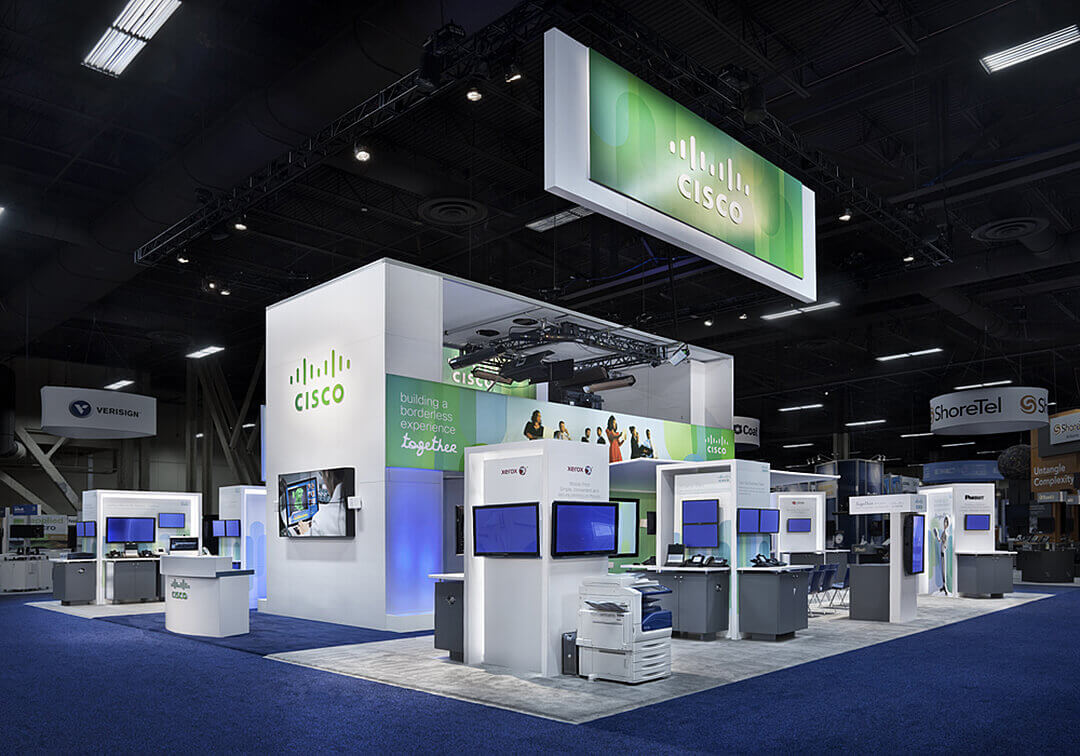
A booth is a promise made by marketing and kept by a forklift.
What fails first is the handoff
A company can hire a designer, a fabricator, a printer, a freight carrier, a local installation crew and a storage warehouse. It can also spend the week before a show translating among them. Blazer’s pitch is not that these jobs are mysterious. It is that their seams are dangerous. The more parties involved, the easier it is for a measurement, deadline or responsibility to disappear.
That explains the unusually broad service menu. Conceptualization becomes 3D rendering; rendering becomes fabrication in wood, metal and plastics; the structure gets large-format graphics, lighting and screens; then come registration, shipping, installation, dismantling, inventory, storage and refurbishment. The glamorous item is the booth. The commercially useful item is a chain of custody.
The booth’s six lives
The company makes this point with the kind of sentence only an operator would choose: “Mistakes discovered at the show are usually too late to correct.” This is less a slogan than a description of physics. Once a crate is on the wrong truck, charm is of limited use. Blazer’s public materials talk about checklists, show-floor rules, traffic flow, drayage and post-show damage reports. It is marketing viewed from the service entrance.
The price of the object - and the price of surprise
Blazer prices projects by quote. Size, materials, custom versus rental construction, electronics, graphics, freight, labor and storage all move the number. The company advertises free initial exhibit design, and a historical industry directory placed its typical project budget below $10,000. Treat that figure as a marker, not a menu: a portable display and a multi-level custom island do not belong in the same arithmetic.
The more useful question is total program cost. A cheaper structure can become expensive after freight, drayage, emergency graphics, local labor and storage. Rental protects flexibility; custom construction protects specificity; refurbishment protects sunk investment.
Blazer’s model earns money at each of those decision points. It charges for design and fabrication, rentals, graphics, logistics, installation, storage, repair and asset management. That makes it different from a portable-display seller, and also from a creative agency whose work ends at the rendering. The company sits in the middle of a fragmented market: smaller and more hands-on than the giant general-service contractors, but broader than a local sign shop or booth builder.
The adjacent move that changed the room
When physical trade shows paused during the pandemic, Blazer did not have to invent an entirely new craft. It already made 3D renderings so clients could inspect a booth before fabrication. The company redirected that skill into virtual exhibit environments. The rendering, previously a preview, became the destination.
This is the quiet kind of adaptation worth copying. Blazer did not chase an unrelated market. It asked which existing capability still mattered after the venue disappeared. More recently, its public updates show the same widening logic in physical form: a Pacsun activation at Outside Lands with live apparel customization, retro-arcade demonstration stations for Gurucul at Black Hat USA, and SilverDoor’s first GBTA Convention presence. The unit of work is no longer merely “a booth.” It is a branded place where something happens.
Four things a marketer can steal
- Design the return trip before the outbound truck. Storage, inventory and repair belong in the original brief.
- Make one person own the seams. Every vendor boundary needs a named decision-maker and a deadline.
- Render before you build. A cheap digital correction beats an expensive physical apology.
- Give the space a verb. Let visitors test, play, print, compare or learn - not merely stand and receive a brochure.
There are limits to this approach. A company running one small local event may be better served by a simple pop-up and a nearby printer. A digital-only launch gains little from warehouse and freight expertise. A brand that changes its identity every month may not recover the cost of a custom structure. And organizations that genuinely want to coordinate every specialist themselves will not place much value on a turnkey premium.
But when the schedule is national, the booth must be reused, or the installation is too important to improvise, Blazer’s breadth becomes the point. The customer is not only buying walls and graphics. The customer is buying fewer phone calls among anxious strangers.
That is why the company has lasted through hand lettering, digital printing, virtual events and whatever now counts as an “experience.” The visible output keeps changing. The hidden need does not. At eight fifty-nine, somebody still has to know where every piece is, what condition it is in, and who has the wrench.