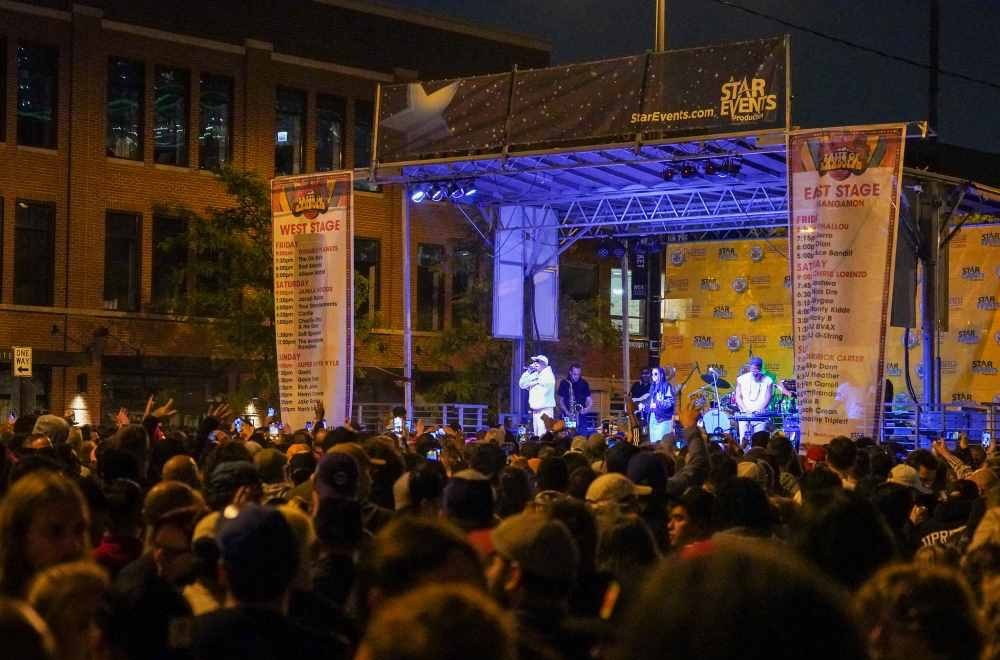
At eleven o'clock on a Friday morning, a Chicago street is still a street. Delivery vans nose toward loading docks. A restaurant hostess chalks the evening specials. Someone is annoyed about parking. By five, the same asphalt can have two stages, a beer tent, a row of kitchens and several thousand people holding plastic cups. The transformation feels spontaneous. It is the opposite.
The business of StarEvents is the production of that illusion. Founded by John Barry in 1996, the Chicago company takes a public place full of competing obligations and makes it behave, for a weekend, like one coherent venue. The visible inventory is familiar: music, food, art, banners. The actual inventory is insurance, permits, power, barricades, contracts, schedules, toilets, trash, staff and the frightening possibility that one missing signature can immobilize all the rest.
Barry came to this work through music. He started playing drums at 12 and later described drumming as the reason both StarEvents and its related talent-buying business, Chicago Entertainment Agency, came into being. This makes intuitive sense. A drummer's job is to coordinate people who believe the audience is watching them. An event producer does the same thing with vendors, sponsors, performers, city departments and neighborhood organizations.
The party is merely the user interface
StarEvents sells a bundle. A neighborhood association or nonprofit may know why it wants a festival, but not how to draw a floor plan, solicit sponsors, contract security, recruit vendors, buy talent or satisfy city requirements. Hiring each piece separately creates a new problem: somebody must coordinate the coordinators. StarEvents positions itself as that somebody.
The production stack
& insurance
& power
& talent
& sponsors
& cleanup
Its service list runs from consulting and site scouting through accounting, sponsorship, public relations, ticketing and race management. It can hire the caterer, negotiate the act, erect the stage, staff the gate and clean the ground. During the pandemic, it even added compliance planning, cleaning crews and on-site safety enforcement. The breadth is not decorative. Every handoff removed is one fewer seam that can split in public.
The customers form an unusual circle. Community groups buy production capacity. Sponsors buy attention. Vendors buy access to foot traffic. Performers sell a reason to arrive. Residents lend the neighborhood its identity. Attendees supply the crowd that makes every other customer happy. A good producer makes each party feel like the event was designed for them, although their interests are not always aligned.
A street festival is a community ritual with commercial plumbing.
What the booth fee reveals
The public prices reveal more about this business than an abstract promise of “full service.” A 2022 Taste of Randolph application listed a 10-by-10-foot artisan booth at $495 and a merchant booth at $595. Electricity was $150. A tent was $300. A corner, if available, cost another $100. Food vendors faced a $1,500 reservation fee before the balance, permits, insurance, inspection and sanitation paperwork were complete.
The numbers show the model at work. StarEvents does not merely sell a patch of pavement. It standardizes access to a temporary market, then adds equipment, power and operational support around it. Sponsors purchase a similar thing at larger scale: a designed encounter with a neighborhood audience. The company promotes customized activations and pre-festival marketing, turning the festival from entertainment into a physical media channel.
That is also what separates StarEvents from a venue planner or a talent agency. Its product lives between categories. It is part logistics contractor, part promoter, part ad platform and part civic intermediary. Competitors include other Chicago event producers such as Special Events Management, Duff Entertainment and Amdur Productions, but the alternative is often not another firm. It is a chamber or nonprofit trying to assemble the same capabilities itself.
The first failure was a sentence
In 2023, the weak point was not a generator or a stage. It was the wording at the gate. Chicago events that close public streets cannot charge admission. They can request donations. Online listings for Taste of Randolph presented a $10 payment as admission, and attendees complained that something optional had been made to look mandatory. The city told organizers to correct the listings, and refunds were offered to people who felt misled.
This was not an obscure formatting error. It touched the compact underneath the entire event. A festival producer temporarily rearranges public space and earns money inside it. The arrangement works when residents believe the inconvenience, commerce and fundraising still belong to a community occasion. Once the entrance feels like a tollbooth, the public begins inspecting everything behind it.
The difficult part is that the money was doing real work. Bands, security and portable toilets do not accept civic spirit as payment. By 2026, organizers said Taste of Randolph's gate donations had fallen from as much as $200,000 five years earlier to perhaps $80,000, even as production costs climbed. Fewer than one in five attendees typically donated at comparable Chicago festivals. The old mechanism was both unpopular and less effective.
A raffle replaces the tollbooth feeling
Taste of Randolph changed the design in 2026. There would be no suggested donation at entry. Instead, the festival introduced an optional raffle and silent auction, with theater tickets, spa visits and restaurant cards among the prizes. Entrance remained free. The ask moved away from the narrowest point in the experience, where a request can feel like a demand, and became a choice with something tangible attached.
That change is the most copyable idea in this story. When a revenue mechanism depends on ambiguity, clarification will feel expensive. Make the value exchange explicit instead. A vendor knows the price of ten feet of frontage. A sponsor knows the audience it wants. A raffle buyer knows the prize. The more public the setting, the less tolerance there is for a transaction that needs verbal fine print.
What another operator can copy
Bundle the ugly work. Price the optional pieces plainly. Put one owner across permits, vendors, talent and cleanup. Most of all, treat trust as production infrastructure: test the sign at the gate as carefully as the sound system.
The approach works best when events repeat, local partners have real standing and the producer can reuse relationships across a calendar. It is less effective for a one-off gathering with no sponsor base, a community that does not want scale, or an event whose economics require every passerby to pay. Standardization saves money, but it can also flatten local character. The operating system must remain backstage.
StarEvents' reported record is substantial: more than $25 million raised for charities, partnerships with hundreds of organizations and an annual audience above one million. Its portfolio has included Taste of Randolph, Andersonville Midsommarfest, Retro on Roscoe, Mayfest and Festa Italiana. The deeper achievement is not any single lineup. It is making a complicated temporary city reproducible.
Then, on Sunday night, the last song ends. The taps close. The tents collapse into trucks. By Monday morning, Randolph or Clark or Roscoe is expected to look like a street again. That final reversal may be the cleanest description of the product: StarEvents manufactures a place that can disappear without taking the neighborhood with it.