The strange thing about a company that makes moving pictures is how much of its future depends on a still image: an empty chair. Somewhere inside Pika's Palo Alto orbit, there is a desk for a researcher who has not yet said yes, a designer who has not yet seen the message, an engineer who may not know the company needs precisely the peculiar thing they do well. Louis Lee's job is to turn those absences into colleagues.
His title is founding recruiter. It sounds ceremonial until one considers the verb hidden inside it. A founding recruiter does not inherit a hiring machine so much as help construct one while it is running. The company is setting its technical direction, sharpening its product, shipping new creative tools and deciding what sort of place it wishes to become. Every hire is both an employee and a small constitutional amendment.
Lee arrived at Pika in 2026 after a career that moved through several versions of Silicon Valley scale. He worked through JBC in partnership with Meta, moved to Google, and later recruited for TikTok and ByteDance's DataAILab. Those names tell one story: platforms of enormous reach, elaborate systems and hiring needs measured at industrial scale. Pika tells another: a compact company in a crowded AI-video field, where a single search can materially change what gets built next.
The work before the work
Recruiting is easy to omit from the mythology of technology. Company histories like immaculate nouns: founder, model, funding, launch. Recruiting consists mostly of verbs, many of them uncinematic. Search. Ask. Listen. Follow up. Calibrate. Try again. It happens before the team photograph and after the financing announcement, in the untidy interval when ambition has outrun headcount.
Lee seems unusually comfortable in that interval. Former colleagues have publicly described him as someone who handled volume, asked useful questions and contributed to team culture. A person he helped recruit into a coordinator role at Meta recalled that Lee continued to offer advice months after the placement. In an industry that can make candidates feel like rows in a spreadsheet, follow-through is a modest rebellion.
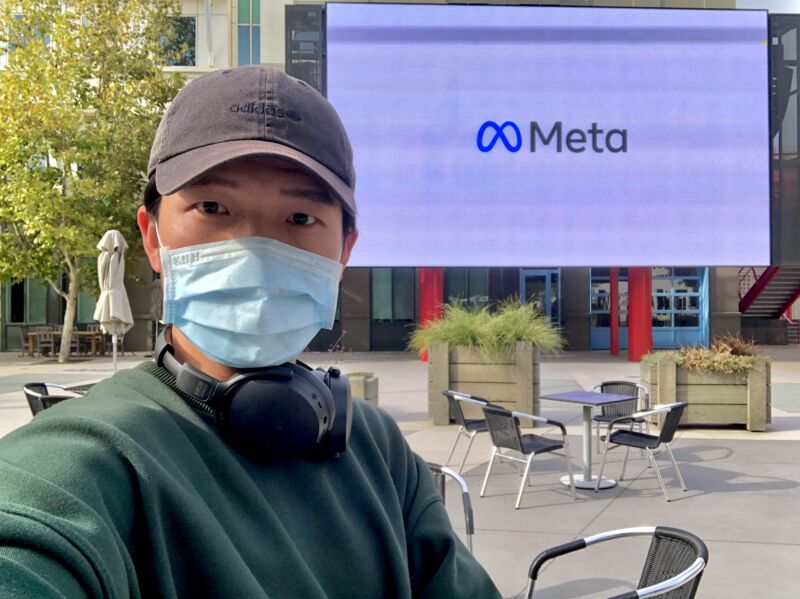
The picture above accompanied the end of one of those chapters. Behind Lee, the Meta name fills a giant screen. In front, café chairs wait under California sun. It is a remarkably literal image of his profession: institutional scale in the background, one person and several open seats in the foreground.
“Help others out, whenever you can. You could be the light in their world.”Louis Lee, on leaving JBC at Meta for Google
That line did not arrive as networking varnish. Lee wrote it after sharing something more personal. He said he had been born and raised overseas and came to the United States with his mother and sister. The family, he wrote, scrubbed toilets for a living after the move. A decade later, they had established a business that was growing. He chose the moment of his own move to Google to thank the people who had coached him and to urge others to pass opportunity along.
There is no need to turn hardship into a tidy parable; lives resist PowerPoint. But the experience lends his work a clear moral weight. A job is never merely a requisition to the person who needs it. Access can change the weather inside a family. A recruiter sits at one of the few desks where that abstract truth arrives daily with a résumé attached.
A recruiter learns to automate
By the time Lee reached TikTok and ByteDance, recruiting itself was becoming an AI problem. In his farewell to the DataAILab recruiting team, he wrote about diving into workflows and using AI to automate the manual “heavy lifting.” He thanked Allen Dao for the constant process-tweaking and research that helped them keep pace with both hiring and AI adoption.
This is a useful distinction. The machinery is not the judgment. A tool can move information, surface patterns or shorten the distance between question and answer. It cannot make a candidate trust a company. It cannot notice the hesitation after an interview answer, explain a confusing process with tact, or decide that an eccentric background contains exactly the kind of thinking a young team lacks.
His farewell post also reads like an anatomy lesson in collaborative work. Managers, recruiters, hiring partners and teammates across regions appear by name. Lee calls the experience fast and rewarding, then gives the credit away in a long procession. The post's most revealing sentence is short: “The real growth happened behind the scenes.” It is both a comment about his time at ByteDance and a neat definition of recruiting.
The work has another irony. Recruiters must be public enough to be found and discreet enough to be trusted. Lee has built a visible professional network - roughly nine thousand followers on LinkedIn - while keeping much of his personal biography private. What does surface is purposeful: gratitude, colleagues, process, transitions and the occasional nudge to help someone else.
Pika and the expensive empty chair
Pika began with a frustration over how hard it was to make good video with the available tools. Its founders, Demi Guo and Chenlin Meng, left Stanford's AI program and built a product that could generate and edit short video from prompts and images. The company moved quickly from a tiny team into a heavily financed contest with startups and technology giants. In June 2024, an $80 million Series B brought its disclosed total funding to $135 million and put a reported valuation around $470 million.
Money accelerates a company, but it also increases the cost of indecision. A funded startup must convert capital into research, products and users before competitors convert theirs. This makes each open role an expensive little clock. Pika's own description of the founding-recruiter job called for someone to hunt technical and creative talent, refine the recruiting process and preserve a blend of “chaos and genius.” The phrase is jaunty. The balancing act is real.
Technical recruiting for generative video is not simply a matter of locating people who know machine learning. The product sits at an awkward, fertile junction: research and interface, compute and taste, model performance and the mysterious human verdict that a clip feels right. The team therefore needs people who can cross borders between disciplines without becoming tourists in either. A recruiter has to understand enough of each world to recognize a rare bridge-builder.
Pika's careers page now describes more than 40 team members across more than ten nationalities and lists working locations from Palo Alto to Brooklyn, Shanghai, Curitiba, Beijing, Seoul and Ulaanbaatar. That distribution makes “culture fit” a dangerously lazy phrase. The useful question is whether a candidate adds a way of seeing, working or building that the company does not yet possess.
The founding recruiter's product is not a pipeline. It is the company that walks out the other end.
The human interface
Lee's move has a satisfying symmetry. At TikTok, he experimented with AI inside recruiting. At Pika, he recruits the humans who build AI for creative work. The technology changes sides of the desk; his central problem does not. How does one reduce friction without reducing people?
Pika's current language imagines creation moving away from the prompt box and toward conversation. Recruiting has always worked this way. The résumé is a prompt box: constrained, optimized, often inadequate. Conversation reveals the interesting errors in the format - the detour that became expertise, the side project that proves taste, the family business that taught endurance more convincingly than any leadership seminar.
Lee knows something about detours. His public story stretches from difficult work after immigration to the polished campuses of enormous companies, and then into a startup trying to redesign how images move. It would be tempting to describe the path as improbable. That lets the systems around it off too easily. Talent is common. Recognition is scarce.
A good recruiter works on that scarcity. The job is to see past familiar packaging while remaining exacting about the work. It is to move quickly without making people feel processed. It is to keep a company's standards high and its doors visible. Most of all, it is to remember that every organization chart conceals a collection of private turning points.
So the empty chair at Pika is not empty for long. A message is sent. A conversation begins. Somewhere, somebody learns that the obscure thing they have been practicing is suddenly useful to a company making pictures from language. If they accept, there will be an onboarding plan, a laptop, a new name in the chat. Later, perhaps, there will be a product launch and a neat company photograph.
Louis Lee will probably be outside the frame. Recruiters often are. The evidence of the work is everyone who made it into the picture.