In a four-bedroom apartment in Beijing's Zhongguancun district, the future was running a night shift. By day, Liang Rubo and Zhang Yiming worked on Jiujiufang, their property-search business. By night, with fewer than ten colleagues, they built a news product that would learn what each reader wanted. The apartment was office, workshop and rehearsal room. In August 2012, that side project emerged as Jinri Toutiao. The company around it was ByteDance.
The familiar version of the story places Zhang in front: strategist, public founder, chief executive. Liang is easier to miss. Yet he was there writing systems, buying and installing servers, shaping recruitment and corporate policies, and leading product development. His career is the line behind the visible line, the scaffolding left out of the architectural photograph.
That omission became harder to sustain in 2021, when Zhang chose his university roommate and twice-over co-founder to succeed him. Liang did not arrive from the usual CEO casting department. He had been an engineer, a product builder, the head of collaboration software, an efficiency specialist and, eventually, the person overseeing human resources and management. His route to the corner office went through almost every room in the building.
“Always day one.”Liang's remembered lesson from ByteDance's startup years
The first shared asset
Liang and Zhang met as freshmen at Nankai University in 2001. They shared a dormitory, studied together, played badminton and table tennis, and used the same desktop computer. It is tempting to turn the machine into a sacred relic, but its charm is more domestic than divine: two students arranging scarce hardware so each could keep working. Long before equity tables and board seats, cooperation meant taking turns.
After graduating in 2005, Liang became an engineer at Accelicon Technologies, a microelectronics software company. Zhang moved through startups. Their careers rejoined in 2009, when Zhang asked Liang to help build Jiujiufang. Liang accepted. The real-estate app found an audience, but it also became a staging ground for the more ambitious idea taking shape in their borrowed apartment.
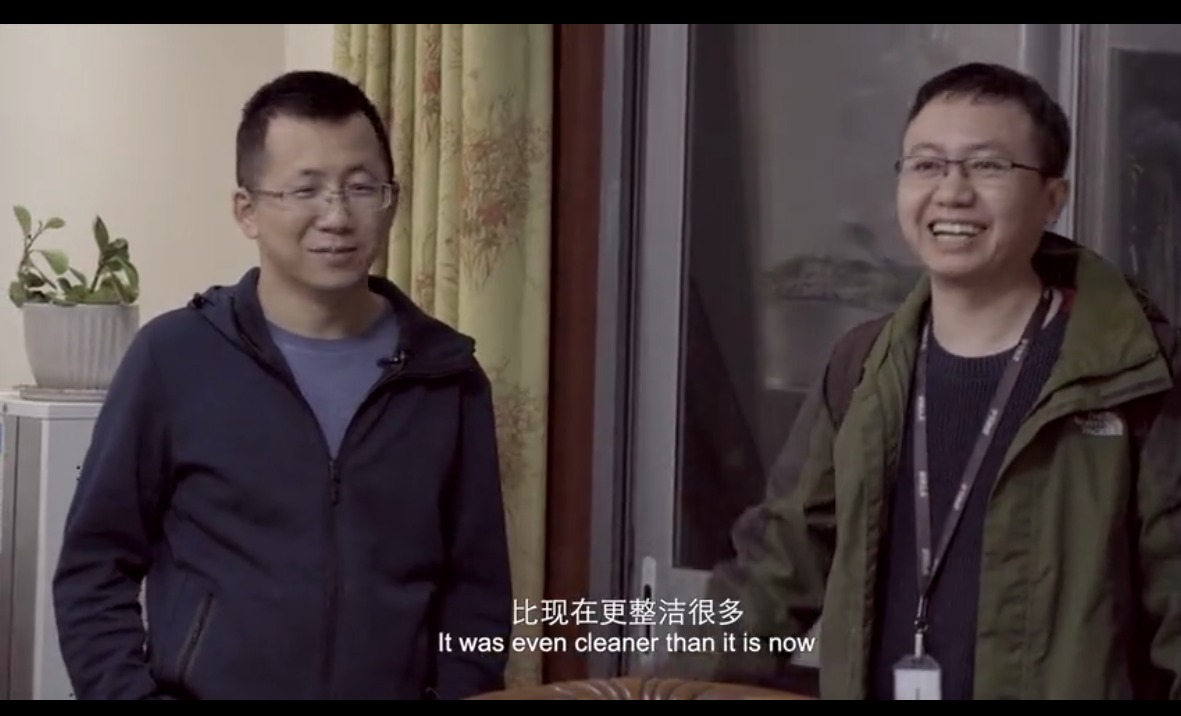
There is another small story from those years. On subway trips between Beijing and Tianjin, where their server was located, the two founders competed to memorize station sequences. Liang usually answered faster; Zhang was more accurate. It is a neat partnership parable, almost suspiciously neat, except that it also sounds exactly like what two programmers might do to make a long commute tolerable.
A builder changes materials
From 2012 to 2016, Liang led product research and development across Toutiao, creator tools, advertising and user-growth systems. He also helped establish the technical framework behind Douyin. The work was consequential, but the public attention went elsewhere. Liang appeared comfortable with the arrangement. He rarely gave interviews and seldom became the subject of profiles.
In 2016 he took charge of Feishu, known internationally as Lark, and ByteDance's efficiency engineering. The assignment sounds dry until one notices the problem it was trying to solve. ByteDance had tested free, paid, open-source and proprietary collaboration systems. None suited the company it was becoming. The absence of a good internal tool was beginning to constrain the organization, so ByteDance decided to make its own.
Consumer products at the company could move from proposal to release in roughly three months. Feishu took three years. Liang later called it the product he had spent the longest polishing at ByteDance. The engineer associated with speed had learned when speed was the wrong measurement.
The operating route
By 2019, the materials changed again. Liang moved into human resources and group management. He dealt with legal work, internal communications and logistics as well as people operations, becoming what one person close to the company described as its corporate housekeeper. It was an unflashy title for a vital job. Between March 2020 and March 2021, ByteDance's workforce expanded from about 60,000 to 100,000.
The CEO handover that followed surprised outsiders because outsiders had been looking at the stage rather than the rigging. Zhang's announcement listed the work Liang had performed since the beginning, from code and servers to recruitment and management systems. The selection was less a promotion than an acknowledgment of accumulated responsibility.
Success develops gravity
Running ByteDance did not mean maintaining a finished machine. In November 2021, Liang divided the group into six business units, including Douyin, TikTok, Lark and Volcano Engine. The reorganization clarified accountability across a company whose products ranged from entertainment to enterprise software.
Then came generative AI, carrying its usual gift to incumbent technology companies: an opportunity shaped like an accusation. By January 2024, Liang was openly worried that ByteDance had become slow and inefficient. He urged employees to recover a sense of crisis, concentrate on fewer priorities and remain “always day one.” He also supplied the phrase that best captures his managerial fear: “escape the gravity of mediocrity.”
“This is an era of great change.”Liang Rubo, speaking to ByteDance employees about AI
The language matters. Liang talks about corporate decline as physics. Scale pulls downward. Routine exerts force. A successful company does not need to choose complacency; it can drift there. In this view, “day one” is not nostalgia for bunk beds and temperamental servers. It is a daily effort to notice what success encourages people to ignore.
There was, however, one public gesture in 2024 that faced backward as well as forward. Liang and Zhang jointly donated RMB 200 million to Nankai University to support mathematics research and the development of new talent. In the same year, Liang was included in the TIME100 AI list. The pairing is revealing: recognition for directing a new technology cycle, followed by investment in the kind of institution where their own partnership began. Neither event turned him into a celebrity executive. They merely made his outline easier to see.
ByteDance's response has centered on Doubao, its AI assistant and model family. At a 2025 Volcano Engine conference, Liang compared AI's development to the first 500 metres of a marathon and promised long-term investment. The metaphor rejected both panic and leisure. Five hundred metres is early. It is also far too late to remain at the start.
Liang's four technology peaks
In Liang's 2026 formulation, major computing waves arrive roughly 15 to 20 years apart. His drawing deliberately made the first three look smaller beside AI.
The backstage becomes the product
In September 2026, Liang returned to Feishu's history at a conference in Beijing. On screen was an early 2017 design with only basic messaging. A message from Feishu president Xie Xin carried two exclamation marks showing it had failed to send; even his avatar was missing. It was a gracious way to present technical embarrassment: old bugs become charming once they stop being current bugs.
Liang's larger point was about recombination. ByteDance had brought together Doubao, Feishu and Volcano Engine. Doubao would supply intelligence. Feishu would hold the context and tools of collaborative work. Volcano Engine would provide models, computing resources and development tools for companies making specialized agents. The old internal solution was becoming part of a broader attempt to place AI inside actual organizations.
For enterprise customers, the argument also depends on trust. At a June conference, Liang said strengthening customer trust and security had appeared in his personal objectives for several years. It was a practical admission that companies will not place sensitive data and workflows inside an AI system on enthusiasm alone.
This is a characteristically operational vision. It is less interested in the lonely brilliance of a chatbot than in what happens when software knows where the calendar, document, colleague and decision live. The company that once built its own collaboration layer because existing tools were inadequate now wants that layer to carry agents as well as people.
Liang said ByteDance would devote more resources to the enterprise market. He also called AI the fourth great technology peak after the PC, web and mobile eras, and argued that it would rise higher than the previous three. Opportunities of this scale, he said, appear only every 15 to 20 years. His annual keyword for ByteDance was “strive to climb the peak.” The quiet engineer had acquired an alpine vocabulary.
The useful unease
There are easier ways to lead a prosperous company than repeatedly telling it that prosperity may be making it mediocre. Liang's public remarks rarely sound celebratory. Even his ambition is paired with unease. The point is not to perform humility. It is to preserve the irritation that precedes useful work.
His own career offers the argument in miniature. Each time ByteDance changed scale, Liang changed the system he was building. First code. Then products. Then collaboration. Then the organization itself. Now he is working on the connection between models and work, while trying to keep a mature company alert enough to build its replacement before someone else does.
The shared desktop at Nankai makes a tidy origin story. The harder achievement is carrying that economy of attention into a company spread across nearly 120 cities. Day one was once a date. Under Liang Rubo, it has become a discipline, repeated precisely because the calendar refuses to cooperate.