The most consequential idea in Zhang Yiming's career was a small reversal. For most of the internet's history, a person went looking for information. A search box waited, patient and empty, until someone supplied the right words. Zhang wondered why the information could not do some of the travelling. A phone knew what its owner paused over, ignored, shared and returned to. Perhaps the machine could learn the route. Perhaps the next useful or irresistible thing could arrive before the question.
That reversal became the organising principle of ByteDance. It also produced one of the great ironies of its founder's life. Zhang built a company whose products are difficult to put down, then became famous for putting down the chief executive's job. He left daily management in 2021, explaining with unusual plainness that he was better at exploring possibilities than supervising people. Four years later, reports placed him back in meetings with the company's core artificial-intelligence researchers. He had disappeared from the org chart's summit and reappeared near the question that started everything.
An unsettled tech geek
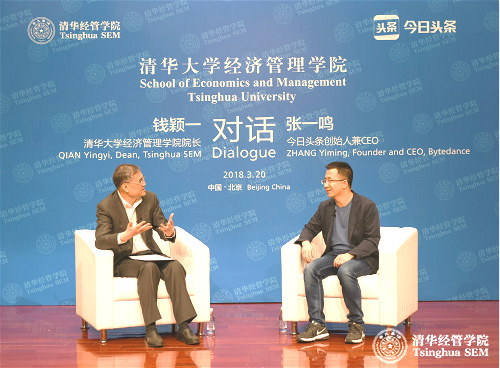
Zhang was born in 1983 in Longyan, a city in China's Fujian province. At Nankai University he switched from microelectronics to software engineering. The change feels almost too neat in retrospect, but the useful detail is less the degree than the habit. He repaired computers for classmates. He read outside the syllabus. He especially liked biographies, he later told a Tsinghua University audience, because apparently singular lives reveal common ways of meeting difficulty. The future founder was already studying how systems behaved, including human ones.
After graduating in 2005, Zhang moved through a compressed education in Chinese technology. At Kuxun, a travel-search startup, he joined as an early engineer and rose to technical director. A brief stretch at Microsoft gave him a view of the large corporation, and a reason to leave it. He later reduced the problem to a wonderfully blunt diagnosis: boredom. He worked at the microblogging service Fanfou, then started the real-estate search business 99Fang with his university friend and former roommate Liang Rubo.
The industries kept changing: travel, social posts, property. The underlying irritation did not. How could software connect a person with the right piece of information more efficiently? Zhang described himself as a quiet, low-profile “tech geek,” then corrected the label with a crucial adjective: unsettled. He liked hard things and the sense of achievement that came with making them work. Restlessness, properly directed, can look remarkably like strategy.
Kuxun: travel search becomes an education in information retrieval and startup speed.
99Fang: Zhang and Liang Rubo apply search to property and learn to run a company.
ByteDance begins in a four-bedroom apartment; Toutiao launches in August.
Douyin launches, TikTok goes abroad, and Musical.ly is folded into one global app.
Liang succeeds Zhang as CEO and chairman; Zhang turns toward longer questions.
The apartment and the feed
In 2012, Zhang and a team led with Liang rented a four-bedroom apartment in Beijing's Zhongguancun district and founded ByteDance. The timing mattered. China was becoming mobile-first. Cheap smartphones were placing an intimate computer in millions of pockets, while older web portals still behaved as though every reader arrived at the same front page. Zhang's answer was Toutiao, a news and information app whose title translates roughly as “today's headlines.” It launched that August and assembled a feed around the reader rather than an editor's homepage.
This was not magic, though the experience could feel like it. Recommendation software converted behavior into clues, clues into rankings, and rankings into a stream. The product improved as people used it. The business gained a flywheel: more attention generated more signals; more signals sharpened recommendations; sharper recommendations attracted more attention. The search box had been turned inside out.
“Operations are about context, not control.”Zhang Yiming, speaking at Tsinghua University in 2018
ByteDance applied the same conviction to video. Douyin launched in China in September 2016. TikTok followed outside mainland China in 2017. ByteDance acquired Musical.ly that November and merged it into TikTok the following year. Suddenly an idea refined through listings and headlines was choreographing a global succession of jokes, recipes, songs, tutorials and dances. A clip did not need a famous creator or an existing network of friends to travel. It needed to hold attention.
Zhang understood that the people building a youth product could not study it only in slide decks. After the Musical.ly acquisition, he told the Tsinghua audience, staff were required to create two short videos a month. Fail to collect enough likes and push-ups awaited. Corporate immersion had acquired a fitness component. The anecdote is funny because it compresses the ByteDance method: use the product, observe the response, adjust quickly. Even the embarrassment was data.
The honest resignation
Founder mythology insists that the person with the original insight must also enjoy budgets, approvals, hiring plans and a calendar paved with meetings. Zhang declined the myth. In May 2021, he told ByteDance employees that Liang would succeed him as CEO. By November, Liang had also taken the chairmanship. The handover kept the company with someone Zhang had known since university, a collaborator from 99Fang onward, but familiarity was only part of the logic.
Zhang wrote that he lacked some of the skills of an ideal manager. Daily executive work had made him reactive, occupied by presentations and decisions that left little room for the exploration from which ByteDance had emerged. His preferences ran elsewhere: reading, being online, listening to music and daydreaming about what might be possible. Coming from the founder of an enormous company, this was either an eccentric confession or an exact piece of job design. It was probably both.
He proposed a ten-year horizon for learning, systematic thought and experimentation, with attention to long-term strategy, company culture and social responsibility. The aim was not retirement in a deck chair. It was a return to the spaciousness before ByteDance, when there had been enough time to notice that machine learning and mobile computing might change how information found people.
“I'm not very social, preferring solitary activities like being online, reading, listening to music, and daydreaming about what may be possible.”Zhang Yiming, in his 2021 note to employees
What the quiet years bought
The public record after his departure becomes deliberately thinner. Zhang remained ByteDance's founder and a major owner, but Liang ran the company. Philanthropy supplied a few visible markers. In 2021, Zhang donated 500 million yuan toward education in his home region of Longyan. In August 2024, he and Liang jointly gave 200 million yuan to Nankai University to support mathematics research and the development of talent. The gift brought their long partnership back to its point of origin. Two software founders were investing in the slower foundations beneath software.
By then, ByteDance bore little resemblance to the apartment startup. The company says it has more than 150,000 employees across nearly 120 cities. Its products include TikTok, CapCut, Lark and a wide Chinese portfolio alongside Toutiao and Douyin. That scale also makes the founder's withdrawal more interesting. He had argued that good operations provide context without suffocating creativity. Succession turned the maxim from management advice into a personal wager.
Then the founder edged back toward the laboratory. Reporting in June 2025 described Zhang as regularly travelling from Singapore, where he is based, to Beijing, attending meetings with core AI researchers since the second half of 2024. He had not reclaimed the CEO title or the daily machinery of management. His involvement resembled a technical founder returning to a frontier, close enough to shape questions without resuming every answer.
The next prediction
The symmetry is hard to miss. ByteDance's first great wager was applied artificial intelligence: systems that inferred taste and ranked information at vast scale. The present race concerns models that can also generate text, images, audio and video. Recommendation asks, “What should this person see next?” Generative AI adds a more unruly question: “What can be made next?” Zhang's career has arrived at a larger version of its original puzzle.
His wealth has followed ByteDance's rising private valuation. In September 2026, a Bloomberg estimate reported in the financial press put it near $105 billion and ranked him as Asia's richest person. Such numbers are estimates attached to an illiquid private holding, better read as weather than architecture. They measure the market's changing view of ByteDance, not the private founder's inner weather. Zhang's more durable unit has always been the next problem worth learning.
There is a temptation to make disappearance romantic. It can also be practical. By leaving the chief executive's chair, Zhang gave a trusted operator room to operate and gave himself permission to be a student again. The arrangement reunited temperament and task. Liang manages the institution they built; Zhang studies the technological turn that may remake it.
The boy who repaired classmates' computers became the engineer who reversed the direction of search. The engineer became an executive, then confessed that executive life was not his most useful form. Today, the screen keeps offering its next item with unnerving confidence. Somewhere behind it, Zhang Yiming is again thinking about what the machine should learn to do before anyone thinks to ask.