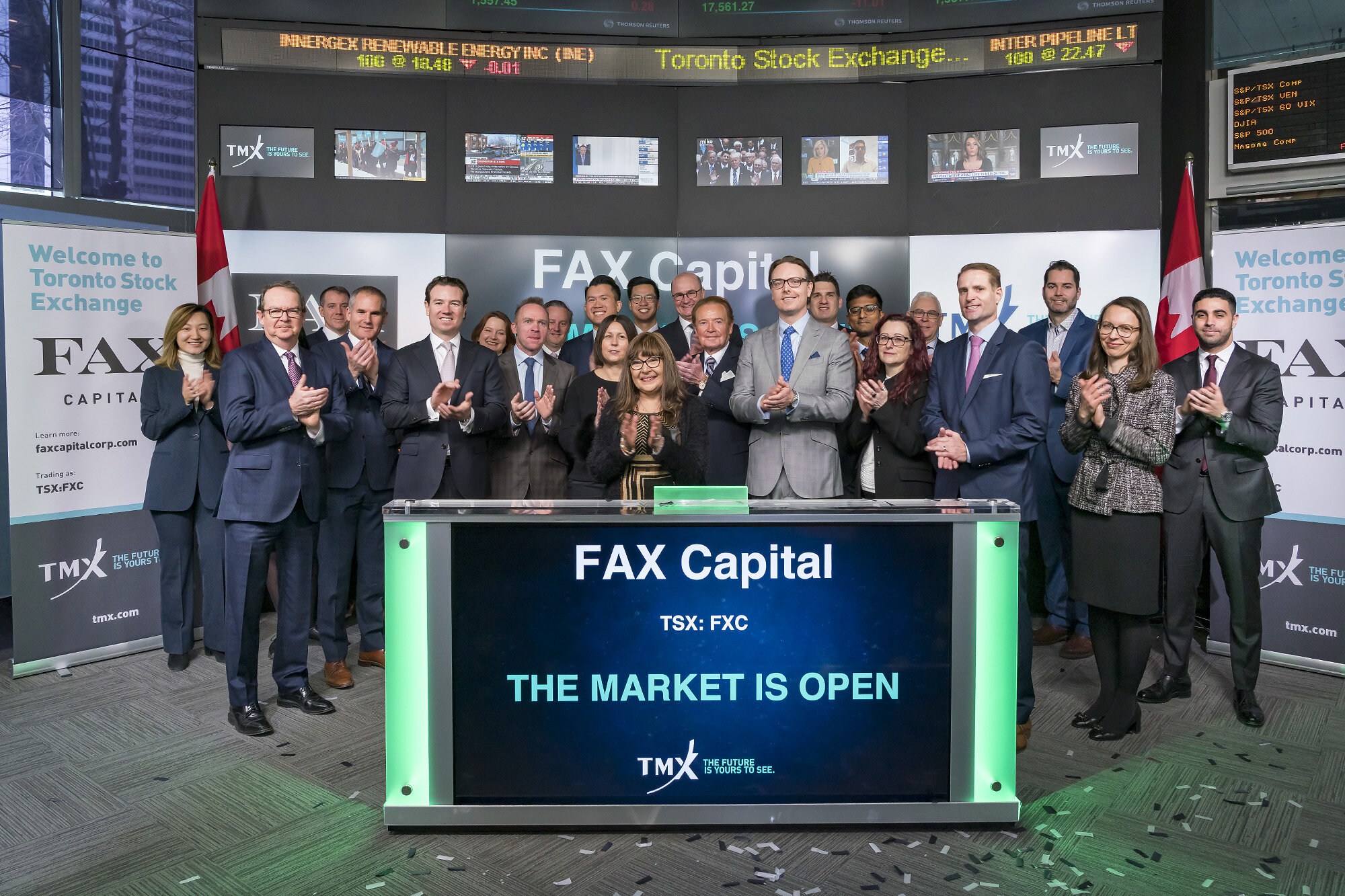
Blair Driscoll joined the Toronto Stock Exchange’s market-opening ceremony on January 22, 2020. FAX Capital had started trading there two months earlier. The photograph has the familiar ingredients: suits, applause, a company name and the assurance that the market is open. For an investor interested in holding businesses for years, it was a rather punctual beginning.
The less photogenic part of the launch was the structure behind it. In November 2019, FAX raised C$190 million through a public offering and a private placement. The money went into an investment company with its own balance sheet. Driscoll had helped create a vehicle whose capital could remain available while the businesses it owned did their work.
That distinction runs through his career. He had studied companies at CIBC, worked inside Sentry Investments and then moved into FAX and Federated Capital. Each position offered a different view of the same problem: a business develops on one timetable, while the people providing its money may operate on another.
Before he owned companies, he studied them
Driscoll began his investment career in the equity research department at CIBC World Markets, supporting coverage of telecommunications, media and entertainment. These were businesses to examine rather than businesses to run. The job placed him on the analytical side of corporate life, looking at companies whose decisions would eventually appear in financial results.
His education included a Bachelor of Arts at Western University and an MBA at the University of Toronto’s Rotman School of Management. At Sentry Investments, his responsibilities later encompassed investment management and investment operations. He also served as a director and vice president. The firm was acquired in 2017 for C$780 million.
Sentry gave him an experience beyond selecting securities. In his account of those years, operating a business taught respect for management decisions and company culture. An investor can observe a choice from outside. The person making it has to manage the consequences, including the people who will carry it out.
He also encountered the constraints of an open-ended mutual fund. Investors can redeem their holdings, and the manager has to accommodate those withdrawals. A portfolio manager’s long-term conviction therefore sits beside a shorter-term obligation to make cash available. Driscoll’s later work would put considerable effort into changing that arrangement.
A company built to keep its money
FAX’s 2019 financing combined approximately C$70 million from the public offering with C$120 million from Fax Investments. It supplied an investment base before the portfolio was assembled. The financing matters to Driscoll’s story because it gave his preference for patience an actual corporate form. An investment philosophy still needs somewhere to keep the money.
With a corporation, a shareholder who wants to leave can sell shares to another buyer. That transaction need not require the company itself to sell a portfolio holding to finance a redemption. The distinction gives an investment team more freedom over when to buy or sell the underlying businesses. It also means shareholders depend on the price available for their shares.
Capital raised at launch, before investment decisions put it to work.
There is an appeal to the idea of being allowed to wait. There is also an obligation. Capital that remains in the business still has to be allocated sensibly. A longer horizon gives a poor decision more time too. The structure removes one pressure; the judgment required to choose a business remains.
Driscoll’s interest lay in smaller companies. In January 2021, he published a case for publicly held micro-caps in advisers’ portfolios. The argument treated them as an area where market inefficiency deserved closer examination. His career had moved from researching established sectors to looking for businesses whose size could leave them outside the attention of larger pools of capital.
The house inspector with more than one business
Carson Dunlop made that approach tangible. FAX completed its C$11.75 million acquisition of an approximately 78 per cent interest in March 2021. Co-founder Alan Carson remained involved. The business brought together home inspections, education for inspectors and reporting software. It was a practical collection of activities around a transaction that homeowners take seriously.
An inspection itself is tied to a particular property and a person doing the work. Training and software can serve a wider population of inspectors. The combination explains why a home-services company could interest an investment group considering a platform for growth. A house might have one front door; the business surrounding its inspection had several ways in.
FAX appointed Graham Badun as CEO of the new platform company. He also became president of Carson Dunlop, working alongside Carson. Badun brought experience in residential services, including leadership at AlarmForce and Brookfield Residential Property Services. Driscoll’s job included putting an operator into the structure, rather than expecting a financial investment to operate itself.
Three related activities, with the inspector’s work connecting them.
In April 2022, Carson Dunlop acquired National Property Inspections and Carson Dunlop Weldon in two transactions with a combined enterprise value of C$18.6 million. NPI supplied a franchise network operating in Canada and the United States. CDW added commercial-inspection and education capabilities. The platform had begun adding businesses around its original asset.
The founders stayed part of the picture. Roland Bates remained involved with NPI and joined the Carson Dunlop board. Richard Weldon continued as CDW’s president. Those arrangements show the human work inside an acquisition strategy: deciding which responsibilities move and which relationships should continue. The transaction is signed once. The companies have to function together afterward.
A preference for having a say
FAX’s public-company strategy also contemplated meaningful ownership. Its stated approach allowed support through board representation, observer rights and help with financial, strategic and capital-market decisions. Driscoll was interested in an investor having enough involvement to contribute to a business. Share ownership could become a working relationship.
This requires a different kind of attention from simply maintaining a broad list of securities. A concentrated portfolio makes each company consequential. The investor has to understand the business and the people responsible for it, while recognising that influence does not guarantee agreement or a favourable result. A smaller collection of holdings leaves less room for any one decision to hide.
The family relationships are part of the structure too. John F. Driscoll is FAX’s co-founder and chairman. Sean Driscoll is a co-founder, director and co-CEO alongside Blair. Blair also shares leadership of Federated Capital, a single-family office. His work spans both the investment company and the family’s continuing management of capital.
It would be easy to let the shared surname stand in for the career. The work has more distinct stages: research at CIBC, investment responsibilities at Sentry, the creation of FAX and the acquisition of businesses with their own founders. The continuity of ownership sits alongside changes in what Driscoll was actually responsible for doing.
The exchange was one chapter
FAX completed its going-private transaction on July 4, 2022. Fax Investments acquired the outstanding subordinate voting shares other than those already held by it or Blair Driscoll, at C$5.18 a share. The public-market chapter that began in November 2019 had lasted less than three years.
This is an essential turn in the story. The opening-bell photograph records a particular moment, rather than describing FAX’s current status. Today, Driscoll is listed as co-founder, director and co-chief executive officer. An investor’s working life can continue through a change in the vehicle’s ownership and the audience to which it reports.
Carson Dunlop also moved into another chapter. In February 2024, Co-operators announced its acquisition of the parent company. The package included the commercial-inspection operation and franchise networks. Co-operators said the business would continue under the name its customers knew. The platform assembled during FAX’s ownership now had a new parent.
A long investment horizon permits waiting without requiring perpetual ownership. The distinction matters here. The record shows an initial controlling investment, related acquisitions and a later change of ownership. Those events supply a concrete sequence against which to consider Driscoll’s preference for capital that gives businesses time.
A career with room for uncertainty
Driscoll’s writing has also left space for what an investor cannot predict. In his 2020 shareholder letter, he considered the difficulty of assigning neat explanations to market movements. “Causality is overrated,” he wrote. It is a mischievous sentence to find in financial correspondence, where an explanation is usually expected to arrive wearing a tie.
“Causality is overrated.”
Blair Driscoll · 2020 shareholder letter, dated March 25, 2021
The point was to focus on business fundamentals rather than demand a satisfying account of every price change. That emphasis connects the research desk to the later ownership role. The investor still examines the company. The permanent-capital structure gives him more control over how long that examination can inform an investment.
In a 2020 interview, Driscoll was described as a father of four boys. His explanation of what kept him engaged professionally was modest: “For me, it’s a business that’s never easy.” The sentence fits a career whose central ambition has been to make more room for judgment, without removing the need to exercise it.
The enduring question in Driscoll’s work is what happens after the money arrives. A founder remains, an operator joins, an acquisition extends the business, and eventually another owner may take over. Each development uses time differently. The opening bell was quick. The work it announced required a much longer conversation.