Bing Yuan remembered the flowers, the small cake and the champagne. OnCusp’s Shanghai office was opening, and only a few colleagues were there to mark the occasion. For an executive whose career already included multinational companies and a stock-market listing, this modest celebration stayed with him. A company had begun to exist in the practical sense: people together, a place to work, decisions to make.
There is something pleasantly uncorporate about the small cake. Business biographies tend to measure beginnings in dollars. Yuan’s recollection measures one in colleagues. Both matter in his story. He co-founded OnCusp Therapeutics in 2021 with Eric Slosberg and Andy Fu, taking his first role as a co-founder and chief executive after years of helping other organizations grow. He arrived with experience. The responsibility was new.
Three universities before the corner office
His route into management passed through Nanjing, New York and Cornell. He earned a bachelor’s degree in biochemistry at Nanjing University in July 1991. Columbia University followed: a master’s degree in 1995, another in 1997, and a doctorate in cellular, molecular and biomedical studies in May 2000. In May 2002, he received his MBA from Cornell University.
The sequence gives his later career a particular texture. He learned the language of scientific investigation before adding the language of business. It would be too tidy to turn those qualifications into a personality test. They do, however, explain why his résumé can move between technical organizations, commercial planning and negotiations without changing its subject: deciding what an organization should pursue, and how it might pay for doing so.
A doctorate and an MBA can look like two certificates sharing a wall. Yuan’s subsequent work put them in the same conversation. His roles involved evaluating opportunities, setting priorities and working with people whose expertise differed from his own. The business side of a technical company requires decisions about evidence as well as money. His education gave him formal training in both disciplines, years before the founder title appeared.
A career spent on both sides of the table
Early roles included product management at Thermo-Fisher and global marketing at Eisai. At Novartis, where he worked from January 2008 to July 2014, his responsibilities expanded into global commercial strategy. He eventually became an executive director and head of life-cycle strategy. New-product planning, portfolio strategy and business-development evaluation also figured in that stretch of his career.
Those job descriptions cover different clocks. A launch asks what happens next. Portfolio planning asks what deserves attention years ahead. Life-cycle strategy asks how an established business should develop over time. Moving among them means repeatedly changing the distance from which a decision is viewed. The opportunity that looks attractive in a presentation still has to make sense within a company’s longer commitments.
At Merck, he became an executive director and global business-development lead. The work put him on the side of a large organization assessing outside opportunities. Later, at CStone and OnCusp, he would help smaller organizations seek partners of their own. That change of seat matters. A dealmaker who has represented both a large prospective partner and an emerging business has encountered the transaction’s demands from different directions.
His professional activities also extended into sharing experience. A November 2016 career-development event organized by Princeton’s Chinese students and scholars association listed him among its speakers. His biography for the event recorded three Novartis Oncology President Awards. Alongside the succession of executive titles, there was a career worth asking about before he had founded his own company.
CStone made the job bigger
Yuan joined CStone Pharmaceuticals in November 2016. The assignment grew well beyond negotiating individual agreements. His responsibilities included commercial strategy, business development, government affairs, public relations and support for the chief executive’s strategic planning. By 2020, as chief strategy and business officer, he was responsible for licensing, alliance management, corporate planning, project management, portfolio strategy and business insights.
That is a substantial collection of things to find waiting in an inbox. It also describes an apprenticeship in how a company fits together. Public relations depends on what the business can credibly say. Alliance management depends on what two organizations have actually agreed to do. Project management tests whether a plan survives contact with calendars and competing demands. These functions share consequences, even when an organizational chart gives them separate boxes.
CStone listed on the Hong Kong Stock Exchange on February 26, 2019, roughly three years after its establishment. Yuan was part of the early executive team that helped build the business through that transition. His work there included partnerships with Pfizer, Bayer, Blueprint, Agios and EQRx. The achievement was collective, and his contribution sat at the intersection of company strategy and external relationships.
For the story that followed, the listing matters as experience. He had worked inside a young company as it became accountable to public shareholders. He had also helped establish the departments needed to support its growth. OnCusp would give him the chance to make more of those organizational choices from the beginning.
The idea had been waiting
The desire to start a company predated OnCusp by about a decade. Yuan had considered entrepreneurship while at Novartis. After leaving CStone in February 2021, he received approaches about chief-executive positions and investment roles. He chose to establish a business of his own with co-founders whose skills complemented his.
His reasoning was tied to a view of how companies would compete. In 2021, he expected more Chinese businesses to pursue international markets and more transactions taking innovations abroad. He also expected new companies to become more specialized. The ambition to assemble every function inside one organization was, in his view, becoming harder to sustain as competition and costs increased.
There is a useful distinction here between wanting to start a business and deciding which business to start. Yuan’s years in established companies supplied more than a network of contacts. They gave him a set of choices to reconsider: how broad to make the organization, which capabilities to build, and where a partner might contribute more than an additional internal department.
OnCusp opened its Shanghai office in April 2021 and its New York office that June. The international arrangement was present at the start. So was a $25 million seed financing led by Sequoia Capital China and BioTrack Capital. Yuan’s long-considered idea now had investors, colleagues and operations in two countries. The cake had company.
“Resilience is essential to leading a successful company.”
Bing Yuan, reflecting on OnCusp’s first year
A phone call reaches the beach
Recruiting supplied one of the founding story’s better details. Slosberg answered Yuan’s call while on holiday on a Hawaiian beach after leaving Daiichi Sankyo. He eventually joined as a co-founder after assessing the business, its strategy and the team. A beach is an excellent place to contemplate a quieter life. It can also, apparently, receive a startup invitation.
Yuan described the first year in terms of responsibility, humility and passion. He also emphasized open debate across a team working in the United States and China. Read together, those reflections suggest a management challenge rather than a motivational slogan: invite different judgments, then accept responsibility for the decision.
The public company question
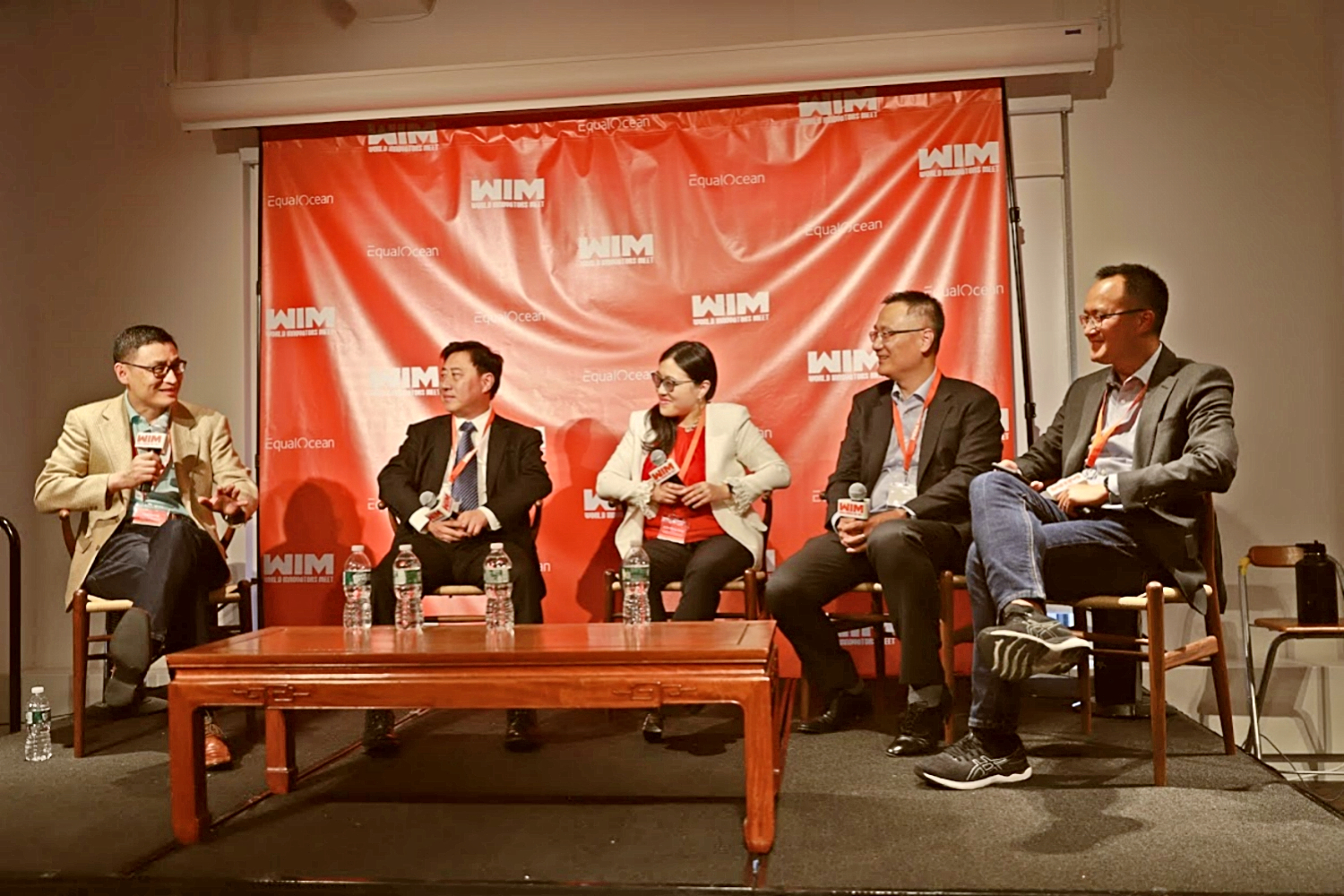
At World Innovators Meet in New York in July 2022, Yuan appeared alongside Ying Huang, Dahai Guo and Sally Wang, with Leon Tang moderating. The discussion ranged across business conditions and capital markets. It placed Yuan among executives wrestling with a common problem: how to keep building when raising money becomes harder.
His comments on stock-market listings were particularly revealing for someone who had already helped a company reach one. He distinguished raising money through an IPO from an eventual acquisition. In discussing the United States, he described a public offering as financing and an acquisition as an exit. A listing, in that account, belongs within the company’s journey rather than automatically supplying its final scene.
He also acknowledged the tension between getting a company listed and receiving the valuation its owners want. This is a less ceremonial way to think about the stock exchange. The bell makes a good photograph; the capital has work to do afterward. Yuan’s position makes sense alongside his own career: he had experienced a listing, then returned to the work of building another private business.
A website with a job to do
Even the account of OnCusp’s original website offers a small clue to his working priorities. The founders hired Core Communications to help establish the company’s public presence. The process included conversations about the business model, its mission and its audiences, with attention to communicating across the United States and China.
Yuan described the finished website as a tool for hiring, partnerships and future fundraising. That is a practical brief. Each audience asks a different version of the same question: why should we commit to this company? A prospective colleague commits time and reputation. A partner commits resources. An investor commits capital. The website needed to make the business understandable to all three.
The detail is modest beside a financing announcement, but it belongs in a founder’s story. Company-building includes deciding how people encounter the organization before they meet its leaders. Yuan’s assessment of the work focused on what it could help the team accomplish. The corporate shop window had been given a sales target, even if nobody called it that.
Series A co-led by Novo Holdings, OrbiMed and F-Prime Capital.
More capital, more people to answer to
In January 2023, OnCusp announced independent directors Robert Forrester and Chau Khuong. Forrester brought experience as a founder and executive; Khuong brought an investment background. For Yuan, expanding the board meant adding people who had seen young companies from perspectives beyond his own executive career.
A year later, OnCusp announced an oversubscribed $100 million Series A, co-led by Novo Holdings, OrbiMed and F-Prime Capital. The January 4, 2024 announcement put cumulative financing at $139 million. BioTrack Capital, an investor from the seed round, participated again. The round also brought plans for investor representatives to join the board.
Those numbers describe resources entrusted to the company. They also expand the circle of people expecting it to deliver. Yuan thanked both investors and his team when the financing was announced. The balance is appropriate to his job: raising money depends on persuading outsiders, while making use of it depends on the people already inside.
By May 2026, another piece of the organization was taking shape. OnCusp appointed Anthony Kim as chief financial officer, with responsibility for capital-markets strategy, investor relations, financial planning and operations. Yuan emphasized Kim’s experience building investor relationships and executing financings. Hiring an executive to own that work reflects how the founder’s responsibilities develop as the company grows.
The small Shanghai gathering remains a useful beginning for this story. There was already a financing behind it, but Yuan remembered the people and the occasion. Years later, the tasks have become more elaborate: boards, institutional investors, executive recruitment, planning across borders. They still return to an ordinary founder’s obligation. Get people to commit. Give them work worth doing. Be answerable for what happens next.