Before William P. Angrick III had a business plan, he had a web address. He found Liquidation.com advertised in a newspaper, bought it, and began building a company around the things other companies were finished with. In the late 1990s, when the internet seemed to promise a frictionless future, Angrick chose a field full of pallets, discontinued merchandise and equipment somebody would eventually have to move.
His first office came with an appropriately economical backstory: space subleased from Al Gore’s presidential campaign. He put $100,000 of his savings into the venture. The address was ambitious; the accommodation was a bargain. There is something pleasing about an enterprise devoted to extracting value from overlooked assets beginning with a good deal on somebody else’s office.
More than a quarter-century later, Angrick remains chairman and chief executive of Liquidity Services. The business has stretched from surplus inventory into machinery, government property and, with an October 2026 acquisition, fine art and antiques. Its founder’s recurring question is still recognizably the same: who else might want this?
The accountant enters the ring
Angrick grew up in Iowa, where delivering newspapers and running a landscaping service supplied early lessons in responsibility. His account of learning leadership is practical: summer work, sport, education and the gradual accumulation of experience. There is no single afternoon when the future chief executive conveniently discovers his destiny. There are customers to serve and work to finish.
At Notre Dame, he also boxed. In February 1989, the campus newspaper identified him as a defending super-cruiserweight champion in the Bengal Bouts. His nickname was “The Annihilator,” a substantial increase in theatrical ambition over the name he would eventually give his company. That year, Sam Elston beat him in a close decision after six minutes of fighting. The surviving account allows for something business biographies often edit away: a competitive person losing.
He graduated with honors in 1990 and earned his CPA certificate that year. Accounting remains part of his stated leadership toolkit, alongside communicating ideas and understanding where a market is headed. It is an unusually useful combination for an entrepreneur: know the numbers, explain the proposition, and remember that a promising idea still has expenses.
A friendship before a marketplace
At Northwestern’s Kellogg School, Angrick found both training and a future business partner. He and Jaime Mateus-Tique completed their MBAs in 1995. Their shared interest in entrepreneurship grew through classes, clubs and conferences; Angrick helped establish a technology entrepreneurship conference. The partnership developed before there was a company for it to run.
They did not immediately set off together. Angrick went into investment banking, working in the consumer and business services group at Deutsche Banc Alex. Brown from 1995 to 1999. Mateus-Tique entered consulting. Each acquired experience that would prove relevant when they reunited around the reverse supply chain: the awkward business of handling goods moving away from their original intended destination.
By the time Kellogg profiled the venture in 2005, the partnership had become tangible. Liquidity Services employed about 300 people, and its buyers came from 116 countries. Asad Haroon, another Kellogg graduate, was its chief marketing officer. The company’s beginnings also included co-founder Ben Brown. This was a network of people with complementary experience, assembled around a problem with very physical dimensions.
Then the internet became a liability
Starting an online business in 1999 offered a particular lesson in timing. Soon, the collapse of internet companies made prospective customers wary of web-based suppliers. Angrick wanted major retailers and corporations to trust a young marketplace just as the category itself was becoming a reason to hesitate.
The team found early traction with government sellers. Winning and bringing those clients aboard required a three-year investment cycle, in Angrick’s later account. He said the initial clients more than doubled the sales value recovered from their assets. Those results gave the company examples it could take to commercial customers; major retailers followed in 2004 and 2005.
Government surplus demanded more than an auction page. A 2004 study described the company’s Government Liquidation operation handling property at more than 200 Defense Department locations. Items had to be received, grouped, checked, listed and tracked through sale and shipment. The supply varied in quantity, type and condition. Software had to accommodate the disorder rather than wish it away.
That operational detail matters to Angrick’s story. An internet marketplace can sound like a clever arrangement of screens. In this business, its credibility also depends on what happens in a warehouse and whether the buyer can actually collect the goods. The website makes a promise that people elsewhere must keep.
“With every downturn, there are opportunities.”
William P. Angrick III, 2020
Somebody else’s inventory problem
The commercial logic is easy to understand at the level of a single object. A company no longer needs a machine. Another business may need precisely that machine, at a price below the cost of buying new. Matching them can release money for the seller and lower the buyer’s cost of getting to work. The complication is finding each other, agreeing on condition and completing the exchange.
Angrick’s marketplaces address that complication at scale. The company went public on February 23, 2006, under the Nasdaq symbol LQDT. In 2008, it acquired GovDeals, extending its role in state and local government surplus. The inventory may be secondhand; the organizational work of making it tradable has to be done afresh.
When Angrick spoke to Notre Dame students in 2013, he explained the business through the network effect. Additional supply makes a marketplace more useful to buyers. More buyers can improve results for sellers, encouraging more listings. That loop helps explain why building both sides takes patience: an empty marketplace is an exceptionally orderly place in which to do no business.
A simplified illustration of the network effect, rather than a forecast of results.
His advice to those students was similarly concerned with people. Recruit talent, bring employees into the mission, give them a clear objective and allow them room to achieve it. A marketplace is built from other people’s decisions. So, in his telling, is a team.
The business behind the bargain
By 2021, the company was taking its proposition more directly to consumers through AllSurplus Deals. The launch also exposed a familiar entrepreneurial irritation: having an offering does not guarantee that people will notice. An early campaign fell short of its registration goals. Subsequent television coverage put the operation, including its warehouse work, in front of a wider audience.
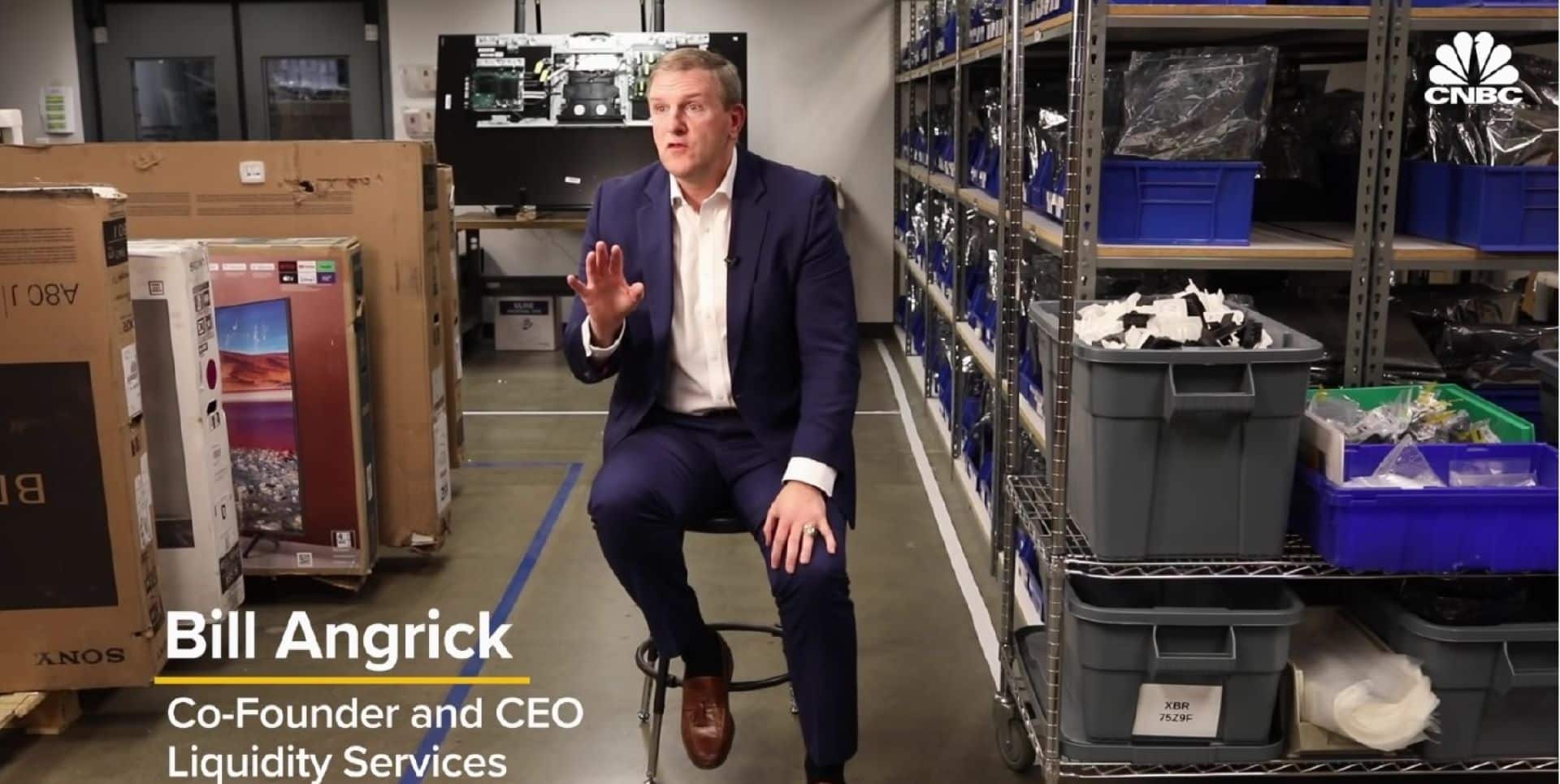
Angrick’s warehouse interview is an apt portrait of the job. He sits amid boxes and shelving, dressed for business in a setting designed to store things. The surroundings do much of the explaining. These objects have not vanished because their first transaction failed to stick. They are waiting for another transaction.
For the quarter ended June 30, 2026, Liquidity Services reported $129.6 million in revenue and approximately 334,000 completed transactions. Its registered buyer count stood at about 6.4 million. Registration measures the accumulated pool of accounts, rather than the number of people actively bidding that quarter. The distinction is useful: a crowd is one thing; getting a particular lot sold is another.
at June 30, 2026
in Q3 FY2026
From surplus to something treasured
On October 1, 2026, Liquidity Services completed the acquisition of Auction Holdings, the operator of Invaluable, AuctionZip and RFC Auction Systems. The base purchase price was $80 million in cash, subject to customary adjustments. The move brought the business further into collectibles, fine art, antiques and estate auctions.
There is an enjoyable change of vocabulary here. An item can be excess inventory in one room and a treasured possession in another. The acquired businesses served thousands of auction houses and provided access to approximately four million registered bidders. AuctionZip connected local and regional auctioneers with buyers, a different community from the public agencies and industrial sellers that helped build Liquidity Services.
Angrick described the goal as helping auction houses grow through better technology, services and buyer engagement. The setting has changed, but the work remains familiar: make an object discoverable, give a buyer enough information, and help a transaction happen. A pallet and a painting require different expertise. Both require somebody willing to bid.
The costs beyond tuition
Another 2026 development gives Angrick’s interest in business education a more personal expression. He and his wife, Stephanie, made a $15 million gift to Notre Dame for the Angrick Military Scholars Program, designed to support military-affiliated MBA students. Its announced start was August 2026.
The program addresses expenses that remain even when tuition is covered. Up to ten scholars in each cohort can receive $30,000 annually in additional funding for costs including housing, relocation and child care, with first preference for eligible candidates with families. The Naticchia Fellowship within the program honors Stephanie’s father, Marine Corps veteran Robert D. Naticchia.
The gift has a specific purpose. Moving a family and paying for child care are concrete obstacles. The gift puts resources against those obstacles. Angrick’s stated hope is that Notre Dame can prepare veteran leaders to increase their positive impact on society.
He and Stephanie now live in Flagler Beach, Florida. Notre Dame remains a family connection as well as an alma mater: their son Will graduated from Mendoza in 2025 and played lacrosse for the university. Years earlier, Angrick had described time with his wife and two boys, as a father, coach and mentor, as his favorite part of life away from work.
His public career has involved a long apprenticeship in seeing what remains useful after an original plan is finished. A returned product needs a buyer. A departing owner needs a market. A veteran entering business school may need help with the move. Angrick has spent much of his working life attending to the practical distance between an opportunity and the person who could use it.