Banking technology disappears when it works. A rate changes, a fee is waived, an offer arrives at the right moment, and the customer sees only the result. Behind that small experience sits a layered machine of product catalogs, pricing rules, billing logic, legacy code, approval paths, and people who have learned where the brittle parts live. Bhavna Wadhwa has spent her career moving between those layers. Now, as chief marketing officer at Zafin, her job is to make the invisible machinery intelligible without pretending it is simple.
This is a peculiar kind of marketing assignment. Zafin sells software into regulated institutions, where a promise can become a procurement requirement and a catchy phrase can collide with an audit. The language has to travel from a product team to a bank executive, and then survive contact with an operating model. Wadhwa's advantage is that she entered the story from the technical side. Before the C-suite title, before the conferences and category narratives, there was engineering.
The résumé reads like a translation course
Wadhwa graduated with a Bachelor of Engineering in 2006 and began as a software engineer at Infosys. She moved to Tata Consultancy Services the following year. The early jobs put her close to systems, but her next move widened the frame. From 2008 to 2010, she studied for an MBA at the University of British Columbia, where she also served as president of the MBA Consulting Club.
One project from that period is unusually revealing. Working with a UBC-linked business modeling company, she helped test a method for mapping organizational roles, requests, services, and IT resources across the Sauder School of Business. The purpose was not prettier process charts. It was to turn the way an organization actually worked into information a decision-maker could use. That problem - finding a faithful, usable model of a complicated system - would keep resurfacing under different titles.
In 2010 she joined Deloitte. Consultant became senior consultant, then manager, then senior manager at Deloitte Digital. During that run, she co-authored a paper about the logistical puzzle of moving workers to large remote projects. Its phrase, the “people supply chain,” is a consultant's compressed metaphor, but the substance was operational: connect process, technology, people, information, and suppliers so a complex workforce can move with less waste.
After more than eleven years at Deloitte, Wadhwa spent several months as a director at PwC Canada. Then, in March 2022, she joined Zafin as vice president of transformation. A year later she was senior vice president for enterprise transformation and marketing delivery. In April 2024, she became chief marketing officer. It was a fast sequence, but not a hard turn. Marketing delivery sat downstream from transformation. The story and the operating change had to agree.
The product is hidden. The stakes are not.
Core banking modernization is rich in words that sound final: replace, transform, migrate, modernize. The reality is incremental and political. Old systems often work. They also make a small change expensive because dependencies accumulated over decades. In the opening episode of Zafin's Banking Blueprints podcast, Wadhwa framed the tension with questions rather than a sales claim. Does legacy mean obsolete? When should functionality change? What should replace it? She ended the thought by reminding listeners that everyday financial lives depend on the answers.
That sentence gives away her editorial instinct. Start with the system, but locate the consequence. A catalog is not merely a catalog when it determines which customer receives an offer. Pricing logic is not merely configuration when it changes what a relationship costs. The complexity matters because people meet its output.
“Consistency. Relevance. Trust built over time, not engineered in campaigns.”Bhavna Wadhwa, reflecting on customer loyalty in 2026
Wadhwa's own experience with PC Optimum gave her a concrete way to talk about ecosystems. She has described loyalty at scale as behavioural infrastructure: the routines of earning and redeeming, the choice of where to shop, the brands a person instinctively trusts. In that view, a bank joining an ecosystem is not simply finding another acquisition channel. It is asking to enter a pattern that already belongs to the customer.
The distinction makes her marketing less interested in novelty than in relevance. Digital speed and consistency have become baseline expectations. The harder work is to use what an institution knows at the moment it can be useful, without making the experience feel generic or intrusive. Her shorthand came from a story heard at a marketing conference: when a restaurant learns that a customer just became engaged, champagne is reasonable. The memorable experience begins with what happens beyond the automatic gesture.
Build the room, then improve the conversation
There is another side to Wadhwa's work that looks less like copy and more like architecture. Zafin's Banking Leadership Summit brings bank leaders, advisors, technologists, and partners into the same room. In 2026, she opened the North American event with Mike Cook and later moderated a panel on growth and customer value.
Afterward, she wrote about a moment that refused to leave her. During a panel, an attendee stood and said, “I'm going to be vulnerable now.” The line surprised her precisely because conferences train people to do the opposite: polish the anecdote, protect the institution, land the point. Wadhwa saw the admission as evidence that the room had become safe enough for a more candid kind of exchange.
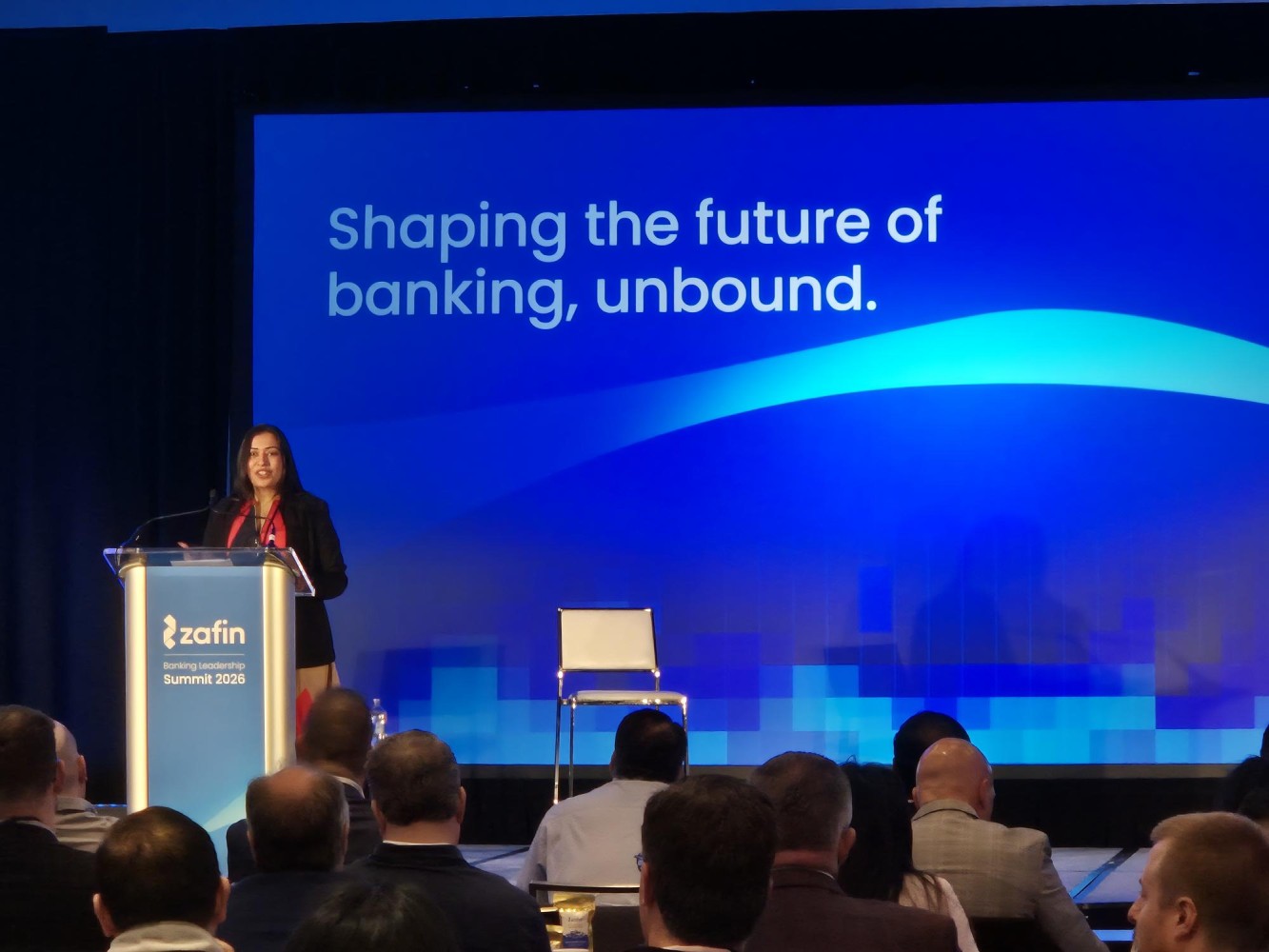
The event had been designed around a deliberate shift. Rather than praise transformation in the abstract, the agenda pushed toward what changes customer outcomes, what leaders can prioritize, and what an institution can execute. Wadhwa wrote that the resulting discussions moved past the surface. People challenged one another, connected observations, and spoke from decisions inside their organizations.
This offers a useful way to understand her practice. Marketing can distribute a point of view, but it can also convene the people who will test it. A conference becomes valuable when the discussion produces sharper judgment than any prepared message could. The marketer's role is partly to design that temporary institution: choose the question, invite real experience, and make enough room for disagreement.
AI, with receipts
In June 2026, Zafin widened its story beyond banking product and pricing with AIOS, an orchestration and control platform for agentic work in regulated institutions. The category arrived with its own fog. Agents, copilots, automation, and transformation were already everywhere. Wadhwa's public explanation focused on the part a regulated buyer could inspect: who initiated the work, which context and controls shaped it, where human authority entered, what it cost, and what evidence remained.
The framing suits both the company and her career. An autonomous agent is another invisible system whose output can look effortless. The institutional obligation sits behind the screen. If software participates in research, delivery, modernization, or an approval workflow, someone still needs to know what was allowed and why it proceeded. Speed is useful. Proof makes speed governable.
“It'll be won by whoever can govern them and prove what happened.”Wadhwa on the enterprise race to adopt agentic AI
The progression from product pricing to governed agents might look like a category leap. At the level of operating logic, it is familiar territory. Both problems ask an institution to move faster without losing control. Both require business rules to become visible and changeable. Both become consequential when an automated decision reaches a customer, an employee, or an auditor.
Ambition without erasure
Wadhwa's public voice also reaches beyond banking. Writing about a leadership gathering for South Asian women, she described a quiet tension: be proud of cultural identity, but careful about disrupting the room; be ambitious, but careful about standing out. She was drawn to a space built on the premise that identity and leadership excellence can coexist, and that belonging need not compete with ambition.
That idea rhymes with her conference reflection. Institutions reveal themselves through what people feel able to say inside them. Wadhwa's emphasis on trust is not confined to a product message. It appears in how a customer interprets an offer, how an executive shares uncertainty, how a woman carries identity into a leadership room, and how a bank proves the work of an AI system.
Her résumé can be read as a climb from engineer to CMO. The more interesting reading is sideways. She kept moving to positions with a wider translation burden. Code became process. Process became transformation. Transformation became a market story. The work still begins by respecting how the system functions and ends by asking whether a person can understand, trust, and act on what it does.
That is not a slogan for making complex technology sound friendly. It is a discipline for keeping the story honest. Learn the machinery. Find the human consequence. Preserve the proof. Then open the room and see whether the conversation holds.