An exchange can have its software, its regulatory approval, and ten heavyweight backers, and still discover that getting a trade done is a surprisingly social problem. BGC Group’s FMX Futures Exchange opened in September 2024. By November, industry reporting was describing clearing bottlenecks and restricted access. The machinery existed. Some of the people who needed to use it were still working out how to get through the door.
- BGC connects institutions across financial and commodities markets.
- FMX makes ownership and clearing part of its competitive pitch.
- The test is repeat participation: a launch alone creates no liquidity.
That small difficulty explains quite a lot about BGC. A broker earns a living by knowing where the other side of a transaction might be. An exchange needs those other sides to arrive repeatedly, in sufficient numbers, at roughly the right moment. Moving from one business to the other means carrying a network across a threshold.
First, find the other side
BGC separated from Cantor Fitzgerald’s voice brokerage business in 2004. Its ancestry matters because voice brokerage involves relationships as well as prices. A difficult transaction may require a person who understands the instrument, knows potential counterparties, and can help negotiate a workable trade.
Today the company serves banks, trading firms, hedge funds, governments and corporations. Its desks cover rates, credit, currencies, equities, energy, commodities and shipping. An institution can use a broker, an electronic venue, or a combination. The practical problem stays familiar: find liquidity, discover a price, execute, and get the transaction processed.
The supporting businesses make that chain more useful. Fenics supplies electronic trading capabilities; Fenics Market Data supplies information and analytics; Lucera supplies connectivity. A customer buying access to a market also needs reliable ways to reach it and understand its prices.
- 01Discover
a price - 02Find the
other side - 03Execute
the trade - 04Clear &
process
Each handoff can become the bottleneck.
Give the regulars a stake
In April 2024, ten banks and market-making firms became minority owners of FMX. The group included Bank of America, Goldman Sachs, J.P. Morgan, Citadel Securities and Jump Trading. Their initial $172 million investment bought 25.75% at a $667 million post-money valuation. That valuation belonged to FMX, not the whole of BGC.
The design went beyond fundraising. The investors received additional equity subject to driving volumes and meeting trading targets. BGC was tying a piece of the ownership structure to the activity its marketplace needed.
“We offered ownership to this incredible investment group”
Howard W. Lutnick, announcing FMX’s investors, April 2024
There is a lesson here for anyone building a marketplace: recruit people with a reason to transact, then make participation economically useful. An ownership stake can help align interests. It cannot make an inaccessible market accessible, or guarantee an attractive price when a customer needs one.
The cost hiding behind the commission
FMX competes with CME’s U.S. interest rate futures business. Its clearing partnership with LCH adds another reason to consider switching: eligible futures and interest rate swap positions can receive cross-margining benefits. Recognizing offsetting risks can reduce the collateral a participant needs to post.
For an institution, that potential capital saving can matter alongside execution fees. It also depends on the portfolio, eligibility and clearing arrangements. A participant without qualifying offsets does not automatically receive the same benefit. The early clearing-access difficulties were therefore central to the proposition.
BGC’s later filings described continued onboarding of futures commission merchants. Meanwhile, its cash Treasury venue gained ground. In the second quarter of 2026, BGC reported 42% share of the cash Treasury central limit order book market. Keep the denominator attached: this was cash Treasury CLOB share, not a 42% share of futures.
FMX UST cash Treasury CLOB market share, as reported by BGC. Bars use a 0-100% scale.
A $325 million expansion
BGC’s growth also has a less abstract component: buying businesses. In April 2025, it completed the acquisition of OTC Global Holdings for $325 million, substantially in cash. OTC had generated more than $400 million in 2024 revenue. The purchase expanded BGC’s energy and commodities network.
Group revenue reached $2.94 billion in 2025, up 30%. Excluding OTC, growth was 14.9%. Read those figures together. Acquisitions added a substantial contribution; the existing business also grew. Commissions and principal transactions supplied most revenue, with data, network and post-trade services adding other income.
Its competitive set changes with the job. TP ICAP and Tradition are alternatives in interdealer brokerage; CME is the incumbent FMX challenges in rates futures. BGC’s particular combination is a network of specialist brokers, proprietary electronic platforms, and an exchange backed by prospective users.
The company has also changed what belongs inside its perimeter. Newmark, its former real estate business, was spun off in 2018. BGC sold its insurance brokerage operation to Ardonagh in 2021 for about $535 million in gross proceeds. Those transactions help explain why an old company description can be misleading: property and insurance acquisitions are part of BGC’s history, while today’s story centers on financial markets, commodities and technology. The current group is led by three co-CEOs, John Abularrage, JP Aubin and Sean Windeatt, appointed in February 2025.
New instruments, familiar questions
In June 2026, BGC launched Compute Infrastructure Markets, initially focused on OTC trading in compute and memory capacity. The pitch applies commodity-market experience to infrastructure with fluctuating supply, demand and prices. Whether that develops into a durable market depends on customers finding repeatable transactions worth making.
September brought a more specific technology milestone. BGC said Fenics AI had arranged a Swiss SMI options trade between two institutional accounts, including Hudson Bay Capital, through Aurel BGC. Wider availability was expected in the fourth quarter. One completed transaction establishes a working example; broader adoption remains a separate test.
The day the commission goes elsewhere
There is another way BGC uses its network. Charity Day began in 2005, remembering the 658 Cantor employees and 61 Eurobrokers employees killed on September 11. Celebrities join brokers, clients trade, and the day’s revenues support charities. In 2026, broadcaster Kate Garraway represented Hope for Tomorrow on the London trading floor.
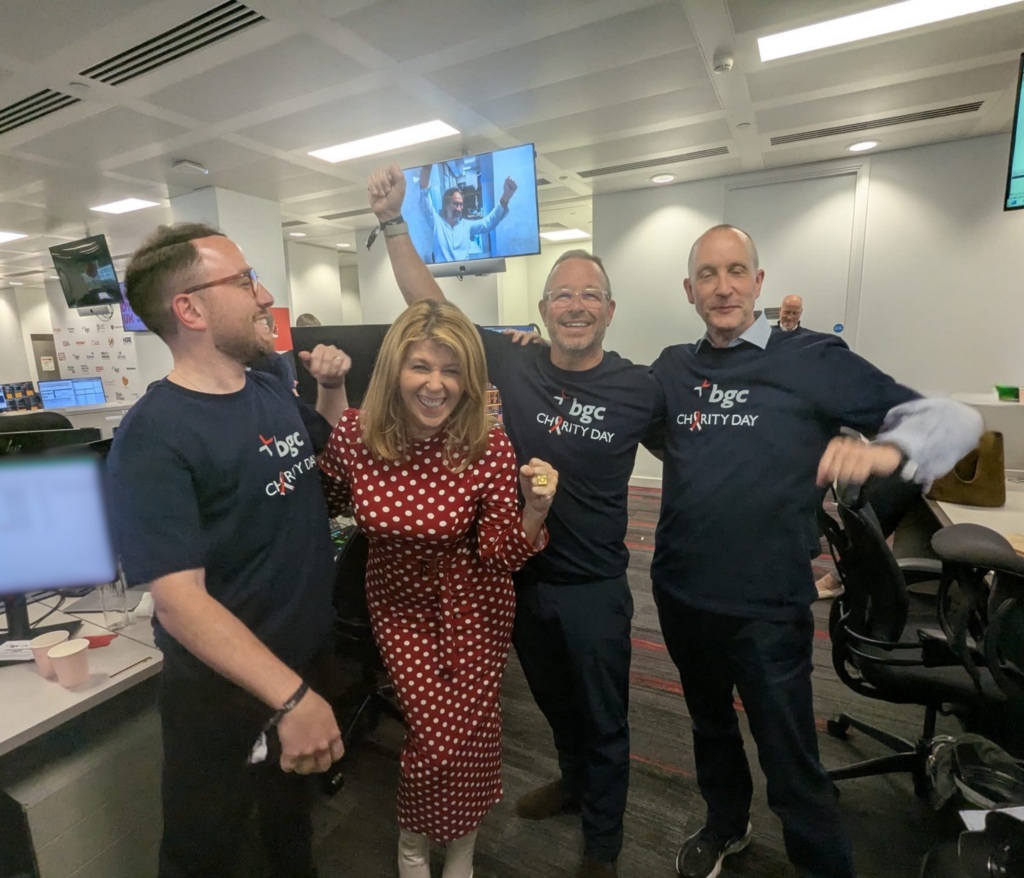
For a day, the familiar machinery sends its proceeds elsewhere. The underlying capability is the same one BGC is trying to carry into new markets: bring people together, give them a reason to participate, and help them finish the transaction.