In 2008, Jon Stein and Eli Broverman began building an investing company. They knew each other through poker. Stein was an MBA student; Broverman was a securities lawyer. At a poker table, deciding when to act is the whole game. Their business would eventually sell people a way to stop making so many decisions about their money.
- You set the destination. Betterment builds and maintains a portfolio around your goals.
- Convenience has a price. Small balances can make the flat monthly fee expensive.
- Control is expanding. Stock picking and custom portfolios now sit beside automated investing.
Working from Stein’s apartment, they divided the problem sensibly: Stein developed the website; Broverman pursued regulatory approvals. The initial financing combined $320,000 in savings and angel capital. A hoped-for September 2009 debut slipped. Betterment finally launched in 2010. Software was only part of the work required to become a financial business.
The proposition was appealingly domestic. Give your money a job. Arrange for more money to arrive regularly. Have somebody else look after the investments. Betterment’s distinctive promise was to turn portfolio maintenance into a service you could leave running.
The chore behind the choice
Consider what happens after someone buys a collection of funds. Prices move. The proportions change. Dividends arrive. Another paycheck lands. A portfolio that began as a plan becomes a succession of small administrative decisions. None is especially glamorous. Together, they determine whether the original plan survives contact with ordinary life.
Betterment’s automated investing handles those jobs through diversified portfolios, recurring deposits, dividend reinvestment, and rebalancing. Customers can invest through taxable accounts or retirement accounts, including traditional and Roth IRAs. The expertise lives in portfolio construction, trading, tax management, and the machinery that keeps them coordinated.
Cash has a different assignment. Cash Reserve sweeps money to participating banks for variable interest; Checking provides spending access through nbkc bank. Betterment itself is not a bank. The distinction matters: investment portfolios carry market risk, while eligible bank deposits have FDIC protection subject to program conditions.
The small-account arithmetic
The Digital plan costs $5 a month unless eligible household investments reach $24,000 or recurring deposits total at least $200 monthly. Qualify through either route and the annual charge becomes 0.25%. On a steady $1,000 balance, $60 a year equals 6%. At 0.25%, the same balance costs $2.50 annually. Fund expenses come separately.
What does convenience cost you?
Digital plan illustration, up to $1 million. Assumes a constant positive balance for one year; excludes fund expenses, promotions, and other charges. Recurring deposits are a pricing qualification here, not added to the illustrated balance.
Premium adds access to CFP professionals and other benefits, with a $100,000 investment minimum and a 0.65% annual fee below $1 million. Betterment is selling degrees of delegation. Whether those degrees are worth buying depends partly on the work a customer would otherwise do.
When the machinery missed
Automation creates an awkward obligation: the company must accurately describe what its code actually does. In April 2023, Betterment agreed to a $9 million SEC penalty. The regulator found that, during 2016-2019, tax-loss harvesting disclosures failed to reflect changes, constraints, and coding errors. More than 25,000 accounts lost approximately $4 million in potential tax benefits.
Betterment settled without admitting or denying the findings. It told Reuters it had made significant compliance investments since 2019. The episode exposes the work hidden behind an effortless interface: testing, records, disclosures, and supervision. A customer outsourcing attention still needs the provider to pay attention.
The customer wanted another button
Then came a revealing number. At the November 2025 launch of self-directed investing, Betterment said more than 75% of customers held self-directed investments elsewhere. People were delegating some decisions and keeping others. The product boundary did not match the way those customers actually invested.
“Investing isn’t binary, it’s a spectrum.”
Sarah Levy · CEO · November 2025
The new service offered commission-free stock and ETF trading without Betterment’s management fee. Its Tax Impact Preview helps customers inspect potential tax consequences before selling. Self-directed accounts do not inherit the managed portfolios’ automated portfolio and tax-management features. The customer has taken back a job.
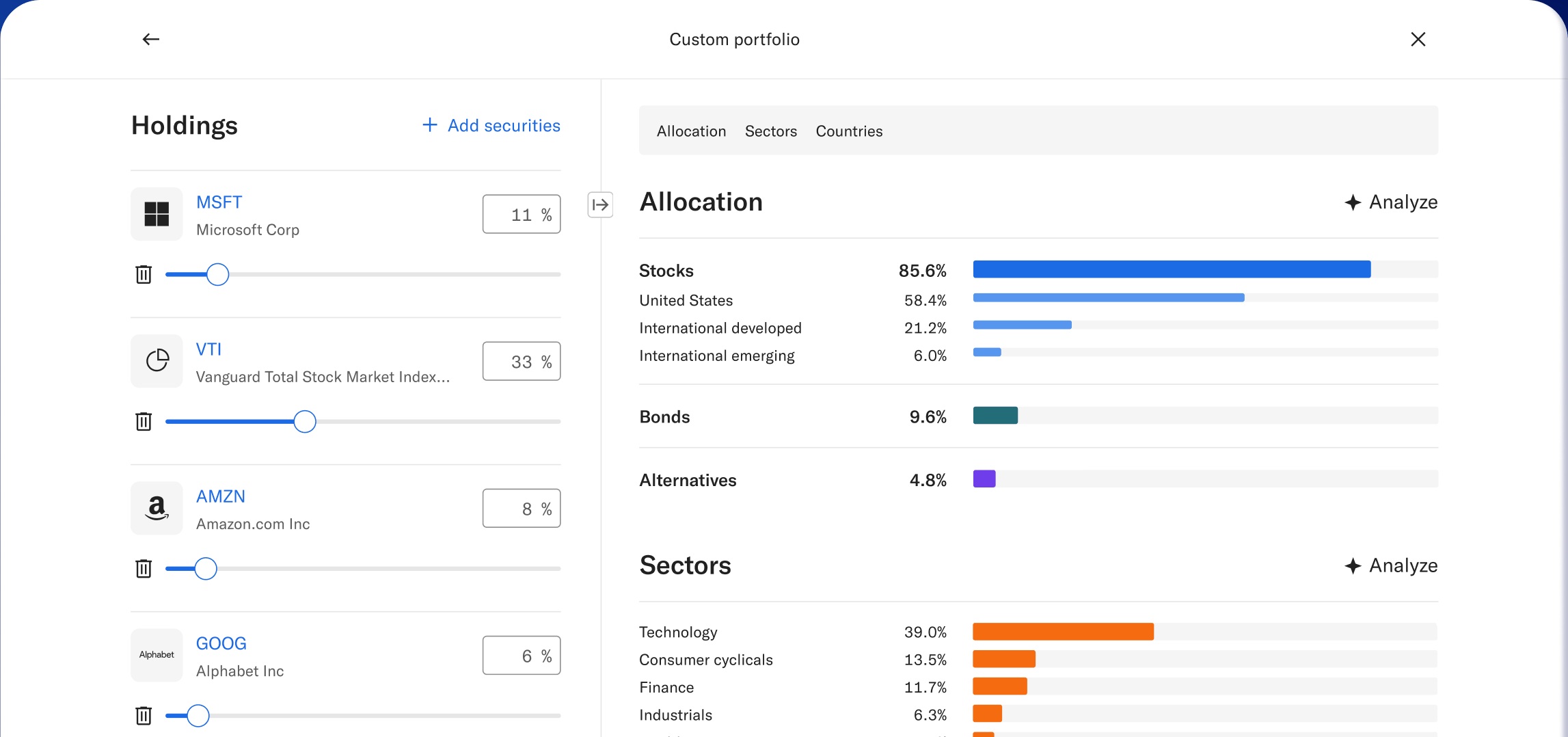
Custom portfolios, launched for retail investors in August 2026, occupy an interesting middle position. Customers select stocks, ETFs, and target weights; Betterment handles ongoing management. AI insights flag exposures and concentrations, but do not make recommendations or consider the customer’s complete financial situation. Choice and maintenance have become separate products.
Three ways into the same household
Betterment also reaches people through their employers and advisors. Betterment at Work supplies workplace retirement plans. Advisor Solutions supplies custody and investment technology to independent registered investment advisors. A consumer app, a benefits relationship, and an advisor’s practice create three routes to customers with different reasons to arrive.
The financing followed that broader ambition. In September 2021, Betterment announced $60 million in equity led by Treasury and a separate $100 million credit facility. The distinction is useful: available borrowing is not another equity round. In 2025, it acquired Ellevest’s automated investing business and portfolio-technology company Rowboat Advisors.

Its latest additions keep extending the maintenance business. On October 20, 2026, Betterment introduced mega backdoor Roth capability for eligible solo 401(k) customers and advisor clients. Paperwork, contribution tracking, and conversions offer plenty of scope for software even when a human still makes the decision.
The company’s own workplace practices put people back into an apparently mechanical story. Its careers page advertises employee equity, coaching, and seven employee resource groups. Those benefits describe an employer’s pitch, rather than independent proof of culture. They also show how much human organization sits behind a service designed to feel automatic.
Buy back attention, carefully
Wealthfront, Vanguard, Fidelity, and Schwab offer competing routes to automated investing. Betterment’s case rests on its combination of managed portfolios, tax tools, cash services, and access to human advice. A disciplined investor can also maintain an ETF portfolio independently.
A prospective customer can separate three questions: which decisions to delegate, which accounts belong together, and what the arrangement costs. Comparing those answers is more useful than choosing a platform simply because its dashboard looks reassuring. The interface is the beginning of the evaluation.
The transferable idea is modest: automate the repeated work you neglect. Its limits deserve equal attention. Tax-loss harvesting depends on personal circumstances, and purchases in outside accounts can create wash sales. Short horizons constrain investment choices. Fees matter more on small balances. Software can maintain a plan; the customer still has to choose one worth maintaining.