Consider a British professional who takes a job in Dubai. This is a hypothetical household, but the ingredients are familiar: a pension left in Britain, savings accumulating abroad, perhaps a property, and a retirement destination still under discussion. Each account has a balance. Together, they pose a question no single balance can answer: what kind of life will this money support?
- The job: connect cross-border financial planning with a consolidated view of wealth.
- The tools: a free app, retirement scenarios and access to human advisers.
- The distinction: seeing your assets is different from paying someone to advise on them.
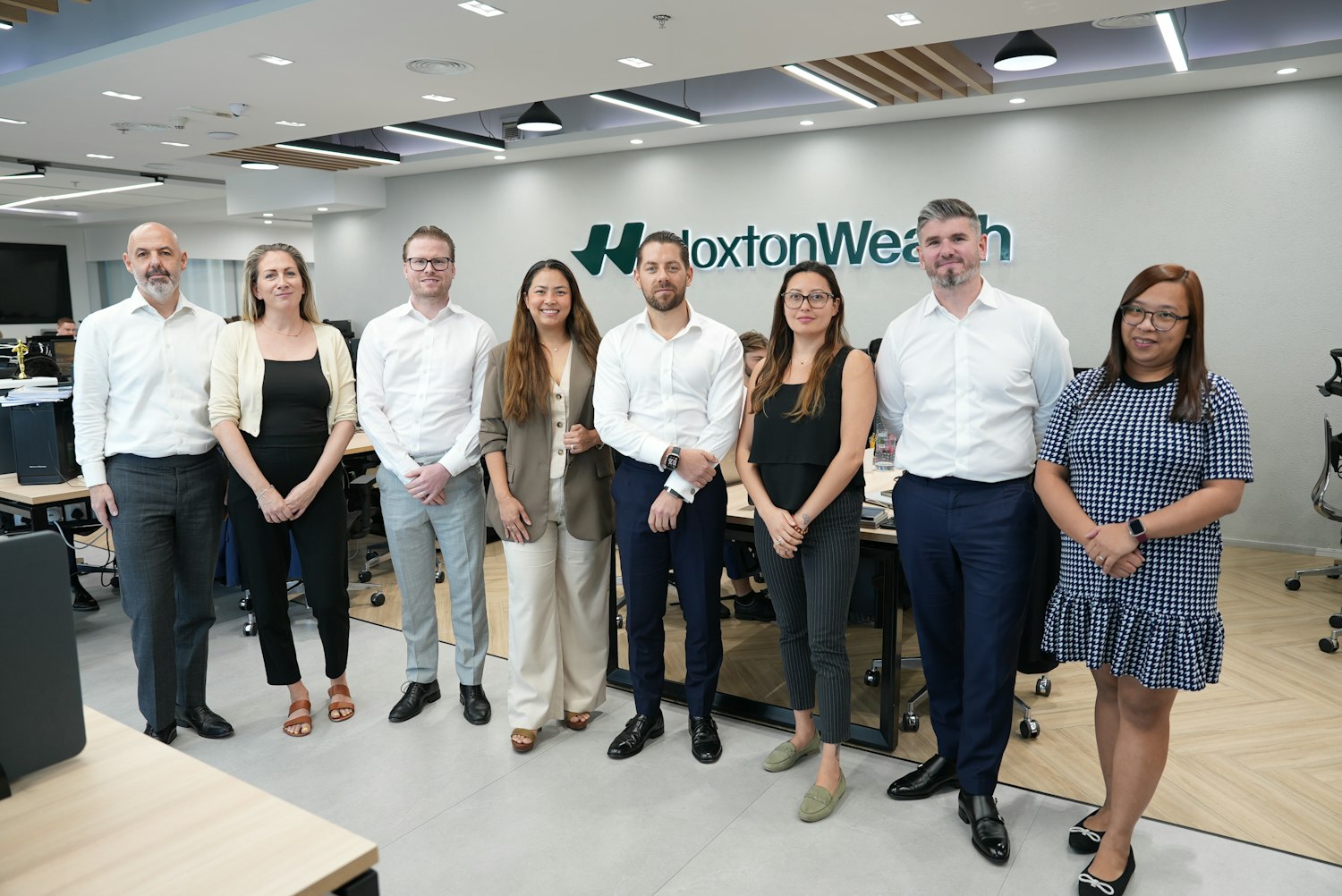
Hoxton Wealth occupies that awkward space between owning assets and organising a life around them. Founded in 2018 by Chris Ball and Matt Dean as Hoxton Capital Management, it serves expatriates and internationally mobile clients. Its services extend from pensions and investments to tax coordination, estate planning, protection and property considerations. The common thread is a financial life spread across places.
The pension did not move with you
Ball’s route into the business helps explain its focus. He began at KPMG in 2004, working on personal taxation involving investment income and pensions. He later moved to the Middle East with deVere before founding Hoxton with Dean, whose background includes foreign exchange and pension-transfer advice. The combination put retirement questions beside the practical complications of living overseas.
The customer problem is easy to underestimate. A pension statement tells you about a pension. A brokerage account tells you about investments. Neither necessarily explains how a proposed move, a different retirement date or family succession fits the rest of the picture. Hoxton’s proposition is to coordinate those decisions through advisers and regional businesses, supported by shared technology.
First, put everything in the same picture
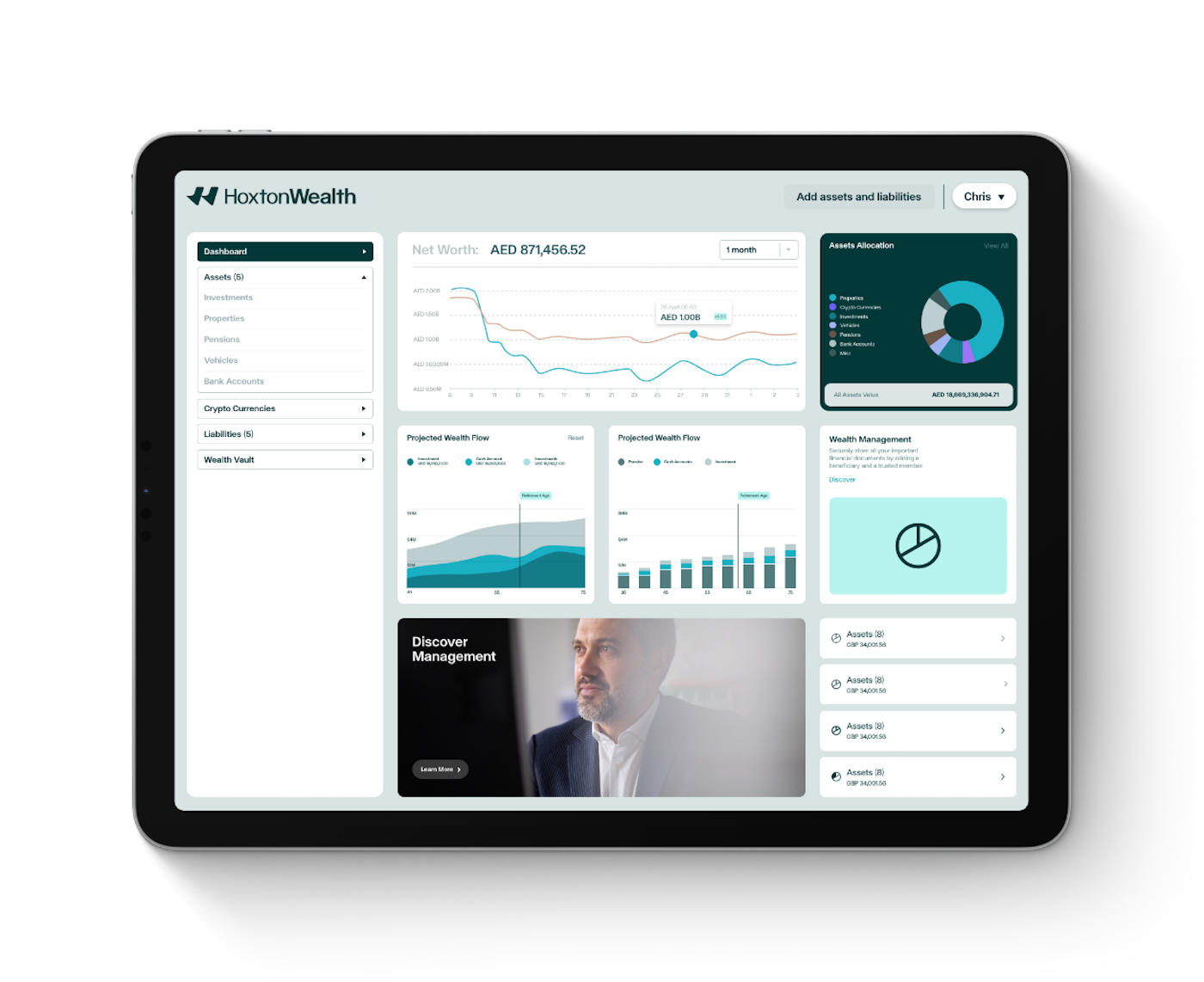
The app begins with an inventory. Users can track assets and liabilities, connect accounts and see net worth in one place. Its scope includes pensions and crypto, but also manually added possessions or holdings such as artwork and private-company shares. This is useful bookkeeping with an ambitious perimeter: the number should reflect more of a person’s actual financial life.
Wealthflow adds time. Users can map future events, build in tax assumptions and examine whether assets might support their intended lifestyle. The Multiple Scenarios feature compares alternatives, including major purchases, changes in savings or retirement timing. A useful way to read those projections is as conditional answers: change the assumptions, and the answer should change too.
Take the hypothetical household again. Retiring earlier and buying another property are two different experiments. Modelling them separately makes the trade-offs easier to discuss. It also gives an adviser something more useful than a vague wish to feel financially secure. The conversation can turn to which inputs matter, which expenses are flexible and which decisions need specialist help. The software’s contribution is to make those questions visible; the interpretation still requires judgment.
A conceptual guide to the workflow, rather than a promise of investment returns.
Connections matter because an elegant display becomes less useful when its numbers need constant repair. Hoxton advertises SnapTrade integration with more than 20 retail brokerages. WealthVault addresses another ordinary nuisance: keeping important documents accessible. These features help explain its market position. It combines a consumer wealth tool with an advice business, rather than stopping at account aggregation.
The advice has a price
The app is advertised as free. Advice is a separate commercial relationship. Hoxton’s UK charging explanation says clients receive personalised quotations and that ongoing charges are typically based on assets under advice. Scope and complexity matter. A prospective client needs the written fee schedule to understand the actual proposition.
The US entity’s August 2026 relationship summary describes non-discretionary advice, with clients consenting to recommended trades. It also discloses possible initial fees and additional custody, transaction and other costs. That distinction limits what “all in one place” means: a connected view does not make every service free, or give every adviser the same authority.
For someone with straightforward finances in one country, a local adviser or self-directed arrangement may cover the need. Hoxton’s combination becomes more relevant when pensions, residence, investments and family plans pull across borders. The comparison should turn on the work required and the total cost of getting it done. An international brand also needs local permissions. Hoxton received DFSA approval to operate in the Dubai International Financial Centre in June 2025. Its own website directs clients to the appropriately regulated group entity for their location.
Growth comes with a handover
In October 2026, Hoxton reported assets under management above $5 billion and more than 10,000 clients. Those are company-reported scale measures, not revenue or an investment-performance record. Its expansion includes acquisitions as well as new markets. The distinction matters because buying an advisory business means inheriting relationships, expectations and habits.
Hoxton’s acquisition proposition typically includes a six-to-twelve-month owner handover. Infinity Financial Solutions told clients that its integration would initially preserve their existing team while adding tools and broader support. Continuity is part of the product here. A familiar adviser may matter more to a client than the name appearing on the app.
When the expert is the bottleneck
Another constraint sits inside the firm. In a September 2026 AWS announcement, CTO Mansel Oliver described knowledge concentrated among senior colleagues. Hoxton is building an internal knowledge base and working on AI-assisted reporting. The firm says reporting that took hours can now take minutes, a productivity claim rather than an independently measured result.
“Often an advisor would need to speak to a senior colleague to get an answer.”Mansel Oliver, CTO · AWS announcement, September 2026
A separate BNY Pershing partnership targets duplicated manual work and fragmented data flows. Together, these projects reveal a less photogenic side of wealth technology: helping staff find answers and avoiding repeated entry. The transferable lesson is practical. Identify the recurring delay, then choose technology that addresses that particular piece of work.
Start with the inventory
A household can copy the same sequence: gather the accounts, record the liabilities, then test future choices against explicit assumptions. The limits deserve equal attention. A missing asset distorts the picture; a projection depends on its inputs; regional service permissions still apply. Hoxton’s appeal rests on connecting the inventory to informed conversations about what happens next.