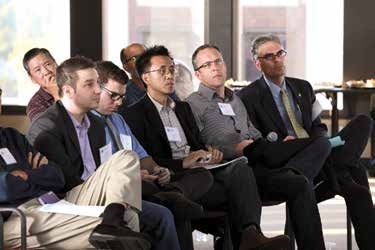
In April 2012, Bhavin Parikh took his test-preparation company, Magoosh, to a meeting of Berkeley Angel Network. He was looking for money. What he found was a room containing more than 20 people already qualified to consider giving it to him. Within weeks, he later told Berkeley Haas, some funding arrived. The useful detail is the room: somebody had assembled the audience before the founder began speaking.
- The offer: access to individual angels, pitch meetings and a community that learns together.
- The connection: investors share Berkeley ties; companies need not.
- The catch: a good meeting still leaves diligence and individual investment decisions ahead.
A university full of people who hadn’t met
Berkeley already had entrepreneurs. It already had alumni who invested in entrepreneurs. The missing piece was a dependable way for those people to find one another. In 2011, alumni and entrepreneurship leaders launched BAN. Early accounts identify George Willman and Jerry Engel as co-founders; subsequent Berkeley reporting also identifies Catherine, or Cathy, Chiu as a co-founder.
By June 2012, Haas reported roughly 100 members. Across the first two pitch meetings, about 30 investors had heard nine companies, and at least three companies had been offered funding. These are opening-chapter figures, rather than a claim about today’s membership. They show what the new organization initially accomplished: it converted a shared affiliation into actual encounters between companies and prospective backers.
“I presented my company to over 20 pre-qualified investors and received some funding within weeks.”Bhavin Parikh, Magoosh CEO · 2012
The distinction matters because an alumni directory and an investor network solve different problems. A directory tells you who exists. A pitch meeting gives those people a reason to pay attention at the same time. Parikh’s account describes the practical benefit of that coordination, while leaving every subsequent founder to earn a separate decision.
The network assembles. The members decide.
BAN’s application guidelines make an unusually useful distinction: BAN itself does not invest. Members decide individually whether to put money into a company. The network organizes the introduction and selection process. A founder is therefore meeting several possible investors, each of whom must develop enough conviction to proceed.
That puts BAN among alumni angel communities, alongside alternatives such as Stanford Angels & Entrepreneurs and other university-linked groups. Its particular organizing principle is Berkeley. Investor membership requires alumni or current or former faculty status, together with accredited investor status. The company side is wider: Berkeley-connected ventures receive particular interest, but the network explicitly considers others.
There are two audiences here. Entrepreneurs want access to people who might provide capital and advice. Investors want worthwhile opportunities and colleagues with whom to sharpen their judgment. Berkeley’s 2018 account described a volunteer organization, where mentoring and coaching accompanied the pursuit of returns. This is a community service built around private investment decisions, with each member retaining responsibility for the risk.
The application is already a sales meeting
BAN’s presentation guidance has little patience for a deck that merely advertises. It asks for the problem, solution, target customers, route to market, competition, business model and proposed use of proceeds. Financial projections should connect the ambition to a business. A demonstration, if central to the story, should take less than a minute.
The implication is wonderfully practical. A working product can establish that something is possible. It leaves open whether customers want it, how they will discover it, and why competitors cannot easily take the business away. Founders can copy this discipline before approaching any investor: make the commercial argument intelligible without requiring the audience to fall in love with the technology.
- ApplyBusiness + terms
- Be selectedReview + dialogue
- PitchQuestions follow
- InvestigateDiligence + evidence
- DecideEach investor chooses
Chiu’s advice in the 2018 Berkeley account was to think about fundraising as selling to a customer. Investors need to see value in spending time with the opportunity. The useful change of perspective is from describing what the founder has made to explaining why somebody else should commit attention, expertise and money to it.
The number that isn’t a fee
The application process linked from BAN’s website contains a concrete request: reserve at least $100,000 for interested BAN investors. That is space in the financing round, rather than a charge for applying or a promise of funding. The document is dated 2015, so founders should read it alongside the current meeting announcement before planning a submission.
There is also a cost in time. Screening and presentations can lead to deeper discussion and diligence. The founder needs to supply backup information, take meetings and keep interested people engaged. The useful follow-up is an organized next conversation, with evidence ready. Applause at a pitch meeting does not perform that work. For the founder, the practical question is who wants to investigate further and what information they need next. Treat that question as part of the presentation, rather than an administrative chore afterward.
A classroom with money at stake
The education runs in both directions. BAN’s calendar records diligence academies, term-sheet sessions and, in 2023, a three-part sequence covering venture deals, preferred stock and convertible instruments. Its 2021 virtual game night offered members another reason to keep talking. A network needs relationships between transactions as well as transactions themselves.
The fit has limits. BAN states a preference for capital-efficient proposals that can grow without large amounts of follow-on investment. A company requiring repeated, enormous financing rounds should examine that preference carefully. A founder seeking guaranteed capital on a fixed deadline must also account for a selection process and investors who can independently decline.
As of October 27, 2026, the official calendar lists an October 19 pitch meeting and targets the next gathering for Q1 2027. The precise date and submission deadline are still to come. The durable lesson is already available: assemble the right audience, explain a business they can evaluate, and give their questions somewhere productive to go. Berkeley supplies the connection. The company must supply the case.