Two weeks of listening produced three months of sorting. In 2015, Benjamin Humphrey was working with a researcher on a diary study at Atlassian. Participants wrote regular journal entries; the material was then mapped onto a whiteboard. Collecting the observations was comparatively quick. Making them useful took rather longer. For a product designer trying to understand customers, this was an awkward arrangement. The answer could arrive after the question had lost its place in the queue.
Humphrey saw a job that software ought to make easier. The first version of the idea was modest: an email and SMS surveying tool, with a schedule for research participants. It would change shape. In 2017, he left Atlassian and persuaded his friend and colleague Bradley Ayers to join him in building Dovetail. The company would move from gathering diary entries to helping teams organize, analyze and retrieve customer knowledge.
That journey is easier to understand if you begin before the startup. Humphrey had already spent years helping people use information that existed but was inconvenient to reach. The material had once been Linux documentation. Eventually, it would be everything a company’s customers had been trying to tell it.
& analysis3 months
A manual before a company
Humphrey grew up in Christchurch, New Zealand, and studied computer science at the University of Otago. He did not graduate. Open source and web development drew him toward work, and the aftermath of the 2011 Christchurch earthquake added a family reason to earn a living. His route into technology was taking shape outside the lecture theatre.
He started the Ubuntu Manual Project to make operating-system documentation available across languages. In February 2010, he reported on a community learning event that ran 15 sessions over two days, with about 60 people attending. The details were decidedly human: teachers preparing slides, volunteers handling tools, contributors joining the team, and the problem of finding hours that suited people in different time zones.
He also wrote for OMG! Ubuntu! In January 2011, he interviewed Linux creator Linus Torvalds. The young writer was already interested in what made complicated technology approachable. Ubuntu had helped him try Linux; now he was asking the person behind the kernel about where it was going. Documentation and conversation were part of the same apprenticeship.
A job at Loop, a small web development agency, brought client work. Its acquisition took him to AVOS in Silicon Valley, where he worked on a relaunch of the bookmarking service Delicious. By 2013, he had moved to Sydney to join Atlassian. There he worked on Jira Agile, the Cloud Platform team and growth design. Four years inside a growing software company gave him a close view of how products and organizations change together.
The colleague who held the answers
At Atlassian, Humphrey wanted more context about the people using the software he designed. There was no obvious destination for all that knowledge, so he asked a product manager named Sherif. Sherif had been around long enough to know a great deal. A conversation with him could supply what a search through the company’s systems could not.
The arrangement depended on a person being available. It also depended on that person staying. Researchers, product managers and customer-facing colleagues accumulate knowledge that does not automatically become company memory. If they leave, the organization can retain its files while losing the understanding that made the files useful.
This was the wider problem behind the diary-study whiteboard. Teams had plenty of tools for building software and tracking its delivery. Choosing what deserved to be built was harder to support. Humphrey’s ambition became a customer insights hub: somewhere people could ask a question and draw on knowledge gathered elsewhere in the business. It was an ambition that would outgrow the original surveying tool.
Selling across an ocean
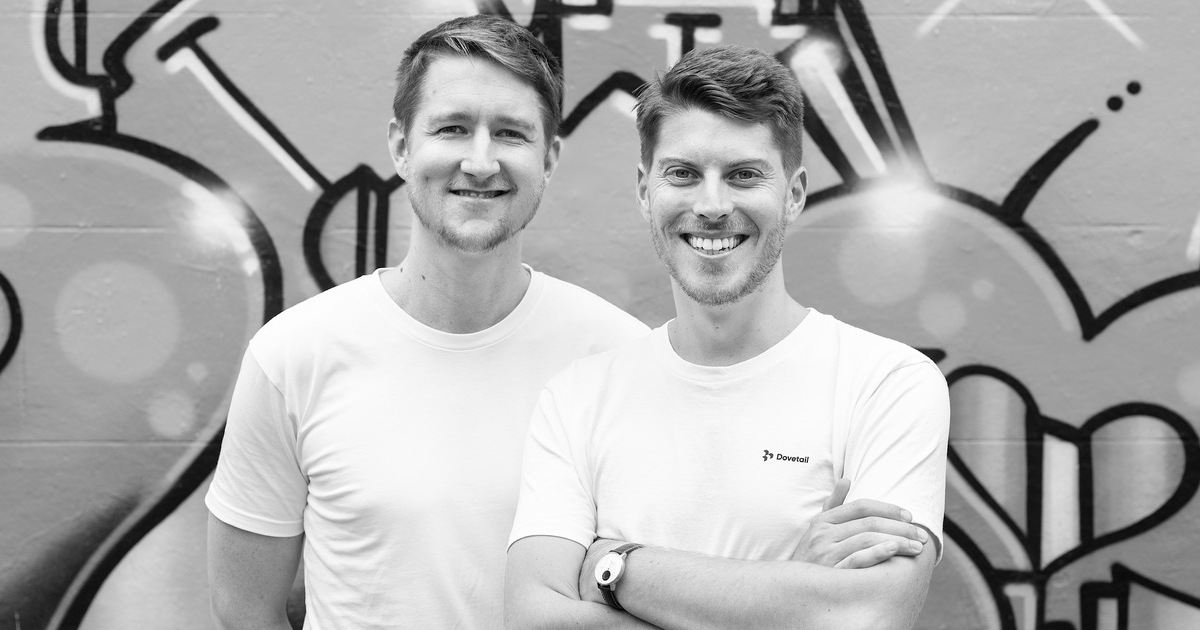
The early company had to learn its way toward a product. In their reflection on 2018, Humphrey and Ayers described starting without investors, advisers or mentors, then following a cycle of listening, learning and improving. Neither founder was a researcher. Getting close to people who did that work was a practical requirement, and a public Slack community gave them a continuing conversation with early users.
By 2019, Dovetail had three employees, no sales team and hundreds of customers, including Shopify, Square and Maersk. That combination made the product responsible for a good deal of its own introduction. People needed to understand it, try it and find value without a salesperson translating every screen. A confusing interface would have been an expensive international representative.
Sydney’s distance from large software markets influenced the approach. Humphrey focused on North America and Europe from the outset. He has described being far away as a reason to build a business customers could enter with little assistance. Geography became a design constraint: the product needed to travel more easily than its founders could.
Growth eventually changed the financing. In January 2022, Dovetail announced a US$63 million Series A led by Accel, with existing investors including Blackbird and Felicis participating. The company then had 65 people and more than 2,600 customers. Its reported valuation exceeded US$700 million. The founders remembered an earlier, smaller target: enough recurring revenue to cover rent and food. Those are useful ambitions to keep in the same picture.
JANUARY 2022 · A historical company snapshot
Culture, after the fact
Humphrey and Ayers waited more than three years before formally creating Dovetail’s values. They wanted the words to describe a culture that had actually developed. When the team gathered to discuss them, the process combined employee workshops with founder editing. Culture Amp’s Didier Elzinga and Robyn Dunn, who had helped create Atlassian’s values, contributed to the conversation.
It is an appealingly unfashionable sequence: do some work, observe how people behave, then write down what matters. The team discussed real examples from working life. The founders turned the workshop material into five values with explanations. Lisa, Dovetail’s illustrator, made posters for the office. The words were meant to guide decisions; the pictures helped give them a life beyond a document.
The founder’s role was changing, too. In a 2023 conversation about running a company, Humphrey described trying to push accountability down through the organization and build trust with his direct reports. He wanted the business to function when he was away. Written updates and internal blogging helped make strategy available for people to return to, rather than requiring another performance by the CEO.
In July 2026, he published a 76-page handbook called By default. It covers communication, collaboration, delegation, feedback and decision-making. For somebody who began by organizing an operating-system manual, the instinct is familiar. A handbook can make expectations available before someone has to interrupt a colleague to discover them.
A film camera in the AI conversation
The growing company did not keep Humphrey from noticing the noise around it. In 2025, his public writing described AI conversations extending from investor meetings to the queue at Chipotle near Dovetail’s San Francisco office. The billboards were participating, too. A founder seeking a little quiet had an unusually well-distributed opponent.
A four-week European sabbatical gave him some distance. He traveled with his fiancée, took a film camera, removed Slack and turned off email notifications. He also manually unfollowed everybody on LinkedIn. There was no bulk option. Productivity advice had met an unusually patient opponent.
The trip led him to reflect on ordinary things people keep doing: cooking, shopping, taking photographs, spending time with friends. Back at work, he applied that thought to software. A business still needed pricing, onboarding, customer service, infrastructure, hiring and leadership. New tools could help; the responsibilities remained. Later that year, he published photographs of Japan’s Nakasendo Trail, shot on a Canon New F-1 using Ultramax 400 film.
“New tools can help us do all of this, but the old rules still apply.”
Benjamin Humphrey · August 2025
An answer when you need it
Humphrey’s AI work keeps returning to the old delay. In 2024, Dovetail introduced features for transcription, summaries, suggested highlights, clustering and search. He described an approach that kept people involved: users could edit summaries and accept or reject suggestions. The technology was being applied to work the company already understood.
By May 2026, he was arguing for a change in when research synthesis happens. A report is produced on the researcher’s timetable. A designer may need its context months later, when the question has changed. His proposed alternative lets people query a shared body of customer material at the moment they are making a decision.
- Keep the evidenceInterviews, feedback, support tickets and sales calls
- Ask at the decisionRetrieve context for the question being considered
- Apply research judgmentMethods and standards guide the answer
He also made room for the work AI cannot perform: observing the unprompted nuances of human behavior or testing a feature that does not yet exist. In his account, researchers would put more expertise into the methods governing the system and continue doing specific, original research. Easier retrieval would give that work more places to matter.
The July 2026 Sun’s Out launch put part of this direction into the product. Dovetail introduced Digital Twins grounded in customer interactions, made Agents generally available and placed Channels 2.0 in closed beta. These are the current tools around a problem Humphrey first encountered with journal entries and a whiteboard.
His path has involved several kinds of knowledge: instructions for Ubuntu, bookmarks at Delicious, software design at Atlassian, customer conversations at Dovetail. The recurring concern is access. Somewhere, somebody may already have learned what a team needs to know. Humphrey keeps working on the route between that person’s experience and the next person’s decision.
Keep following the question
- Benjamin’s website and biography
- His writing on design, software and photography
- X / Twitter
- GitHub
- Watch: Insight Out 2024 keynote
- Watch: Sun’s Out 2026 keynote
- Listen: From Atlassian designer to Dovetail founder
- Read: Building from Sydney, with Fund/Build/Scale
- Read: By default, the company handbook
- Explore Dovetail