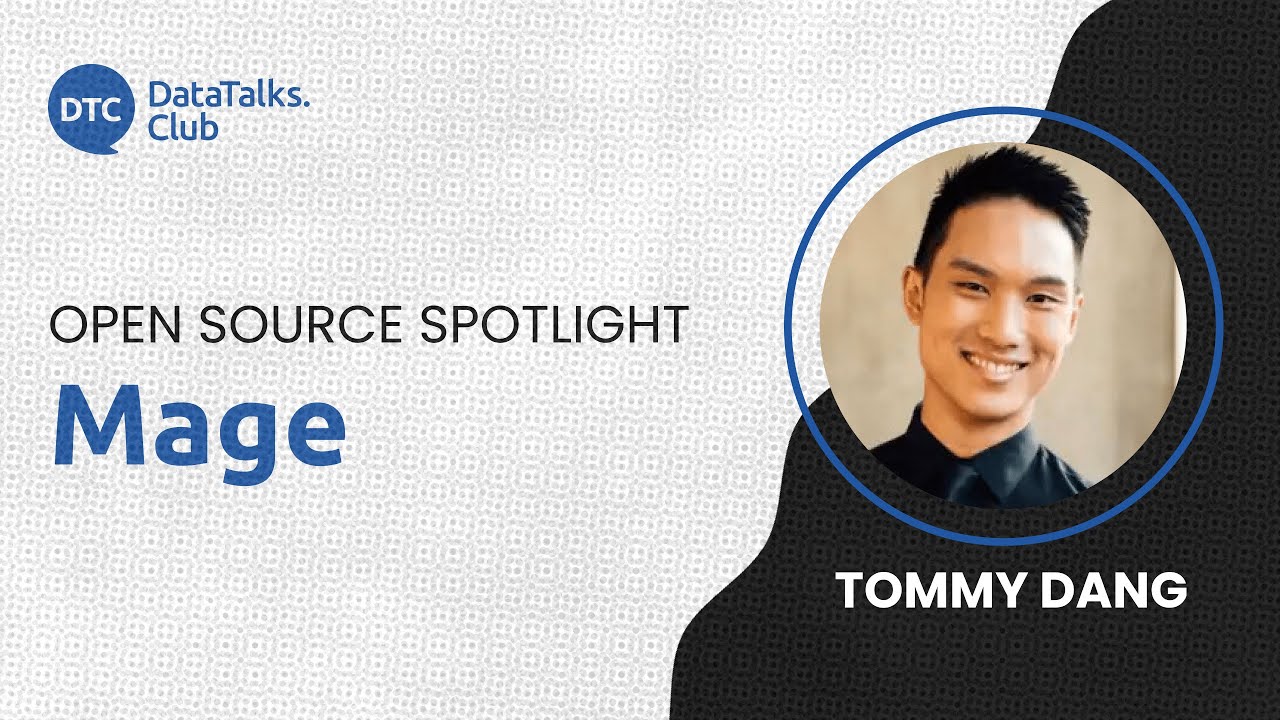
The Pipeline Whisperer
In 2018, Tommy Dang assembled a 25-person team at Airbnb and built an internal tool called Omni - a low-code platform that let over 1,000 employees and hundreds of developers create landing pages, fire off push notifications, and send billions of emails without writing a single line of backend code. Nobody asked him to build it. He just saw the gap and filled it.
Two years later, he walked out of Airbnb's doors - voluntarily, mid-pandemic - and started Mage. Not because he was bored. Because the problem he'd spent half a decade watching was still unsolved for everyone outside of companies with Airbnb's resources: moving data reliably from point A to point B, transforming it along the way, and doing it without hiring a team of infrastructure engineers to babysit the pipes.
Mage is now an open-source data pipeline platform with 8,700+ GitHub stars, a community of engineers across the world, and a growing enterprise business built on top of the free core. It runs data pipelines in Python, SQL, and R. It integrates with every major cloud provider. It has 82 employees, $11.8 million in funding from Gradient Ventures (Google's AI fund), and an open-source license that lets anyone use it forever, free.
"It doesn't matter how powerful your tool is or even if it can predict the future, if I'm going to have to sit around for a month and read a manual, we're going to have to move on."- Tommy Dang, CEO, Mage
The bet Tommy is making is deceptively simple: data teams shouldn't need specialized PhD-level infrastructure knowledge to run production pipelines. Airflow - the dominant tool in the space, built at Airbnb itself - requires exactly that. Mage doesn't. It ships with best practices baked in, a notebook-style interface that doesn't punish beginners, and a debugging experience that won't make you cry. That's the whole strategy.
What makes Tommy unusual isn't his technical background. Plenty of ex-Airbnb engineers have tried to sell developer tools. What's different is his go-to-market. He personally shows up in Mage's Slack, responds to DMs, jumps on Zoom calls to pair-program through users' pipeline bugs, and has built community before he built revenue. He calls it "doing things that don't scale" - a phrase he borrows from Y Combinator lore and actually means.
Before Airbnb, Tommy co-founded OnMyBlock, a student housing marketplace he built from two people to 30+ employees, raised $6 million, and shut down. They returned more than half the capital to investors. He counts that shutdown as one of the formative experiences of his career - proof that doing the honest thing, even when it's painful, is always the right call.
His operating philosophy traces back to a mentor at Airbnb named Joe Bot, one of the company's early employees, who gave him two rules: don't let your job title define what you work on, and actively do things you are not qualified for. He followed both. He was a software engineer who built a product team. He was a product engineer who became a CEO. His Twitter handle is @TommyDANGerouss - a pun - because he is exactly that kind of person.
The version of Tommy you meet in 2026 is reading Dune novels for inspiration, running a company with real enterprise contracts, watching his open-source repo inch toward 9,000 stars, and still answering DMs himself. The goal, he says, is to build something so reliable and invisible that users forget it's even running. That's not a tagline. It's the engineering philosophy made business strategy.
Mage: The Anti-Airflow
Apache Airflow was built at Airbnb in 2014. It became the de facto standard for orchestrating data pipelines across the industry. It also became notorious for requiring serious DevOps expertise just to keep running. Tommy Dang knew this intimately - he'd used Airflow at Airbnb for years.
Mage is built on a different premise: that the people writing data pipelines shouldn't need to be infrastructure engineers. It ships with a notebook-style IDE, built-in best practices, one-click deployment, and first-class support for Python, SQL, and R. The open-source core is free, forever. The commercial tier - Mage Pro - adds enterprise features like RBAC, SSO, and dedicated support.
Since open-sourcing the project in June 2022, the repository has accumulated 8,700+ GitHub stars, hundreds of community contributors, and a growing list of enterprise customers using it in production. As of January 2026, the platform is at version 0.9.79 with active weekly releases.
The company is backed by Gradient Ventures (Google's AI-focused fund), Designer Fund, and Alumni Ventures. With 82 employees and headquarters in the Bay Area, Mage is playing a long game: replace Airflow as the default data orchestration layer for modern data stacks.
The Raise Story
Led by Gradient Ventures (Google) • Designer Fund • Alumni Ventures
From Berkeley to Bytes
Three Acts
The Startup That Shut Down
OnMyBlock had 30 employees and $6 million. Then it didn't work. Tommy and his co-founder returned most of the money to investors and called it. Not a failure - a masterclass in knowing when to stop. He learned more about running a company from that shutdown than from any success that followed.
The Airbnb Education
Five and a half years inside one of the most-copied engineering cultures on earth. Tommy built Experiences alongside Brian Chesky, then assembled a 25-person team to build Omni - which sent billions of emails to Airbnb's global audience. His education came not from his job title, but from grabbing every problem that nobody else claimed.
The Open-Source Bet
Tommy left Airbnb, built Mage, pivoted it once, open-sourced the core, and watched 8,700 engineers star the repository. The bet: give the foundation away, sell the enterprise layer. It's the Red Hat model. The vision is infrastructure so invisible that customers forget it exists - and so reliable that they'd never consider switching.
Tommy on Record
If you wait until you're ready, you're going to be waiting for the rest of your life.
We do a lot of things that don't scale at our stage. We simply talk to everybody.
It doesn't matter how powerful your tool is - if I'm going to have to sit around for a month and read a manual, we're going to move on.
We want to get to a place where everything is so easy that you even forget that we're here.
It's better to be in the wrong place with the right people than in the right place with the wrong people.
Do things you are not qualified for.
The Details That Matter
Tommy built the Airbnb Experiences product on a tiny team alongside CEO Brian Chesky - one of the company's most consequential new business launches. He wasn't an executive. He was a software engineer who just happened to be in the room where it happened.
The internal tool he built at Airbnb - called "Omni" - grew into a 25-person engineering team and handled billions of email sends and thousands of promotional campaigns. It was a mini-SaaS product operating inside Airbnb's infrastructure, built entirely on Tommy's initiative.
When OnMyBlock - his first startup - failed to achieve its vision, Tommy and his co-founder returned more than half of their $6M in investor capital rather than spending it on runway. That decision, which cost them personally, is something he talks about as one of his proudest calls.
Tommy uses a "mind share" test for major decisions: if other projects are consuming more than a fraction of his mental energy, he asks himself whether he should go all-in. That's how he decided to leave Airbnb. The idea for Mage was consuming more than his day job was.
He reads science fiction - Dune, Star Wars expanded universe - not for entertainment but for inspiration. He uses fictional futures as a way to imagine what's technically possible before it is, then works backward. For a data infrastructure CEO, that's an unusual source of product vision.
His mentor at Airbnb, Joe Bot (an early employee and cultural leader), gave him two pieces of advice that shaped everything after: don't let your job title define your responsibilities, and deliberately do things you're unqualified for. Tommy followed both - and built a company because of it.
What Makes Tommy, Tommy
Fun Facts
Tommy's business title literally includes a wizard emoji: "CEO 🧙♀️" - the female mage emoji, because why not.
His Twitter handle is @TommyDANGerouss - a deliberate pun on his last name that he's been running with since 2011.
He studied economics, history, and sociology at Berkeley - none of which are computer science. He taught himself to code.
He listens to Dune and Star Wars novels for creative inspiration - fiction as a product roadmap for the imagination.
He personally responds to DMs in Mage's Slack community and offers 1:1 calls with anyone building on the platform.
Mage's GitHub repo went from 0 to 2,000 stars in under six months after the open-source launch in June 2022.
His go-to leadership book is Team of Teams by General McChrystal - about aligning incentives across large, disparate organizations.
His first startup was OnMyBlock - a student housing marketplace he co-founded and ran for two years in San Diego before shutting it down.


