Candy has a perfectly reasonable objection to getting warm. In 1988, Bender Warehouse Co. answered it with a building: a Reno warehouse whose 60,000 square feet of refrigerated space was designed for a national candy manufacturer. The project cost $3.1 million. Construction took six months. Behind those unromantic numbers sits a rather good explanation of what a logistics company actually sells.
- Bender stores goods, prepares orders and coordinates their journey to buyers.
- Shared warehouses offer flexibility; dedicated operations serve more specific requirements.
- Retail compliance turns small shipping details into consequential work.
- More inventory does not automatically mean a more profitable warehouse.
The candy required a different building
The builder, Clark/Sullivan, records a 163,000-square-foot project, completed in November 1988. Alongside the refrigeration were unrefrigerated storage and executive offices. This was contract warehousing and distribution to retailers, with the physical design answering a particular client’s needs. A pallet of candy has requirements. So does the company whose name appears on its wrapper.
Bender’s proposition becomes easier to understand when you stop imagining a warehouse as a large cupboard. A manufacturer can make a product and still need somewhere to receive it, count it, assemble displays, prepare orders and send those orders into several selling channels. Bender supplies that intervening work. Its broader group adds transportation arrangements and international services.
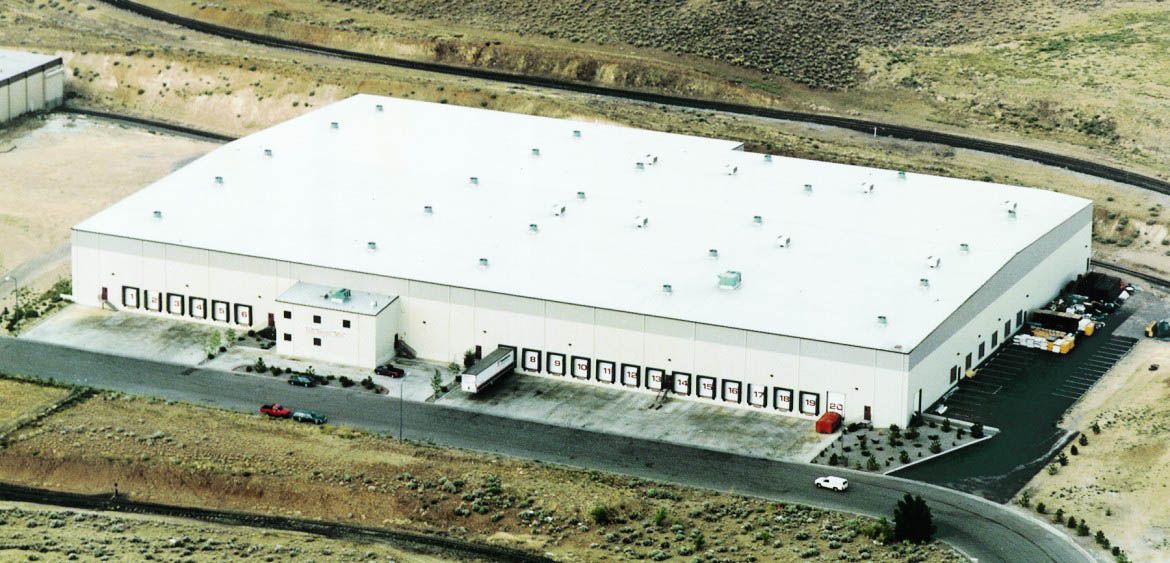
163,000 sq ft total · Six months of construction
Refrigerated space: approximately 37% of the total project area.
A tax question with 600 witnesses
The business dates to 1945. The company credits Edwin S. Bender with its founding; historical reporting also names his son Frank. Reno mattered to its development, but the interesting part is how the economics of storing goods there became a selling point.
A history published by the Historic Reno Preservation Society recounts Edwin storing 600 washing machines for a California firm when someone asked whether Nevada taxed stored goods. Bender and local business organizations supported an inland Freeport policy. The 1949 law allowed out-of-state manufacturers to store goods for one year without personal property tax.
General Motors signed a December 1949 contract to store Frigidaire products destined for its California divisions. The historical account puts the resulting business at 125 to 200 carloads annually. It also describes an early regional constraint: Nevada lacked enough warehouse capacity for the business the policy hoped to attract. An attractive rule still needed roofs.
The transferable idea is to inspect the customer’s entire cost calculation. The building is only one item. Where goods wait, how they move and what happens while they wait can alter the usefulness of the whole arrangement.
The manual gets shorter. The stakes do not.
Today, Bender Group describes multi-client and dedicated warehousing. In the shared model, customers use common operational resources without committing to a fixed warehouse footprint over a long term. Dedicated operations involve longer agreements and more customized work. The choice is a practical one: how much flexibility does the customer need, and how much specialization?
The group’s published locations illustrate the distinction. Reno has temperature-controlled space and rail access. Winchester offers food-grade storage and small-package fulfillment. Riverside is described as a dedicated distribution operation for a global paints and coatings business, with an H3 room and aerosol cage. Products dictate the accommodations.
Retail logistics adds another layer. Bender extracts shipment requirements from retailers’ vendor manuals into quick-reference forms for customer logistics representatives and warehouse employees. It also establishes processes for updating those instructions with clients. A rulebook that changes cannot safely become a checklist that never does.
The aim is to reduce chargebacks and the risk of losing retail business through noncompliant shipments. For a supplier, correct labels, accurate orders and adherence to routing instructions belong to the commercial transaction. The useful trick to copy is small: give the person doing the work a concise, maintained version of the rules.
Count & storePREPARE
Pick & labelDISPATCH
Route & track
For consumer orders, Bender advertises picking, packaging, shipment notifications and online order visibility. Its technology offering includes electronic data interchange and advance shipment notifications. These are the mechanisms that connect a customer’s instructions to activity on the warehouse floor. They help answer the questions a seller needs answered: what is available, and what has shipped?
Full shelves, quieter loading docks
A February 2009 report captures the awkward economics of the recession. Shipping volume was down, while goods remained in storage longer. Business development manager Jared Lindwall explained that reduced labor activity made the work less profitable. The warehouse could hold more and produce less of the activity that supported earnings.
The same report described competition pushing Bender toward greater efficiency. It named ITS Logistics and Jacobson Logistics among the alternatives then operating in its market. Bender also had expanded into Riverside, serving AkzoNobel. These are historical observations, but the buying question remains current: which provider can handle this particular flow of goods?
Storage occupancy deserves a companion measure. Buyers should ask about receipt timing, picking accuracy, shipment performance and the cost of exceptions. A business with specialized handling needs should establish those requirements before comparing quotes. Cheap space becomes less persuasive if the operation cannot prepare the goods correctly.
Who is closest to the center?
Bender gives its workplace philosophy an ungainly acronym, IOTBFTGTW, and a cheerful expansion: “It Ought To Be Fun To go To Work.” Its published principles concern listening, responsibility, truthful feedback and direct communication. Recognition is part of the program. The organizational chart is described as a circle, with importance shifting toward the person whose work most affects the customer at that moment.
“It Ought To Be Fun To go To Work”Bender Group’s workplace philosophy
Read as an operating idea, that puts the spotlight on the person handling the next consequential detail. For a prospective customer, the corresponding homework is straightforward: describe the products, destinations, order patterns and handling constraints; then decide whether shared capacity or a dedicated operation fits.
International work needs the same specificity. Bender International provides customs brokerage, while freight partners perform forwarding services. Knowing who carries out each task makes the arrangement easier to assess. Bender’s story keeps returning to that plain discipline: understand the requirement, then organize the work around it. Even candy gets its say.