Consider a drum of an ingredient sitting in a warehouse. It has arrived. It has been counted. Someone has found space for it. To an inventory spreadsheet, the story may already be over. To a manufacturer, the interesting questions have barely begun. Has the laboratory released it? Which lot does it belong to? Which formula may use it? What happens if the test comes back wrong?
- BatchMaster makes ERP for businesses that manufacture by formula: food, chemicals, cosmetics and more.
- Its specialty is connecting recipes, batches, quality checks and inventory records.
- Buyers can choose a complete ERP or manufacturing software tied to an existing financial system.
- The useful test: follow one real batch from supplier receipt to customer shipment.
The ingredient that is there, but unavailable
This distinction is BatchMaster’s territory. The company makes enterprise resource planning software for process manufacturers, whose products begin as recipes or formulas. Its customers include makers of skincare, coatings, beverages and supplements. The shared problem is remarkably physical: materials change, batches consume them, tests determine their status, and somebody must remember what happened.
BatchMaster’s inventory tools track weights, volumes, locations and quality status. Production teams can reserve material for jobs and record actual yields. That makes “how much do we have?” a more demanding question than it first appears. The answer needs to say what is present, where it sits and what production can use.
The difference matters when planning meets purchasing. A production schedule built around unusable stock is an appointment with disappointment. The attraction of specialist software is that these distinctions belong inside the system, where the planner can see them, rather than in a separate conversation with the laboratory.
- 01ReceiveRecord item, lot and location
- 02Hold + testQuality status controls availability
- 03ReleaseApprove material for use
- 04Make + traceConnect consumption to the batch
On the shelf is a location. Ready to use is a decision. Illustrative workflow, not a measured customer result.
A recipe has a memory
The company’s UK history traces its predecessor to paint-formulation work. That is an instructive origin for an ERP business. Paint asks a software designer to think about proportions and properties before invoices. A formula must describe a product well enough for someone else to make it again.
In BatchMaster, developers can manage formula versions, attach quality tests and manufacturing instructions, estimate losses and compare alternatives. Ingredient characteristics and costs roll into the specification. Packaging bills of materials sit separately, allowing a formula to connect to different finished-good configurations. The cream and the jar have related, but distinct, jobs.
That separation also makes costing less theatrical. Ingredients are only part of the bill. BatchMaster’s costing materials describe calculations that include packaging, labor, setup and other production expenses, alongside comparisons of packaging configurations and what-if scenarios. A cheaper mixture may still produce an expensive finished product.
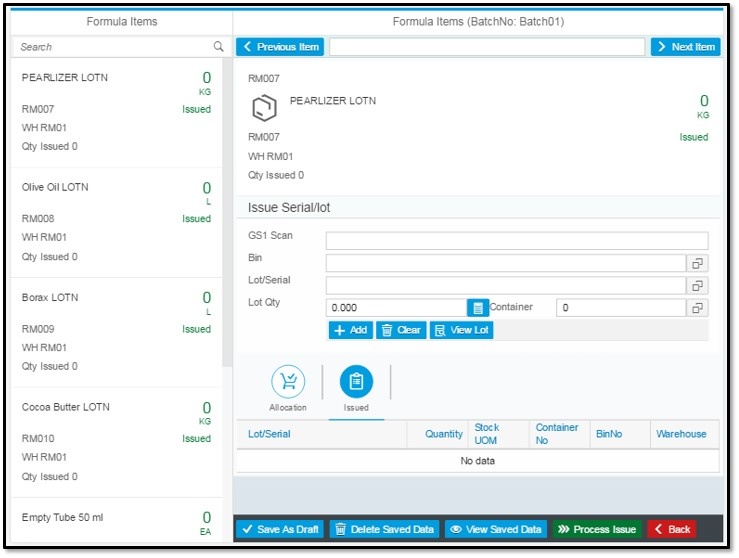
Quality management extends that record with accepted values, tolerances, approval workflows and Certificates of Analysis. Its broader QMS offering includes document control, audit management and employee-training records. The appeal is administrative coherence: the formula, the test and the approval can remain connected as the product moves.
The first thing to fail is often the handoff
Tata Harper’s published customer account describes a manufacturing business that outgrew its QuickBooks setup. Staff competed for access; crashes meant restoring files and repeating work. The company selected BatchMaster for production, inventory and warehousing, while deliberately keeping its manufacturing system separate from other applications to manage operational risk.
“It’s really the home for our supply chain.”
Carolina Harper / Senior Systems Specialist, Tata Harper
Coseva encountered a different version of the problem. The nutraceutical maker brought manufacturing in-house, then found its legacy system poorly matched to its needs. Employees recorded information in recipe spreadsheets, the older system and inventory spreadsheets. Its BatchMaster selection aimed to reduce those repetitions and improve traceability. The account includes hoped-for benefits, so it is better read as a buying decision than a finished scorecard.
SIPCO Innovations offers a more concrete reported result. The Canadian specialty-chemical business connected operations with BatchMaster ERP and SAP Business One. An interactive material-planning dashboard and bulk purchase-order creation replaced manual entry and copying between platforms. Its June 2026 customer account reports procurement planning time falling by half.
less procurement planning time
The mechanism is useful to copy: connect demand to orders, record receiving, apply quality gates and preserve the link to financial documents. International Coatings reports another outcome, a 10% reduction in inventory while growing. These are individual customer accounts published by the vendor. They describe what happened in particular operations, rather than what every buyer should expect.
Two ways into the factory
BatchMaster gives buyers a choice about how much of their business to move. Its SME Edition combines its own accounting with process manufacturing in a cloud-native ERP. Its Enterprise Edition builds on SAP Business One, combining specialist manufacturing with back-office functions and offering cloud or on-premises deployment.
There is also a route for manufacturers that want to retain their financial software. BatchMaster markets integrations with QuickBooks, Microsoft Dynamics GP, Dynamics 365 Business Central and Sage 100/300. That changes the buying conversation. The question becomes which functions need a new home, and how information should pass between the systems.
Its partner network includes resellers, consultants and integrators who recommend, implement and support the software. The company's US website identifies it as a division of eWorkplace Manufacturing. This is a business built around software plus the work of fitting that software to a factory.
Competition depends on the customer’s starting point. Published evaluations mention Epicor, Deacom and SAP options. SAP Business One is also BatchMaster’s platform partner, a pleasing complication for anyone hoping to divide the market into tidy enemies and friends. The distinguishing proposition is depth in formula-based operations, not a claim that every company needs the same ERP.
The budget has people in it
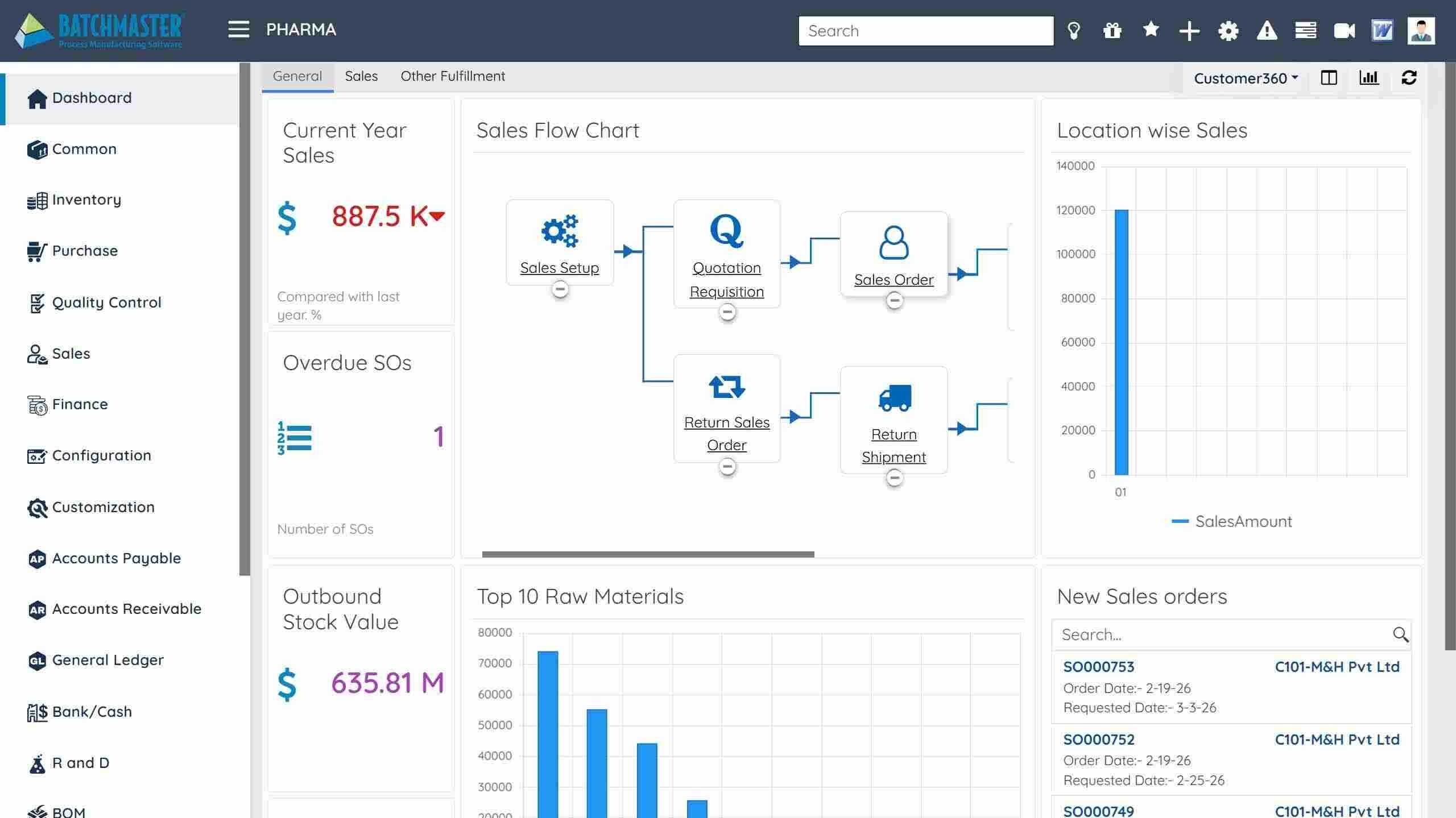
BatchMaster’s web offering uses a subscription model, and pricing is configured for the buyer. G2’s pricing listing says users, modules and deployment affect the quote, with implementation and support available in bundles. A buyer should therefore ask for a costed scope, not infer the price of a factory system from a single seat.
There are also internal costs: people must prepare data, decide how approvals work, test integrations and learn the system. BatchMaster’s implementation guidance puts process mapping, master-data preparation and real-world validation ahead of go-live. The software purchase and the work of making it usable belong in the same budget discussion.
The fit is strongest where formulas, batches, quality and traceability drive operations. A business with simple stock movement has less reason to buy this particular depth. A manufacturer with inconsistent material records or unresolved approval rules also has work to do before automation can produce dependable answers. Faster access to a disputed number leaves the dispute intact.
The new assistant still needs good records
BatchMaster Web 9.0 adds a newer layer. In September 2026, eWorkplace described Ask BME, an assistant for finding guidance within the ERP, alongside AI-supported formulation and sales forecasting based on historical data. The features address the daily friction of searching, developing and planning.
They sit on top of the older discipline. A forecast needs usable history. A proposed formulation still needs review. An assistant becomes valuable when the records and rules beneath it are dependable. The company's published values emphasize customer needs, industry expertise, reliability and continuous improvement; those promises become tangible in the quality of implementation and support.
Bring one troublesome batch to the demo
For a prospective customer, the most revealing demonstration begins with something awkward. Bring an actual formula, a packaging choice and a material awaiting a quality decision. Ask the team to show the purchasing requirement, the release approval, the production record and the resulting cost.
Then change something. Reject the incoming lot. Substitute an ingredient. Alter the pack size. BatchMaster’s own selection guidance recommends validating complete workflows, financial integration and reporting with realistic scenarios. The purpose is to see whether the software follows the factory’s decisions all the way through.
That exercise is useful even if another vendor wins. A factory that can explain one troublesome batch has learned something about itself: where responsibility sits, where information disappears and which records deserve to be trusted. BatchMaster’s business begins in those details. The finished jar is the part the customer sees. The company sells the memory behind it.