Breaking
Quantum Boost claims 2-5x faster formulation than classic Design of Experiments London deep-tech, backed by Entrepreneur First & Inovo VC ~$770K raised to put Bayesian optimization on the lab bench Inks, paints, pharma & specialty chemicals all in scope Founders Filip Auksztol & Kacper Kielak bet on fewer experiments Quantum Boost claims 2-5x faster formulation than classic Design of Experiments London deep-tech, backed by Entrepreneur First & Inovo VC ~$770K raised to put Bayesian optimization on the lab bench Inks, paints, pharma & specialty chemicals all in scope Founders Filip Auksztol & Kacper Kielak bet on fewer experiments
Company Profile / Deep Tech

Quantum Boost

An AI formulation assistant for chemists who are tired of guessing which experiment to run next.

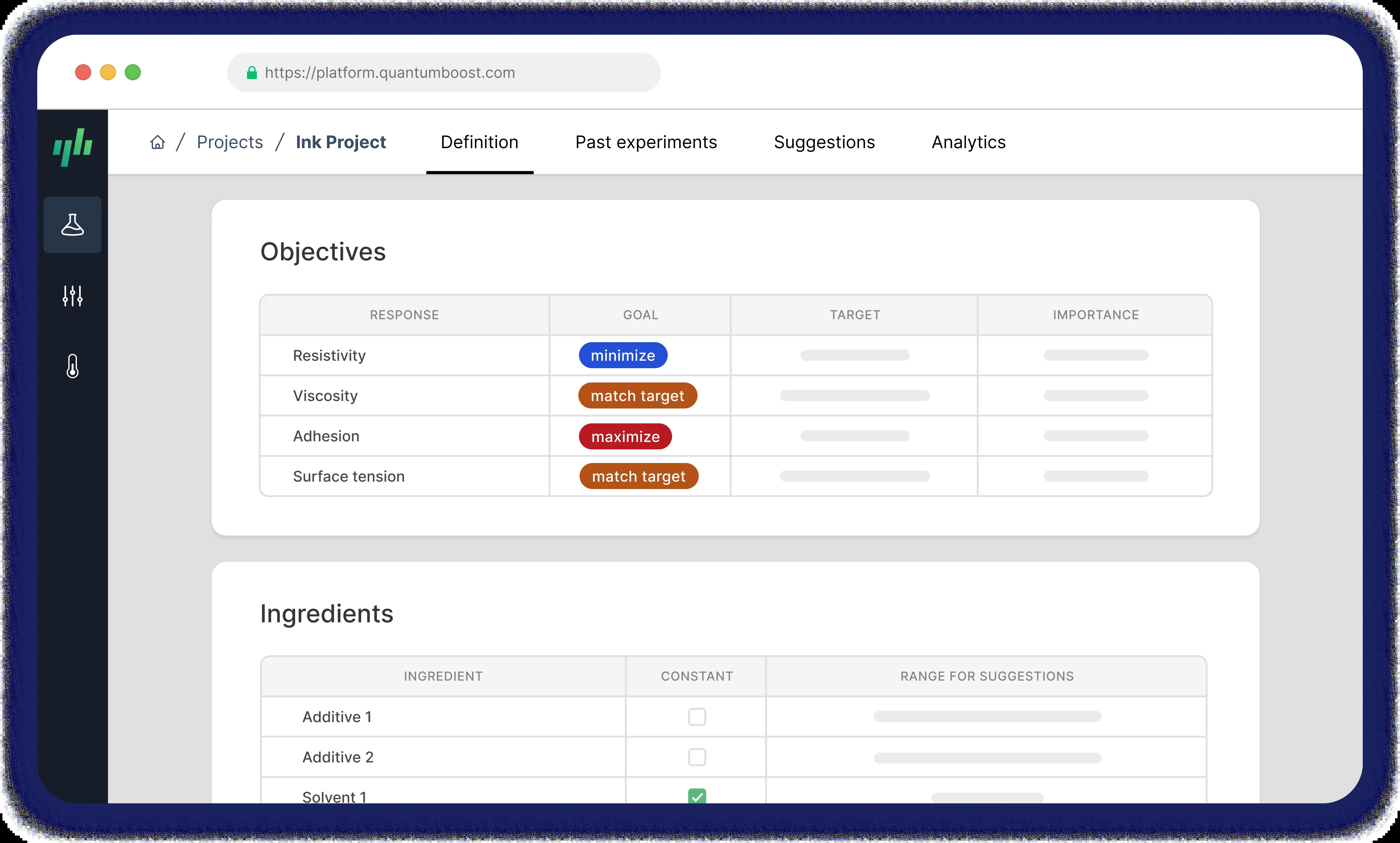
The Quantum Boost platform showing an ink formulation project with objectives and ingredient ranges

EXHIBIT A: The actual product - an "Ink Project" mid-formulation. Somewhere a scientist is deciding whether to maximize adhesion or match surface tension. The software has opinions.

Founded2021
HQLondon, UK
StageEarly / Seed
Raised~$770K
The Scene

A lab bench, a deadline, and one very expensive guess

It is Tuesday in an R&D lab. A formulation scientist is staring at a coating that almost works. Resistivity is good. Adhesion is wrong. There are eleven ingredients, each with a dial, and changing one nudges the others. The classic move is to run a planned grid of experiments and hope the pattern shows up. The grid is large. The materials are not cheap. The deadline does not care.

Quantum Boost exists for that exact Tuesday. Open the platform and it does not hand you a grid. It hands you a recommendation: run this experiment next, because this is the one most likely to teach the model what it still doesn't know. Then the next. The point is not to run more experiments. The point is to run fewer, and learn faster from each.

"Your own AI formulation assistant that helps you develop breakthrough chemicals and materials faster than ever."- Quantum Boost, in its own words

That is the company as it stands now: small, technical, and pointed at a problem that has quietly cost the chemicals industry billions in wasted flasks. Three people. A live product at platform.quantumboost.com. And a claim that raises a skeptical eyebrow before it earns a nod - that they can hit a formulation target two to five times faster than the method most labs have used for a century.

The Problem They Saw

Design of Experiments was a triumph. In 1925.

Design of Experiments - DoE to its friends - is genuinely brilliant statistics. It tells you how to vary inputs systematically so you can read out cause and effect. For a century it has been the backbone of industrial R&D. It is also, increasingly, the wrong tool for the job.

Modern formulations are high-dimensional, non-linear, and frequently non-convex - which is a polite way of saying the relationship between what you put in and what you get out is a tangled mess. DoE assumes a tidier world. Push it into the messy one and the planned grid balloons, the assumptions creak, and the lab burns through material chasing a surface it can't see.

"DoE software can fail with high-dimensional, non-linear, or non-convex problems. Quantum Boost is built for exactly those."- The company's core technical argument

Here is the irony the founders noticed: the chemicals industry was sitting on mountains of experimental data and still treating each new project like a blank page. The information needed to choose a smarter next step already existed. Nobody was letting it choose.

The Founders' Bet

Two builders out of Entrepreneur First, betting on less

Quantum Boost came together in 2021 through Entrepreneur First, the London talent program that pairs ambitious technical people and dares them to build. The two who paired up were Filip Auksztol, now CEO, who studied at the University of Oxford, and Kacper Kielak, now CTO. Their wager was almost contrarian: in an industry obsessed with running more, the win is running less.

FOUNDER 01

Filip Auksztol

Co-founder & CEO. Oxford-trained, London-based. The face of the company and the voice on the demo calls.

FOUNDER 02

Kacper Kielak

Co-founder & CTO. The one turning Bayesian optimization theory into software a chemist will actually open on a Tuesday.

THE BACKERS

EF & Inovo VC

Entrepreneur First incubated the team; Inovo VC led the early round. Roughly $770K to prove the thesis.

The bench has always rewarded the busiest scientist. Quantum Boost is a bet that it should reward the best-aimed one.- The thesis, paraphrased
The Product

It doesn't run the experiment. It chooses it.

Under the hood sits Bayesian optimization, a method built precisely for expensive, noisy search problems. It keeps a running model of what it believes about your formulation space and, at every step, picks the experiment that best balances two instincts: exploit what looks promising, or explore where it's most uncertain. That second instinct is the one humans skip when they're under deadline.

CAPABILITY

Formulation

Recommends the next experiment so you reach the target in the fewest trials possible - the company's headline use case.

CAPABILITY

Experimental Design

Navigates high-dimensional, non-linear factor space where standard DoE software tends to fall apart.

CAPABILITY

Analytics

Folds in your existing experimental data and surfaces insight immediately, so old runs inform new decisions.

The product screenshot up top is not a mockup. It is the real thing: a project where a scientist sets objectives - minimize resistivity, match viscosity, maximize adhesion - declares which ingredients can move and within what range, and lets the engine propose the next batch to mix. Less art, more aim.

"Achieve your targets in the fewest amount of experiments possible."- Quantum Boost product promise
Milestones

A short history of a young company

Quantum Boost, so far

2021
The pairingFilip Auksztol and Kacper Kielak team up through Entrepreneur First in London and incorporate Quantum Boost Ltd.
2021-22
Product takes shapeThe Bayesian-optimization platform goes live at platform.quantumboost.com, aimed first at inks, paints and coatings.
Apr 2022
The raiseCloses roughly $770K with Inovo VC and Entrepreneur First to push the thesis into real labs.
Now
Widening the aimExpands scope across pharmaceuticals and specialty chemicals - synthesis routes, scale-up, stability and process optimization.
The Proof

The number that has to be true

Every deep-tech pitch lives or dies on one figure. For Quantum Boost it is this: reach your formulation target in a fraction of the experiments. The company frames it two ways - as a speed multiple over DoE, and as resource saved. Treat these as the company's own claims, the kind a skeptical R&D director will want to test on their own bench before believing.

Experiments to hit a target

Illustrative, based on Quantum Boost's stated 2-5x speed-up claim. Lower is better.

Traditional DoE
baseline
Quantum Boost (2x)
~50%
Quantum Boost (5x)
~20%

Source: Quantum Boost marketing claims (2-5x faster than DoE; up to ~50% of experimental resources saved). Independent, peer-reviewed validation is not publicly available - read as the company's argument, not a settled benchmark.

"Save up to 50% of experimental resources."- Quantum Boost, on the prize

What can a team actually do with that? Cut weeks off a development cycle. Spend less on raw material that was only ever going to confirm a dead end. And, less obviously, free up the human scientist to think about the problem instead of babysitting a grid. The proof points beyond the claim are still thin - this is an early company - but the backing from Entrepreneur First and Inovo VC suggests the people who do diligence for a living found the thesis worth funding.

The Mission

Actionable insight, not more data

The industry already drowns in data. Quantum Boost's mission is narrower and more useful: turn that data into the single most valuable thing a scientist can have - the right next move. The company puts it plainly, that actionable insights are the key to solving the toughest R&D challenges. Note the word it avoids: more.

"Actionable insights are key to helping you solve the toughest R&D challenges."- The Quantum Boost mission, unadorned

It is worth saying what Quantum Boost is not. Despite the name, there is no quantum computer involved - the "quantum" is about the size of the leap, not the hardware. It is machine learning applied with discipline to a domain that has been slow to adopt it. The ambition is not to replace the chemist. It is to stop wasting the chemist's time.

Why It Matters Tomorrow

The next battery. The next coating. The next medicine.

Almost everything physical around you is a formulation someone had to discover - the battery in your phone, the paint on the wall, the coating on a pill. The speed at which the world develops better versions of those things is gated, quietly, by how fast a lab can search the space of possibilities. Shrink that search and you don't just save a startup some money. You move the whole front line forward.

That is the stakes Quantum Boost is playing for, even at three people. The bigger, well-funded materials-informatics names are circling the same prize, and the company will have to prove its claims in real labs against real incumbents. But the direction of travel is hard to argue with. The lab notebook, that century-old instrument of trial and error, finally has competition that learns.

It is still Tuesday in that lab. The coating still almost works. But the next experiment is no longer a guess.- Back where we started

The scientist mixes the batch the software suggested. Adhesion climbs. One run, not twelve. The deadline, for once, looks survivable. That is the entire product, the entire company, and the entire bet, distilled into a single good Tuesday afternoon.