Five minutes to explain your business. Three minutes to defend it. In November 2018, eight ventures stepped into that compact arrangement at a startup competition in Medina. There were businesses in interior design, content, home maintenance and video games. Basim Albeladi, founder of Business Hub and chair of the organizing committee, had helped make a room in which their ideas could be heard. A timer is an unusually honest business adviser. It has no interest in your excellent introductory slide.
The detail is a useful entrance to Albeladi's career. He is known as the founder and CEO of Labayh, but his work stretches across apps, shared workspaces and, more recently, the management of Al Ansar Football Club. Seen together, those pursuits suggest an enduring interest in how people get started, find one another and turn an intention into an organization.
Medina keeps appearing in that story. It is where he studied engineering, where he built an early app and where Business Hub gave other founders somewhere to work. His recent football chapter returns him to the same city with a different set of responsibilities. The distance between a pitch competition and a football pitch is smaller than it first appears. Both require someone to put the conditions for participation in place.
A city small enough to know, large enough to build for
Albeladi graduated in electrical engineering from Taibah University in 2012. He worked in project management at Siemens in Jeddah between 2012 and 2014, while his entrepreneurial record began with Medina app in 2012. An engineering qualification, an industrial employer and a venture of his own arrived close together. His route into business included working inside an established organization as well as attempting to create one.
Medina app was a directory for visitors to the city. Its subject was specific and its audience practical: people trying to find their way around a place. That early choice makes the later coworking venture easier to understand. In one case, he was organizing information about a city. In the other, he was helping organize a place for its entrepreneurs. The scale and medium changed; the city remained.
He subsequently founded Rumooz Information Technology in 2016. Labayh followed in 2017, as did Business Hub, where he served as CEO until 2020. These ventures overlapped. A conventional career diagram, with one tidy box giving way to the next, would struggle to do the job. Several boxes would need to sit beside one another, politely negotiating for space.
The founder goes back to class
Building companies did not end his formal education. Albeladi studied at Prince Mohammad Bin Salman College of Business and Entrepreneurship from 2018 to 2020, completing his MBA while already a founder. In 2019 he also undertook executive leadership training at Babson College. The combination puts the classroom in the middle of his working life, where questions about a business model could have immediate consequences.
His own description of the MBA is pleasantly concrete. He wanted to deepen his existing business background. Afterwards, he described being better able to grow his business, present ideas and develop its model. He also singled out leadership skills and a network. There is something revealing in that list: a degree is useful here because of the work it helps someone do.
“pitch ideas more effectively, develop a solid business model”
Basim Albeladi, on what his MBA helped him do
The learning continued. He completed a Stanford influence and negotiation strategy program in October 2024. Negotiation belongs naturally in this career: a founder works with colleagues, partners and prospective backers; a club executive adds another set of relationships. The program extended his business education four years beyond the completion of his MBA.
There is an earlier educational thread, too. As a member of Taibah's engineering club, he organized training courses and represented the college at events. He later volunteered with INJAZ Saudi Arabia, preparing school students for entrepreneurship and the private sector. Those activities make his involvement with other people's beginnings a recurring part of the record.
Eight minutes, then the questions
Business Hub's 2018 competition provided more than an evening with judges. Before the final, participants received help with business development, finance, marketing, technology and law. There was a workshop on starting and developing a venture, followed by preparation for presenting to investors. The program treated the pitch as a skill that could be taught.
About 30 projects reached the first screening, with 15 progressing to the second stage. Financial and service prizes were valued at 50,000 Saudi riyals. Those numbers describe a local operation with a practical mechanism: find promising ventures, give them advice, and prepare their founders for scrutiny. A founder could leave with something more useful than a photograph beside a roll-up banner.
Eight finalists. One room. A business idea made to explain itself.
At the final, the educational entertainment venture Lora took first place. The leading prizes paired cash with three months of incubation at Business Hub. That pairing matters. Winning a competition is an event; finding support for the following months is an operating arrangement. Albeladi's opening remarks connected the competition to developing entrepreneurship in Medina. The prizes gave that ambition a timetable.
A business becomes a case
Labayh was already part of his working life during those Business Hub years. Its team appeared in the social track of the 2017 MIT Enterprise Forum Saudi competition, with Albeladi identified as CEO. It is a useful early marker: the venture had a named team and a place in a program for enterprises pursuing social objectives.
By October 2023, Labayh had almost two million registered users. That stage of the company’s development shows how far his responsibilities had moved from launching an early city directory. An audience of that size brings a different order of organizational work.
He was also taking the company abroad. In June 2023, he represented Labayh at VivaTech in Paris, with support from Monshaat and Invest Saudi. His account of the trip emphasized additional experience and relationships, alongside representing Saudi Arabia. The language sounds familiar after his description of business school: learning and meeting people are activities he repeatedly chooses to mention himself.
Then the working founder became a classroom subject. In 2025, a case about Labayh by MBSC's Doris Rajakumari John won first place in the American University of Beirut Case Hub's case-writing competition. The distinction went to the case and its author. For Albeladi, it meant that decisions from a company he had founded were becoming material for other people to examine. There is a modest reversal in that: the former MBA student now supplies the business problem.
The next room has a football shirt
In January 2026, Albeladi visited Al Fayha as CEO of the Al Ansar club company. His host was Al Fayha's board chairman, Tawfiq Al-Mudaiheem. The itinerary included club facilities, a museum and a library, alongside meeting spaces. It was an institutional visit, concerned with the work around a sporting organization as well as the sport itself.
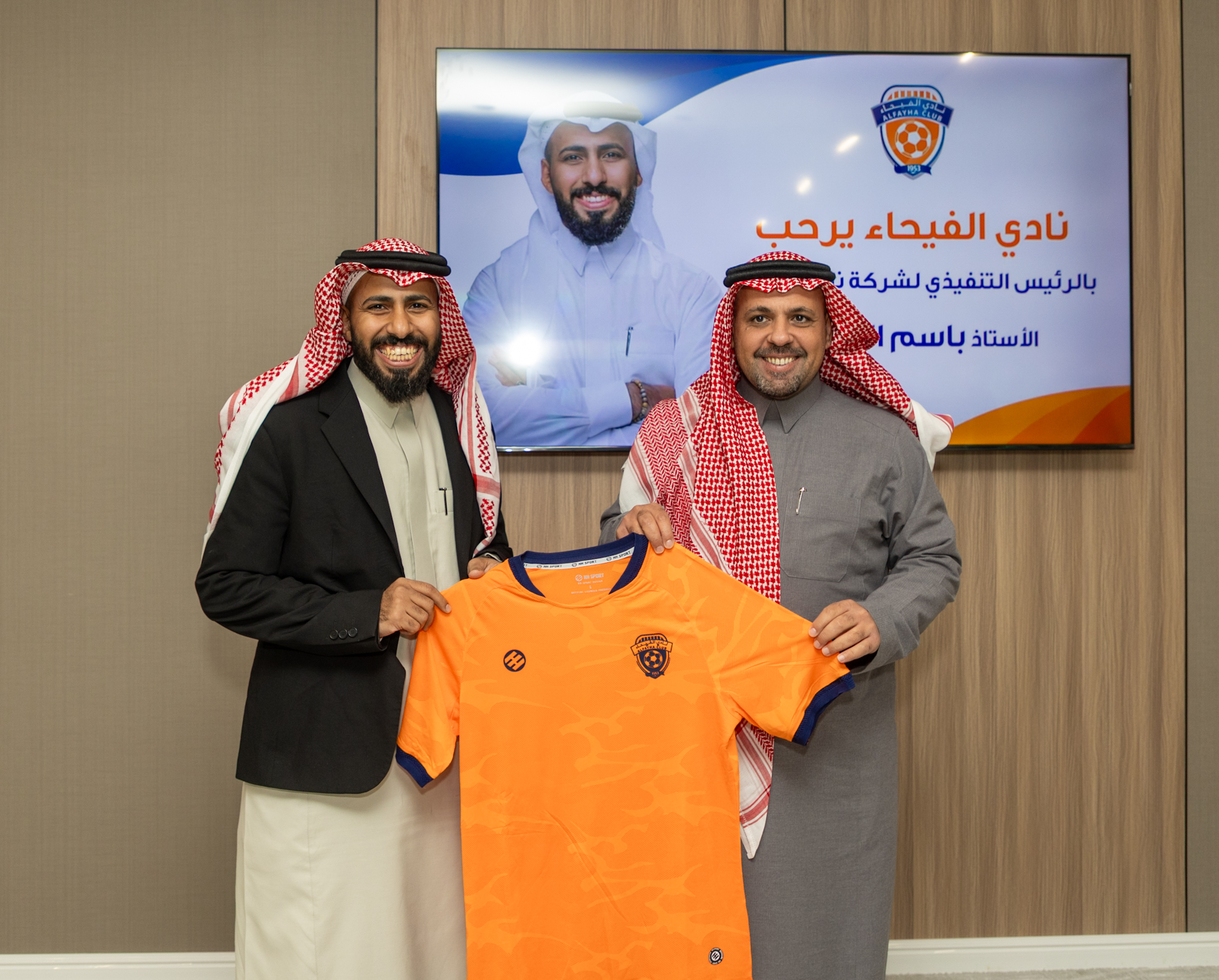
The photograph ends with an orange shirt held between the two men. Albeladi thanked his hosts and praised the organization and facilities he had seen. The visit brought him into the everyday exchange of experience between clubs. For someone with a background in project management, businesses and shared workspaces, the administrative side of sport offers recognizable territory.
Al Ansar's ownership had transferred to Awda Al-Beladi & Sons Company, ABASCO, under Saudi Arabia's club privatization program. That places his role within a larger institutional change. The company owns the club; Albeladi's executive responsibilities concern the organization being built under that arrangement. It is a substantial addition to a career already associated with launching ventures.
His participation in the Middle East Sports Investment Forum in Madrid widened that chapter. Club ownership groups, including Al Ansar's, discussed player development, media rights and facilities with commercial uses beyond match days. These are questions about what a club does throughout the week and how it supports its activity over time. The fixture list supplies only part of the business calendar.
The World Stadiums and Arenas Summit also lists him among its speakers, identifying him with Al Ansar. His public work now crosses between startup gatherings and the business of sporting institutions. The connection is less surprising when viewed from Medina: the same city that appeared in his first app and coworking venture appears again in the club.
Keeping the door open
Albeladi's public advice to founders often comes down to manageable actions. Start with a small team. Give people room to explore and build. In an essay for entrepreneurs, he also recommended beginning with a simple service, controlling costs and finding peers to consult. It is advice concerned with the conditions under which a business can keep going.
That is also a reasonable way to read his varied career. A directory helps someone navigate. A coworking venture gives a founder a place to begin. A competition adds preparation, questions and a few months of support. A club brings another institution, with its own community and obligations, into his working life.
Back at the 2018 final, five minutes were enough to introduce a venture. The harder work began after the timer stopped. Across Albeladi's projects, that is the part that keeps coming into view: the people, training, facilities and relationships that let an idea have a life beyond its introduction.
Follow the next chapter
COMPANIES · CONVERSATIONS · PUBLIC APPEARANCES
Labayh website ↗Basim on LinkedIn ↗Basim on X ↗Sowalif Business interview · Arabic ↗The Al Fayha visit · January 2026 ↗Al Ansar’s ownership announcement ↗The 2025 case-writing award ↗