A founder’s original idea can be a difficult colleague. It wants credit for getting everyone into the room. It objects when someone suggests a different direction. Prince Mohammed Al-Faisal’s story at Clinicy includes the awkward but useful business of letting that colleague lose an argument.
He helped build a Saudi software company whose early proposition changed as its team learned more about the people expected to use it. The business attracted investors, developed a subscription model and eventually appointed a different chief executive. Through those changes, one theme in his public remarks has remained unusually plain: concentrate on the work immediately ahead.
There is an appealing lack of ceremony to that instruction. A prince discussing entrepreneurship could easily produce a grand theory of leadership. Al-Faisal offers something closer to a working rule for Monday morning. Before imagining the company several years from now, give the present decision enough attention to make it a good one.
The idea that changed in company
Clinicy’s early history contains a meeting that deserves a place in any discussion of startup competition. Two teams were developing very similar propositions. One involved Prince Mohammed. Once they compared their plans, they decided to combine their efforts under Clinicy rather than continue separately.
The meeting took place at Al Faisaliah. In the later account of the company’s leadership, the overlap between the two ideas was striking. The practical response was to bring people and development work together. A resemblance that might have become a grievance became the basis of a working relationship.
That episode gives the founding story a useful texture. Businesses are often described as though the finished organization had been present in the first sketch. Clinicy emerged through conversations, introductions and decisions about who should work with whom. Its beginnings were untidier, and more interesting, than a neat list of names can convey.
The team also had to reconsider the product. Its initial focus on a consumer booking proposition gave way to software serving the organizations behind those bookings. Research and practical experience moved the business toward a cloud platform for daily operations. The point of entry changed because the understanding of the problem changed.
Learning to manage a change of mind
Al-Faisal’s education reads like preparation for a business that would need to revise its own plans. He completed a bachelor’s degree in project management at Alfaisal University in 2012, followed by a master’s degree in innovation management at Birkbeck in London in 2015.
Project management concerns the work of getting something done. Innovation management asks how new ideas become useful within an organization. The two subjects meet at a familiar difficulty: a plan needs enough structure to be executed and enough flexibility to survive contact with experience. A university can give that difficulty a name. A young company gives it deadlines.
From 2015 to 2016, he worked as a strategic advisor at Accenture in Saudi Arabia. His subsequent move into entrepreneurship placed him on the other side of the recommendation. Helping build a company means living with the product choices, hiring needs and commercial consequences after the presentation ends.
Corporate biographies date his involvement with Clinicy’s legal entity to 2016; company interviews and funding coverage use 2017 as the founding year. Those dates describe adjacent parts of the same early chapter. By the time he was speaking publicly about expansion in 2024, the business had several years of development behind it.
Alfaisal University
Birkbeck, London
Accenture, Saudi Arabia
Clinicy Series A chapter
A product has to earn its place in the day
One of Al-Faisal’s recurring business concerns is the possibility that technology will make work more complicated. Software can promise efficiency while quietly giving its users another set of tasks. A new screen may be attractive to the person selling it and an interruption to the person who has to use it.
He has emphasized close work with partners, understanding their needs and making updates that simplify operations. This is a practical standard for a founder to adopt. It makes the customer’s working day a test of the product. The feature list has to survive a less flattering question: does using this actually help?
Clinicy’s present platform connects functions such as scheduling, billing, accounting, staffing and inventory. Those are ordinary business nouns. Their ordinariness is the attraction. For organizational software, usefulness often consists of making familiar work less cumbersome and reducing the number of times the same information has to be handled.
The company’s move toward an organizational subscription business gave those questions commercial weight. A customer paying for recurring access needs a reason to keep paying. The relationship continues beyond the sale, through adoption, use and requests for changes. For the founder, listening becomes part of maintaining the business.
Capital arrives, the work continues
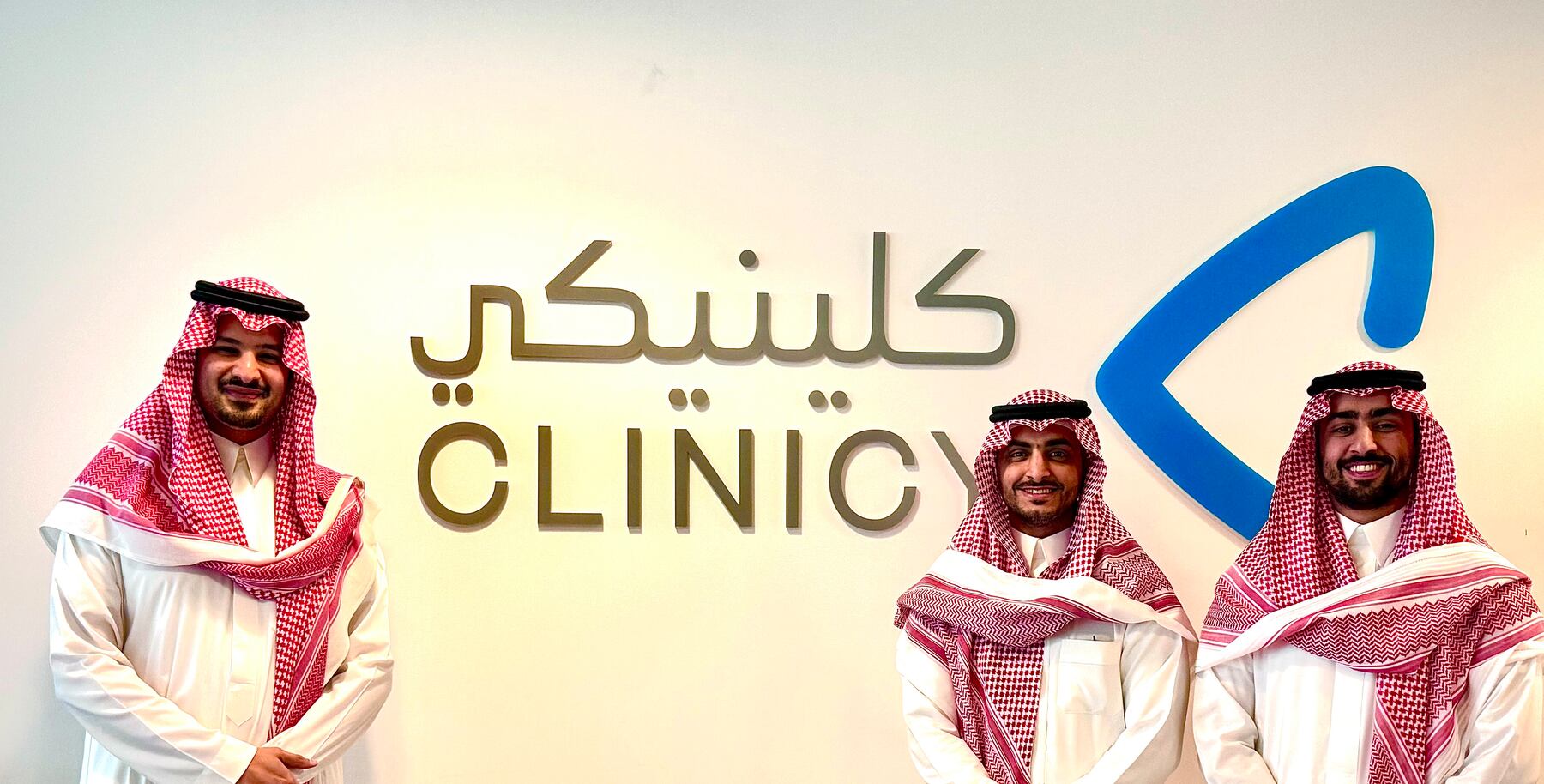
In August 2021, Clinicy announced a pre-Series A investment from Mad’a Investment Company. Prince Mohammed appeared at the signing as chairman. The photograph marked an identifiable stage in the company’s development: an early software venture had secured backing for its next period of work.
January 2024 brought a Series A led by Middle East Venture Partners and structured by Gate Capital, with participation from existing shareholders including Kafou Group and Fadeed Investment. The initial announcement described a seven-figure dollar round. Subsequent coverage put the amount at $5 million.
Clinicy’s Series A, reported in February 2024. Led by Middle East Venture Partners.
At that point Al-Faisal was speaking as co-founder and chief executive. He set out plans for expansion within Saudi Arabia and for additional offerings. His language combined a large destination with an emphasis on incremental work: understand customers, connect the software to their operations, then extend what it can do.
A funding announcement records support for that process. It also makes the company’s intentions public. There is a temptation, when telling a founder’s story, to treat the investment as the final scene. Here it belongs in the middle. The money arrived while the product, customer relationships and leadership structure were still developing.
The customers in the thank-you note
When Clinicy passed one million appointments on its platform, Al-Faisal marked the occasion on LinkedIn. He thanked the team and the organizations that had worked with the company. He also credited customers’ recommendations with improving the product. It was a milestone announcement with a small account of how the milestone became possible.
He named Middle East Venture Partners, Mad’a Investment, Kafou Group and angel investors in his acknowledgments, thanking them for trust and mentorship. The list brought several stages of the company’s development into one post. Capital, advice, product feedback and team effort appeared together.
The customer acknowledgment is particularly revealing as a statement of business practice. Recommendations are useful only when someone considers them seriously enough to change the product. A software company receives information from the people who encounter its awkward corners every day. Its development priorities determine how much of that information becomes improvement.
There is also a pleasingly communal quality to the announcement. The founder’s name sits above the post, as social platforms require. The body of the message makes room for other people. In a company whose early story includes teams joining forces, that distribution of credit fits.
The homework behind the ambition
Asked about business role models, Al-Faisal has pointed to Warren Buffett’s habit of investing time and resources in understanding an industry. He has also named Jahez, the Saudi food-delivery company, as a startup he admires, particularly for its journey to the public markets.
These are useful choices to read together. One concerns depth of knowledge; the other concerns the development of a company in his own entrepreneurial environment. They suggest the kinds of achievements he pays attention to without requiring us to turn admiration into a personality diagnosis.
“Put all your efforts into the next step, give it everything.”Prince Mohammed Al-Faisal, 2024
His own advice returns to concentration. The instruction is demanding because a growing company supplies so many plausible distractions. New possibilities arrive wearing the respectable clothes of strategy. Choosing which one deserves attention means allowing others to wait.
Clinicy’s current website names Faisal AlBuraiki as chief executive. Later public profiles identify Prince Mohammed as co-founder and chairman. The company has moved beyond the period in which he was its public-facing CEO, while his place in its founding and development remains part of the story.
The next step, then, changes with the stage of the business. Early on, it may mean combining two teams or replacing a product idea. Later, it may mean funding an expansion, responding to a customer or building a different leadership structure. Al-Faisal’s public career offers examples of that changing work. His advice keeps bringing the scale back down to something a person can do: attend carefully to the decision in front of you.