In March 2021, Ibrahim Alshamrani put a deceptively simple condition on trust: it should be earned with facts. Writing as Huawei Saudi Arabia’s chief security officer, he argued for common standards, independent verification and cooperation between businesses and government. In a field that sells reassurance for a living, he was asking people to check the receipt.
“Both trust and distrust should be based on facts,” he wrote. The sentence has the useful property of inconveniencing everyone equally. Vendors must demonstrate their claims. Buyers must examine evidence. A familiar name cannot do all the work, and suspicion alone cannot do it either.
Five years later, Alshamrani is making a different demand on the same industry: hurry up. As co-founder and CEO of COGNNA, the cybersecurity company he started with Ziyad Alshehri in 2022, he argues that defensive decisions must keep pace with increasingly automated attacks. Taken together, the two positions pose an awkward question. How do you check the receipt when every minute counts?
Before there was a company to build
Alshamrani came to entrepreneurship with a substantial professional life already behind him. COGNNA’s introduction of its CEO in November 2023 described 15 years in cybersecurity and information technology. His experience included information security management, risk assessment, digital forensics and implementing ISO 27001, the information security management standard.
Those are disciplines in which small omissions can become expensive. Digital forensics asks what actually happened. Risk assessment asks what could happen and which consequences deserve attention. Management asks who will take responsibility. The combination helps explain why his later arguments move between technology, organizational decisions and verification.
His education also crossed technical and commercial territory: an MBA at King Abdulaziz University from 2010 to 2012, followed by a master’s degree in information security and assurance at Georgia Institute of Technology from 2014 to 2016. By 2021, he was publicly writing about the governance of Saudi Arabia’s expanding digital economy. A GISEC programme that year listed him as Huawei Saudi Arabia’s chief security officer. He had a place on the conference circuit before he had a startup to introduce.
King Abdulaziz University
Georgia Tech
Riyadh
An experienced founder goes back to class
COGNNA began in Riyadh in 2022. Alshamrani took the chief executive role; Alshehri became chief technology officer. The founders joined the inaugural, 12-week Cybersecurity Accelerator Program launched by Saudi Arabia’s National Cybersecurity Authority that August. They later participated in TAQADAM, the startup accelerator associated with KAUST and Saudi Awwal Bank.
There is something pleasingly practical about experienced specialists submitting themselves to an accelerator. Knowing a difficult subject and building a business around it require different kinds of fluency. A security professional can explain a threat. A founder must also explain why a customer should change its purchasing plans.
During their time in TAQADAM, COGNNA raised a $2.25 million seed round led by Impact46, with Vision Ventures and Faith Capital among the participants. Alshamrani credited the programme with giving his team resources and strategies for expansion. The money arrived in 2023; the education in becoming a business was happening alongside it.
By February 2024, he was discussing another accelerator, run by Monsha’at, and the work of understanding new markets, their regulations and their staffing needs. His international ambitions already involved rather more homework than a map with arrows.
A founder with something to explain
Alshamrani also took the company’s story into a university setting. On February 19, 2024, the University of Prince Mugrin’s entrepreneurship centre hosted him for an online session about COGNNA and his entrepreneurial journey. The discussion covered the opportunities and challenges of starting a business in cyberattack detection and defence.
That appearance belongs alongside another detail in COGNNA’s early introduction of him: a stated interest in mentoring emerging professionals. The public-facing executive was also willing to talk to people still considering how to begin. A company can recruit for a vacancy; an experienced practitioner can help someone understand the profession before a vacancy even exists.
In March 2025, he appeared on the Arabic-language Zakham podcast for a longer career conversation. His own promotion of the episode listed questions about leaving government work, changing jobs, joining Huawei during a difficult period, and why entrepreneurship needs more people whose hair has gone grey. It is a less conventional startup discussion than the usual celebration of youth. Experience, in his telling of the topics, deserves a seat at the table.
“Both trust and distrust should be based on facts.”
Ibrahim Alshamrani · 2021
The problem hiding inside the alert
At RSA Conference 2025, COGNNA unveiled Nexus, its agentic AI security operations platform, while exhibiting alongside the National Cybersecurity Authority. The product gave the founders’ business a specific proposition: let software undertake more of the work between a warning and a response.
A security operations centre, usually shortened to SOC, has to make sense of information from endpoints, user identities, cloud services and other systems. A warning from one tool may need to be checked against evidence from several others. A busy dashboard can be very good at announcing that something happened while leaving the difficult question of significance to a person.
COGNNA describes Nexus as using AI agents to investigate activity, connect related events and support response. Its design includes a conversational assistant for analysts. These are the company’s intended capabilities, rather than a promise that an AI system will always interpret an incident correctly.
For Alshamrani, the product turns an executive argument into something a customer can examine. What work can be delegated? What evidence is assembled? What still needs a human decision? His earlier insistence on verification gives those questions particular force.
A customer picks up a second pen
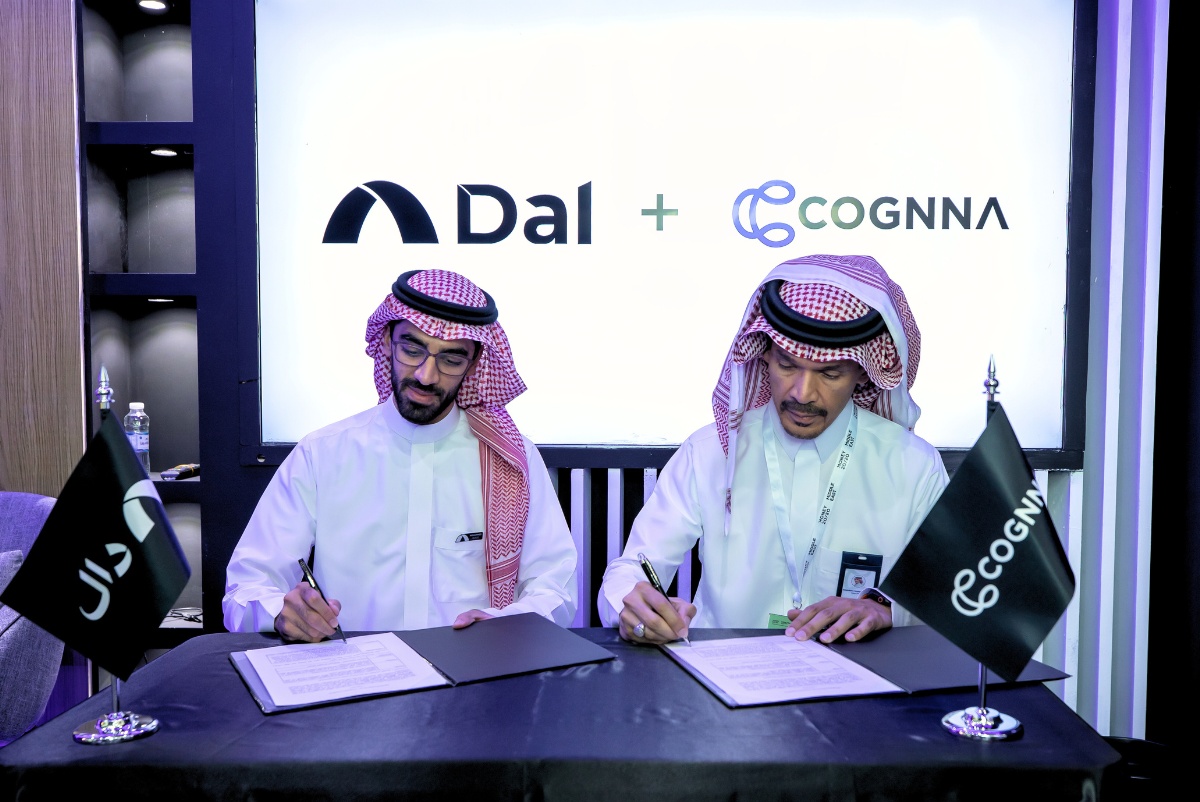
One September 2025 photograph catches Alshamrani doing a thoroughly analogue piece of business: signing documents. COGNNA and Dal announced their partnership at Money20/20, bringing together cybersecurity services and regulatory compliance expertise for financial institutions.
The interesting detail came before the ceremony. Dal had already become an early adopter of Nexus for its own security. A company that had used the product was now putting its name beside it. A signing table makes a better photograph than a procurement process, but the procurement process helps explain why the table matters.
The arrangement combined COGNNA’s threat detection, response and managed security operations with Dal’s work on licensing, risk and compliance, including anti-money-laundering technology for capital-market institutions. Alshamrani described the aim as giving financial organizations a more connected solution.
The partnership illustrates a recurring feature of his public work: technical protection sits inside a wider business obligation. A financial institution has customers to serve, systems to operate and regulatory requirements to meet. Its security arrangements have to make sense in that setting. Even an autonomous agent eventually encounters paperwork.
From Riyadh to a larger network
In September 2025, Google named COGNNA among 14 startups selected for its Google for Startups Accelerator: AI First programme covering the Middle East, North Africa and Turkey. Google described the company as an agentic security operations platform whose AI agents investigate, analyse and respond to threats.
The selection placed Alshamrani and Alshehri in another learning network, this time organized around AI. By November, COGNNA was describing a collaboration with Google Cloud involving infrastructure and its marketplace ecosystem. The mechanics matter to a founder trying to expand: building the product, running it reliably and making it available to enterprise buyers are related jobs.
December brought a larger financial commitment. COGNNA announced a $9.2 million Series A led by Impact46 and co-led by BNVT Capital, with Vision Ventures and tali ventures participating. The stated uses included product development, sales, operations and hiring, alongside expansion across MENA and international markets.
The progression is visible without pretending a funding round answers every commercial question. An established security executive became a founder, joined accelerators, raised seed capital, launched a platform and assembled partners. The next stage required a company capable of carrying those commitments.
An open door in an automated business
There is a human counterweight to all this automation. In an August 2025 account of COGNNA’s leadership approach, Alshamrani described his ambition as “to build a legacy in cybersecurity.” He connected that ambition to developing talent as well as expanding the business.
The company’s account offered practical examples: access to learning platforms, a move by an employee from sales into customer success, and a cross-functional squad approach. It also acknowledged staffing limitations and internal processes that needed improvement. Those details make the leadership philosophy more useful than a framed statement about teamwork.
Alshamrani and Alshehri presented themselves as approachable leaders who wanted people to develop skills and take responsibility. That is their stated approach, with all the ordinary work of management implied. An open door still needs someone on the other side who will listen.
For a CEO selling automation, staff development is an especially revealing priority. His public ambition gives people a continuing role in the business he is building. Faster systems create their own demands for judgment, technical understanding and accountability.
Who gets the next minute?
In June 2026, Alshamrani returned to the question of time in an essay about AI and cybersecurity. His recommendations emphasized the risks actually exploitable inside a particular organization, layered protection, automated workflows and a supervisory role for security leaders.
He also urged readers to begin with original information before accepting other people’s interpretations. The old preference for checking the evidence had survived the arrival of faster machines. His argument was that people should govern automated operations and review consequential decisions, while allowing more routine tactical work to proceed at machine speed.
This remains a demanding ambition. Delegation requires boundaries; supervision requires enough understanding to intervene. Alshamrani’s career gives the question a personal shape: an executive who once argued for verifiable trust is now asking customers to place more operational responsibility in software his company builds.
COGNNA gives him a place to attempt an answer. The accelerators, the product launch, the customer who became a partner and the investment rounds are steps in that attempt. The useful measure of the work will be what a security team can do with its next minute. A quieter queue would be a respectable beginning.