Barbie Bent once finished a summer running a painting company with a clear conclusion: somebody else should be the boss. A paint can had fallen on a customer’s floor. A ladder had fallen off her truck while she was driving. University entrepreneurship had supplied the practical education that a classroom could sensibly decline to offer.
She told her father she would prefer to be the number two. There is something appealingly specific about that ambition. Second place, in this arrangement, meant contributing without being personally responsible for every object that might fall from a vehicle. Her subsequent career would involve rather more responsibility, including leases, teams and rooms full of paying guests.
Today Bent is the co-founder and CEO of Jaybird Studios and the founder of Lagree West. She has described herself as introverted, academic and Type A. Those details make an interesting introduction to a business built around atmosphere. Somewhere between the fallen ladder and the candlelit studio, the reluctant boss acquired a taste for creating the whole experience.
A first job with unfortunate timing
Her first job after her undergraduate business degree was on an equity sales desk at Desjardins. She started in the same month that Lehman Brothers collapsed. It was September 2008. For a new graduate hoping to understand how the world worked, the world had chosen a particularly unhelpful demonstration.
Bent later pursued a master’s degree in optometry in the United Kingdom. While studying there, she became interested in boutique studios and investigated Lagree, eventually buying the licensing rights to operate in British Columbia. An education in business was becoming the means to act on something she wanted to use herself.
In her account of the early years, the difficulty was the accumulation of unfamiliar jobs and decisions. She learned to solve problems, ask for help and keep moving without all the answers. Her retrospective correction was practical: hire people earlier. By the time she built Jaybird, she had applied that lesson through a corporate team.
Twelve machines below West Hastings
The first Lagree West opened on West Hastings in Vancouver in November 2015. Bent had moved from the United Kingdom to start it. The original location was a narrow basement studio with 12 Megaformers, designed by Occupy Design. It was a small, physical proposition: go downstairs, take a place at a machine, try something unfamiliar.
Within nine months she had opened a second location at Lonsdale Quay. Ply Architecture designed that space, giving it an airier North Shore character. Even at this stage, expansion meant another interpretation of the surroundings. The two addresses belonged to the same business without demanding identical rooms.
For Bent, the commitment had involved crossing the world and leaving her job. A basement full of specialised equipment is a fairly emphatic way of announcing that a hobby has become a company. The second studio made the next question unavoidable: could an experience travel beyond the place where its founder first assembled it?
The work between visits
By 2017, a less photogenic problem needed attention. Instructors at Lagree West could speak with clients in person or message them through Instagram. Those conversations were difficult to track. Bent wanted a clearer view of the guest experience and a better way for teachers to stay in touch after class.
The business adopted FitGrid for messages and feedback. In a vendor case study, Lagree West’s first-time visitors who received follow-up messages were three times as likely to return as those who did not. The reported message open rate was 81 percent. Those figures describe that case study, rather than a current promise about either of Bent’s brands.
The useful detail is the problem she chose to solve. A studio can spend heavily on the room and still lose the relationship at the door. Follow-up gave instructors a way to continue the conversation. Feedback also became something the team could review and use in performance evaluations. Behind the carefully composed experience sat a system for hearing what guests thought.
Two founders, different instruments
Ariel Swan had been one of Lagree West’s founding teachers. When she and Bent started Jaybird in Vancouver in 2019, they brought different kinds of experience to the same room. Swan’s background was in dance and teaching; Bent had already built the business around a studio offering.
Swan describes Bent as particularly strong on the business side, while she leads the creative and product work. Their decisions meet in the details guests encounter: music, lighting, how a teacher speaks, what a room asks people to notice. The founders hired Ste. Marie Studio for the first location and later worked with Futurestudio in Toronto.
The partnership complicates the familiar picture of the spreadsheet person paired with the ideas person. A room has to function commercially and make sense creatively. Design affects circulation. A policy affects the atmosphere. The founders’ respective responsibilities meet whenever an appealing idea has to become something a team can deliver again tomorrow.
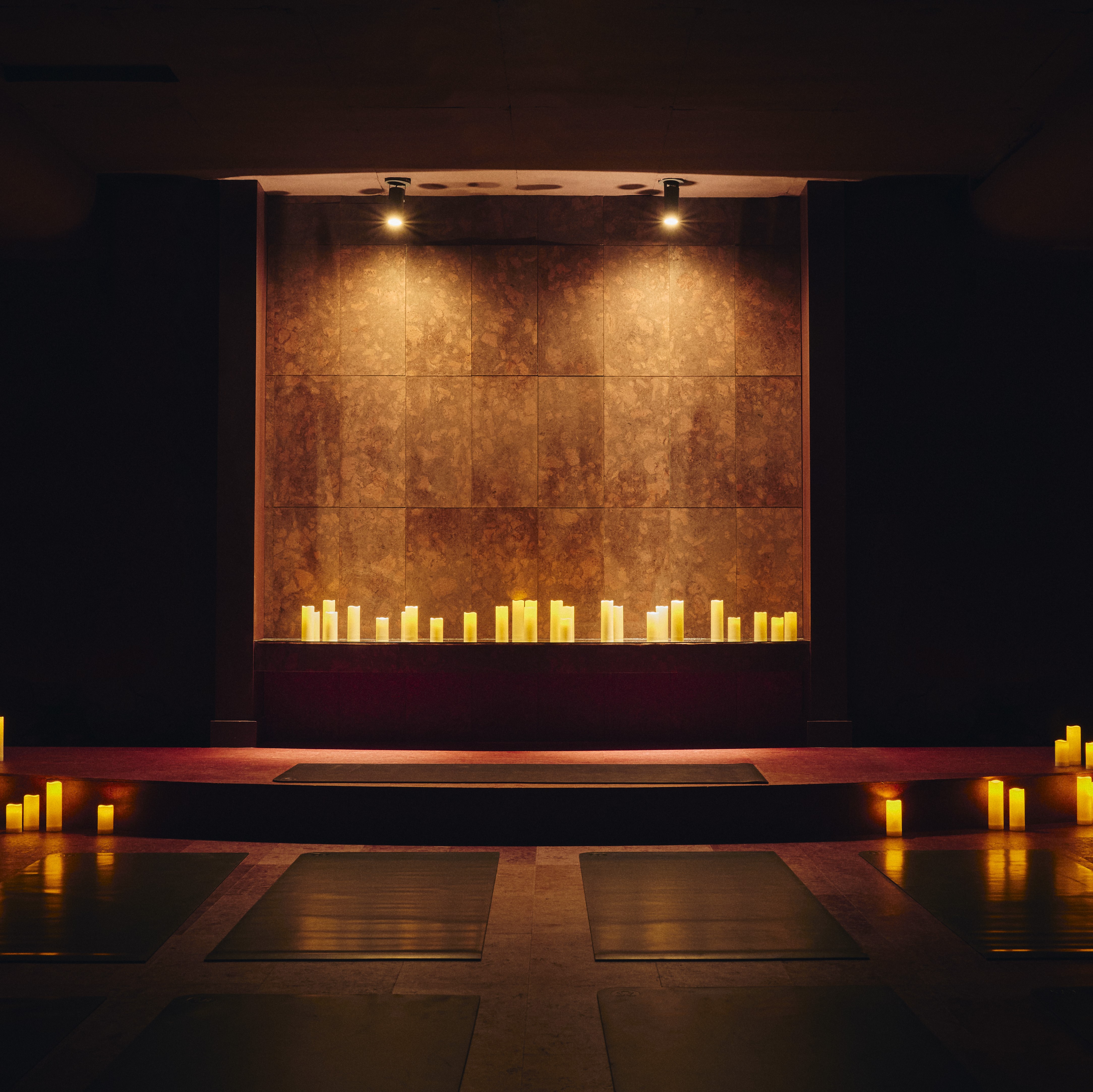
A room without an audience
Jaybird’s Kingsway location makes those decisions visible. Curved walls guide people through the space. Deep blue microcement changes with the light. Cork, tile, wood and drapery give different surfaces different jobs. Futurestudio’s Ali McQuaid treats flow, materiality and lighting as parts of the same design problem.
The distinction between rooms matters. In the Kingsway mat studio, mirrors are absent and LED candles line an altar-like feature. In the Reformer room, mirrors return so guests can check their form on the machines. A tidy slogan about eliminating every mirror would miss the operational judgment involved.
Lighting is directed toward tasks without making guests feel overexposed. Even airflow and the placement of diffusers received attention. These are decisions with an ordinary practical purpose, yet together they produce the character people remember. Bent’s business occupies the distance between the photograph of a beautiful interior and the many small arrangements that allow people to use it.
The address has to cooperate
Expansion brings a less accommodating collaborator: real estate. Jaybird needs spaces that can handle its room requirements and loud music without creating trouble with neighbours. Swan has described the suitable properties as unicorn locations. The phrase is whimsical; the search sounds considerably less so.
Queen West was the brand’s Toronto test, followed by Yorkville, which opened in December 2023. In Vancouver, Kingsway added a second location in 2025. These openings also helped the founders refine an operating preference: several studios within one city can be easier to manage than isolated locations spread across different markets.
Expansion also changes the nature of a founder’s calendar. A room can be finished; a network of rooms needs continuing decisions. The point of clustering locations becomes clearer when you consider the people travelling between them, the colleagues who can learn from one another and the local knowledge that would otherwise have to be rebuilt at every stop.
That concentration gives teachers and managers more opportunities within the same organisation. It also makes the map of a company less abstract. A second address can deepen an existing operation, sharing knowledge and opening possibilities for the team. For Bent, growing the business therefore involves deciding how closely its pieces should sit together.
“There is never a right answer.”Barbie Bent, on learning to make business decisions
Hiring is part of the architecture
Bent’s public LinkedIn activity offers another view of that work. She has shared recruitment for a Toronto general manager and for a director of operations serving both Jaybird and Lagree West. The latter role covered existing markets and new ones, with responsibility for leading and developing a team.
It is easy to tell a founder’s story through openings. Hiring notices show what must sit underneath them. Somebody has to translate a standard into a shift, help a manager improve and keep multiple locations moving together. The address is the public milestone; the organisation makes it usable.
There is an awkward handover inside that process. The person who created the first version has to explain enough of her judgment for someone else to use it. Hiring supplies a colleague, but the work also requires a clear account of what matters, what can change and which decisions belong to the people closest to a guest.
This is also where her early lesson about hiring acquires weight. A founder who starts by answering everything eventually needs other people to make decisions. The company’s ability to grow depends partly on what those colleagues can carry without every question returning to the same desk.
The next room is brighter
In September 2026, Bent described a Midtown Toronto studio planned for early October: approximately 5,000 square feet, with places for 38 mat guests and 20 Reformer guests. Futurestudio worked with the founders on honey and mustard tones, wood, travertine and a skylight. The neighbourhood had suggested something brighter and more playful.
The project was also set to introduce Jaybird’s first custom-designed reformer. Swan leads product development; the new equipment reflects the evolution of the company’s method through teaching. Bent described Midtown as a multimillion-dollar investment. A further planned opening, in New York’s Nomad neighbourhood, was scheduled for November in a 6,350-square-foot space.
These are plans with dates attached, rather than completed chapters. They show the choices now occupying Bent: how a neighbourhood shapes a room, how the equipment should develop and how to bring an established experience into another market. The woman who once nominated herself for second place is helping decide what goes into every corner.
Continue the conversation
Interviews & further reading