Maya Shaposhnik Cadena was sitting in a hotel room with two pieces of advice that could not both become her next move. She had spoken separately with two board members. Each had a case. Each could explain it. Now she had to decide which future she was prepared to spend her days building.
The question was whether Vetted, the company she co-founded, should continue down a physical retail path or commit to a digital one. More locations would mean more money to raise. She estimated another $10 million to $20 million for a concept whose ability to scale she doubted. She chose digital.
What makes the episode revealing is her appetite for the conversations that preceded it. Agreement was readily available to the person in charge. She wanted resistance. An adviser who could make an argument was useful; an adviser who merely returned the decision to her was much less so. A founder can fill a room with nodding heads and still leave with exactly the problem she brought in.
Before the pitch deck, a guest list
Born in Los Angeles, Cadena built a career that crossed Tel Aviv, New York and Chicago before Miami became her base. Entrepreneurship arrived before the MBA. There was an event planning company in Israel, followed by work in major-gift fundraising at AIPAC. She knew how to convene people and ask them to commit to something.
Her earlier business life also included hospitality consulting. She and her husband, Alejandro Cadena, worked with hotel and spa businesses in Israel, then franchises in the United States. They established an import and distribution company, Global Cadena, after deciding to return to America. The couple had met during her military service, attended IDC Herzliya together and married after graduation.
Her degree was in Government, Diplomacy and Strategy, completed in 2014. At the time, she had imagined a future in Israeli public life, perhaps through government, a nonprofit or consulting. An introduction through a classmate’s mother helped connect her to AIPAC’s New York office. Her route into business was full of people opening doors, and her willingness to walk through them.
At AIPAC, she identified a community she felt was being overlooked. She proposed a Sephardic Division, secured approval and became its first director. She later described that initiative as her biggest career accomplishment to that point, pointing to the hundreds of people she had helped engage politically. The task carried a familiar shape: notice an opening, persuade someone to let her try and bring people into the project. By the time she reached Booth, she had already practiced building something within an established organization.
A responsibility acquired at eighteen
Cadena joined the Israeli military at 18. As an infantry instructor, she taught weapons, armored personnel carriers and tactics. Her first posting was to a southern training base; later, she moved between bases along the Gaza and Lebanon borders. She has described the responsibility entrusted to her as empowering.
That experience remained part of her explanation for feeling comfortable leading groups and entering rooms where she was the only woman. At Chicago Booth, she became a co-chair of the Armed Forces Group. The attraction was practical as well as personal: fellow veterans understood one another, and when someone needed help, others stepped in.
Business school offered a chance to build again. Fundraising had become her job, but she missed creating a venture and a team. She and Alejandro both entered Booth. For a couple accustomed to making decisions together, the next chapter came with a shared campus.
A dog, a cat and a co-founder courtship
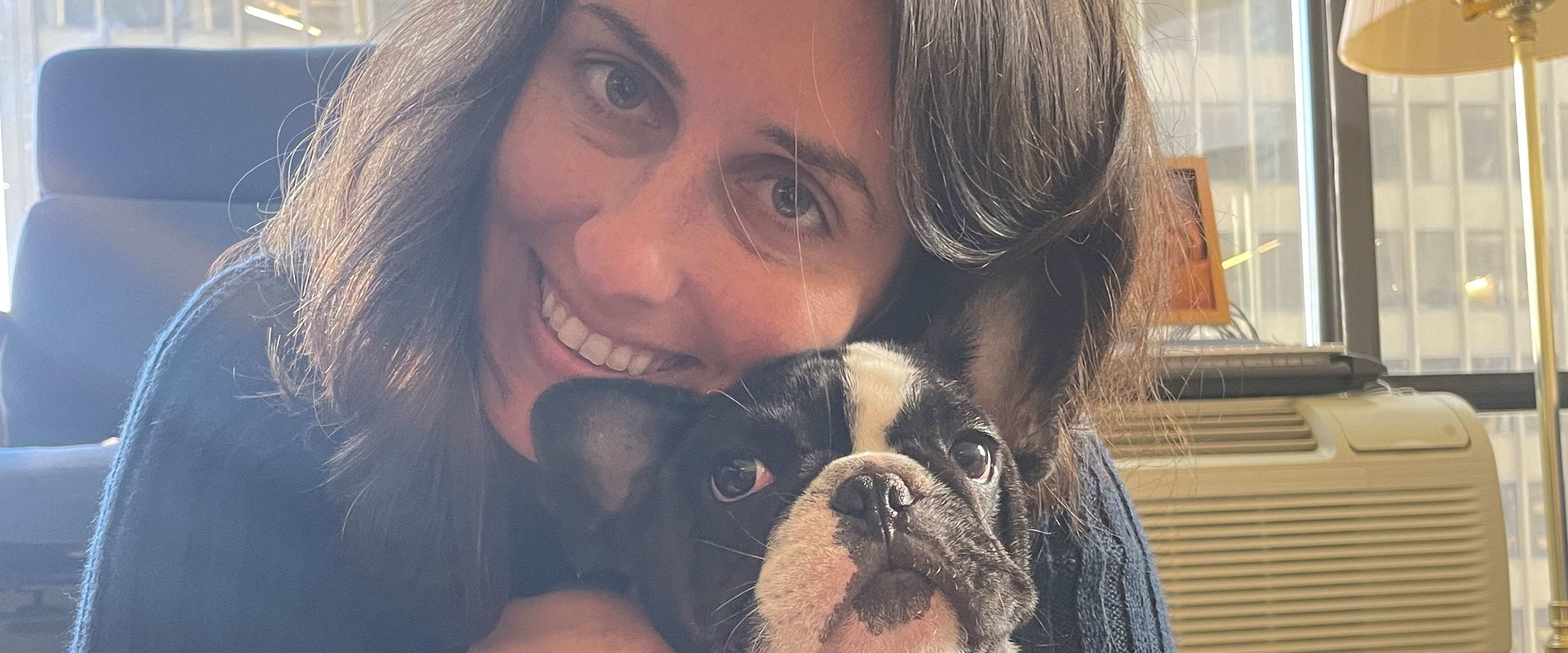
Shor, a French bulldog, arrived as a gift from Alejandro for Maya’s birthday in September 2020, just as she began her MBA. She had grown up around dogs. Now the animal in her own home would help determine what she worked on at school.
At a meeting of Booth’s Entrepreneurship and Venture Capital Group, she met Ashley Brooks, a software development engineer and digital marketing strategist. Brooks had a cat, Neko, and an idea for a restaurant technology business. Cadena had other plans for their partnership. Brooks later described Maya as joking that she had “courted” her.
The match had a business logic alongside the affection for animals. Cadena brought sales experience, networking and earlier ventures; Brooks brought technical and digital marketing skills. They entered the 2021 New Venture Challenge, took third place and won the People’s Choice Award. A beta followed that August. Booth let them slow the pace of their degrees while they developed the company.
Government, Diplomacy & Strategy graduate
Vetted wins third place and People’s Choice at Booth
Moulder Student Entrepreneur Award
Dogiz technology acquisition announced
The seat next to her was occupied
One of Cadena’s advisory relationships began on an 11-hour flight from Chicago to Tel Aviv. She talked with the passenger beside her about the company’s difficulties. Digital user acquisition was an area where she needed help. Her seatmate, another entrepreneur, knew someone.
He introduced her by email, while they were still on the flight, to Doron Dvir, formerly head of user acquisition at Lemonade. She met Dvir a few days later. He became an adviser. It is a tidy illustration of what can happen when a founder allows a conversation to move beyond the polished version of the business.
The passenger beside her could have remained a stranger. Instead, a conversation about a specific difficulty led to someone with relevant experience. An airline seat is an expensive place to hold office hours, but on this occasion it proved productive.
She has also warned against hiring before the direction of a young company is clear. People add capacity, but they need a job that the business actually understands. A growing payroll can create the appearance of progress before anyone has settled what progress should mean.
A prize, then a much larger test
In 2023, Cadena received Booth’s Moulder Student Entrepreneur Award, a $2,000 prize recognizing a graduating student who had launched or grown a venture while completing coursework. By then, she was based in Miami with Alejandro and Shor. Her interests included music, telling funny stories and hosting Shabbat dinners at home.
Those details give the biography a welcome change of pace. A founder’s calendar is often presented as a list of rounds and launches. Here, there is also a dinner table. The person who puts effort into gathering a team also likes gathering people in her home.
In November 2024, she presented Vetted at the Tech & Invest Miami conference. The company reported nine employees and $5 million raised to date, with Destination Pet its largest investor. That figure describes financing at a particular moment. It supplied resources for a business still working out which form it should take.
In her own four-year retrospective, Cadena traced Vetted from its 2021 pitch competition through subscriptions, a physical expansion and an acquisition. The sequence is useful because it resists the flattering habit of making a company’s eventual direction appear obvious from the beginning. There were several versions to build, operate and reconsider.
“I love filling gaps.”
Maya Shaposhnik Cadena
Buying a head start
By July 2025, Vetted had acquired the proprietary technology assets of Dogiz, an Israeli-UK startup, as it prepared a new US app. Cadena had met its founders in Israel and wanted to work with them. The arrangement brought both their technology and their experience in the UK market into Vetted’s plans.
The new product used rewards, streaks and challenges to encourage people to keep logging everyday activities with their pets. Cadena compared the idea to a combination of Duolingo and Strava. The comparison says something about her product instincts: make repetition engaging, give users a reason to return and let the small actions accumulate.
For a company moving toward software, buying technology already developed elsewhere shortened part of the journey. It also meant finding another team whose work she valued. The habit of looking for people with complementary experience, visible in her partnership with Brooks, had become part of an acquisition.
The September 2025 episode of Just Vetting described the platform as live globally. Cadena continued discussing the business and its changes in a December 2025 appearance on Driven: Unscripted Success. The pivot was becoming part of the story she told publicly, rather than something edited out of it.
Leave room for the disagreement
In an undated public interview, Cadena set out a goal of growing Vetted from 100,000 to one million users. She described the challenge of raising money after a pivot while proving the new model. The ambition and the work of demonstrating it appeared in the same answer.
Her advice to other female entrepreneurs was to trust their instincts, assemble people who believed in them and stay committed to their mission through changes of direction. It is easy to imagine that advice producing a very agreeable room. Her own account of board discussions suggests she wants something more demanding from the people closest to a decision.
She has made community a recurring concern, too. In a Booth alumni video, she described its importance to feeling at home and having a support system. Across the earlier ventures, the co-founder search and the airline introduction, the people around her have mattered to what she could attempt next.
Return to the hotel room, and the job becomes quite specific. Listen to two capable people. Accept that each may have a point. Then choose a course whose daily work you can take responsibility for. The argument can be shared. The decision still needs an owner.