A conference can put hundreds of interesting people in the same building and still leave them talking to the colleagues they arrived with. Bänz Ledin made a business out of that small social failure. His early answer came with buttons, a screen and its own radio technology. Before networking became another icon on a phone, he wanted to give the room a device.
The idea dates to 1997, when Ledin was a student at the University of Zurich. He imagined a portable apparatus that would help people meet. By 2000, a prototype, a small team and private Swiss investors were involved. The business found its setting in conferences and events, renting out dedicated handhelds. An introduction, usually left to a name badge and considerable optimism, had become an engineering problem.
That is an appealing place to begin a founder’s story: with a familiar awkwardness rather than an abstract market. Ledin’s subsequent work would move through event technology, product design, mentoring and industrial business development. The handheld is the useful first clue. It makes a social ambition unusually tangible. You could put this particular idea in your pocket.
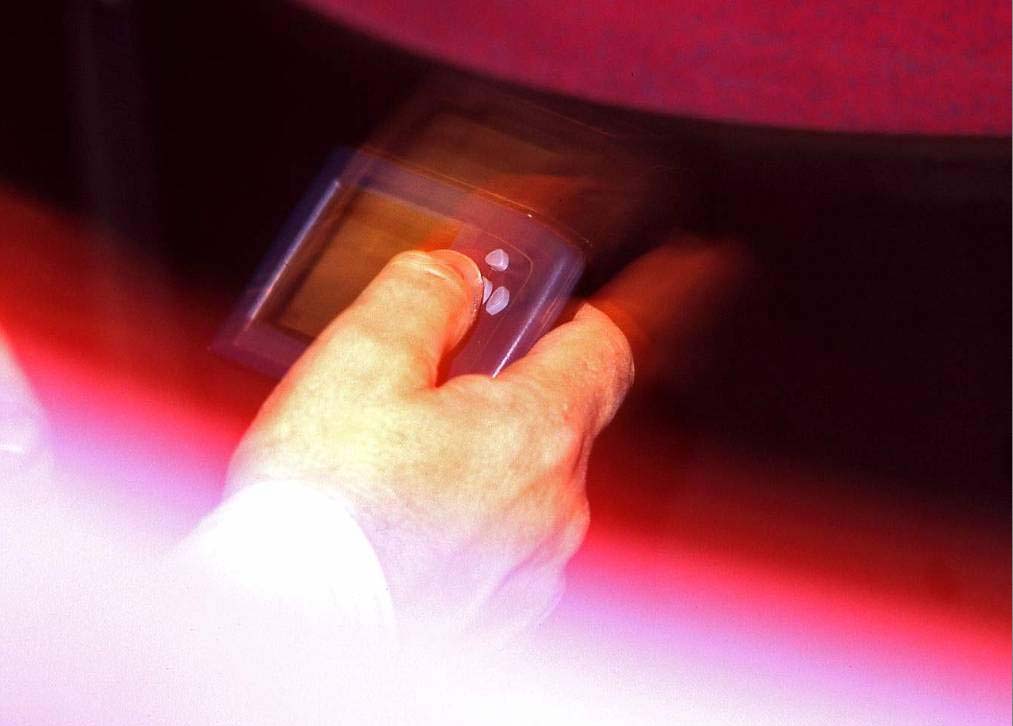
First, give the room a radio
The venture had an earlier corporate name: Shockfish. Ledin founded it in 1998 with Rémy Blank and Roger Meier. A February 2006 company presentation described a ten-person business with two product lines: SpotMe, available since 2001, and wireless sensor networks, developed since 2004. There was engineering behind the introductions, and other applications for the engineering.
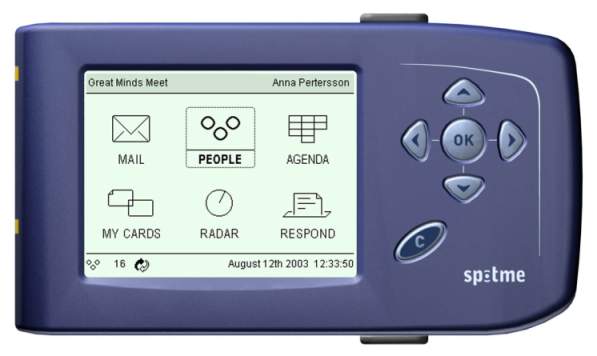
The old handheld’s menu is a small time capsule. Mail. People. Agenda. My Cards. Radar. Respond. Those six labels make the proposition understandable without a pitch deck. A delegate could consult the schedule, exchange information and locate people. The device gave the event a shared set of tools, carried by the people inside it.
The system diagram included handhelds, base stations, photo stations and a server. The presentation described wireless communication among 1,500 devices. The scale mattered because a networking service has to survive the room it is supposed to improve. A clever interaction between two gadgets is one problem; equipping a crowded conference is another, with rather less patience available for technical explanations.
A social idea with engineering underneath
Ledin’s contribution also appears in the invention record. A US patent application published in February 2006 named Bendicht Ledin alongside Blank, Meier and Jim Pulcrano. Its subject was a wireless delegate information and communication device, method and system. The application described distributing current event and participant information, linking information to proximity, and exchanging messages.
Read in ordinary language, the aim was to make a temporary gathering easier to navigate. Who is here? What is happening? Can I reach this person? Each question sounds modest until hundreds of people ask it at once. The technical proposal treated the event as a network whose members were moving around.
A separate application published in 2007 named Ledin, Meier and Pierre Metrailler as inventors on a method for accessing location-based functions. These documents put Ledin inside the product’s technical development, among named collaborators. They also supply a useful corrective to the solitary inventor portrait. Several people had their hands on the machinery of this particular introduction.
Two years of work, one afternoon of applause
In October 2007, the New Spotme system won the EIBTM WorldWide Technology Watch competition. More than 40 international companies had entered. The judging criteria covered innovation, completeness of concept and value to event users. It was recognition for the system as something people could actually employ at a meeting.
Ledin was then Shockfish’s managing director. His response began with the work rather than the trophy, emphasizing the two years spent on development. It is a rather good founder’s sentence. It restores the calendar to a moment that an award announcement might otherwise reduce to a photograph and a handshake.
The winning product would be demonstrated at EIBTM in Barcelona that November. For a company selling a better way to participate in events, an event was also the showroom. The team had to make its argument in the environment where the product would live. There was an agreeable economy to that arrangement: the prospective customers had already arrived at the demonstration site.
“Bringing the new SPOTME to the market has been two years of extremely hard work.”
Bänz Ledin, October 2007
The introduction survives a change of equipment
The early commercial years were difficult. Britain provided an initial market, followed by France. Support from the Foundation for Technological Innovation helped the young business through uncertainty. SpotMe established a US presence in 2007. Then the iPhone and App Store altered what event technology could be built on.
By 2011, the company was specializing in software and tools for creating applications. A dedicated device had once supplied the interface; software could now travel on another kind of screen. The continuity was the occasion: people gathering, trying to exchange something useful. That gives the hardware chapter a longer relevance than the casing might suggest.
Ledin’s public advisory biography describes taking SpotMe from an idea to a profitable international business with more than 60 employees. That is a historical description of his experience, rather than a present headcount. It marks a change in the kind of task a founder faces: first making a device work, then building an organization around the people who use it.
A good idea still needs someone to understand it
The software years also involved creative work. Andy Davidhazy served as SpotMe’s chief creative officer on contracts in 2012 and 2013-2014, working closely with the CEO. His responsibilities included positioning, messaging, the website, marketing, social media and improvements to the product experience. Product-launch work extended to the exhibition booth and its fixtures.
Ledin’s recommendation of Davidhazy singled out an ability to “take on a really hard problem” and return with “great insight and ideas.” He also praised the breadth of the execution, from visual design and photography to video, music and furniture. That is a revealing list of things to value in a collaborator. An event technology business has to make sense on a screen and across an exhibition floor.
There is some pleasure in finding furniture in the story of a software company. Customers encounter a company through quite ordinary physical details. A booth has to work as a place to stop. A demonstration needs somewhere to happen. Ledin’s testimonial gives those practical creative contributions room alongside the technology.
The founder returns to the classroom
His later professional development covered several ways of organizing product work. Ledin lists a Scrum product-owner certification from 2014, project-management certification from 2016, and IDEO.org courses in prototyping and human-centered design from 2017. In 2015, he attended an EPFL directors’ education program for business angels and entrepreneurs. The dates place formal learning well after the founding years.
He also left a public review of an introductory human-centered design course. He gave it four stars and emphasized completing the work in a team. His description of the effect was to become “more human-centered and less idea-driven.” For someone who had spent years turning an idea into a company, that distinction is worth lingering over.
A product starts with an idea, but its eventual users have their own priorities. Ledin’s review values the experience of working through that tension with other people. It is a quieter piece of evidence than an award, and perhaps more personal: an experienced founder taking a course seriously enough to describe what the group work taught him.
From conference rooms to a mobile dairy
By 2017, Ledin was also helping another team develop an altogether different product. GEA’s MilkBuddy project brought a mobile dairy concept to MassChallenge Switzerland. The team gained three mentors: Stefan Dobrev from Nestlé, Peter C. Boehni from Bühler, and Ledin as a startup entrepreneur. The project combined collecting, processing and transporting milk near its point of production.
The GEA participants developed a prototype and took it to potential users in India. Their work moved between a technical concept and the practical conditions of its use. Ledin’s documented role was mentoring, among other mentors. The milk-processing invention belonged to the team. The connection adds another setting to his career: helping people take engineering out to meet a market.
He also appears as an advisor to Jaspr Trades. In 2019 and 2020, he served on the Foundation for Technological Innovation’s Tech Grant selection committee. An organization that had supported SpotMe’s early development later counted its founder among the people assessing new projects. The relationship had acquired a second direction.
Another company, another set of practical questions
In 2022, the SKU alumni career record listed Ledin as head of new business development at Triamec Motion in Baar. The company develops precision servo drives, with work spanning electronics, firmware and software. That placed his business-building experience in an industrial setting, some distance from the conference badge.
His current public profile places him in Zurich and associates him with Shaper AG. Commercial-register reporting records Shaper’s incorporation in June 2026 and names Bendicht Ledin in its management. The career continues beyond the company for which he is best known, with another organizational name attached to it.
SpotMe has its own subsequent chapter. Swiss Post acquired a majority stake in April 2023, when Pierre Metrailler was CEO. It described a platform for secure enterprise communication and events, operating internationally. Ledin’s original portable meeting aid had become part of a much larger business story.
Return, though, to the blue handheld and its six menu choices. “People” sat beside “Agenda.” Someone had decided that the people in the room deserved as obvious a place as the program. It was a small design decision with a substantial business behind it. A conference already knows how to tell you what comes next. Ledin began by helping it answer who might be worth meeting.
Follow the connections
- Ledin on LinkedIn ↗
- SpotMe - company website ↗
- Shockfish’s 2006 presentation ↗
- The 2007 EIBTM award ↗
- Wireless delegate invention ↗
- Location-based invention ↗
- Andy Davidhazy’s SpotMe work ↗
- Ledin’s design-course review ↗
- GEA’s MilkBuddy project ↗
- FIT’s 2020 committee ↗
- Jaspr Trades advisory team ↗
- SKU’s career record ↗
- Shaper AG register listing ↗
- Swiss Post’s SpotMe announcement ↗